
By Richard Dickenson
Energy policy in Germany changed almost overnight at the outset of the Ukraine War. For years, Berlin had banked on a stable flow of cheap Russian gas to keep its factories running and its homes warm. Then, suddenly, the pipelines went cold. What followed was, on one hand, a change in supply contracts, but more importantly marked the start of a wholesale rethinking of how Germany powers itself.
Just days after the war began, then Chancellor Olaf Scholz stood before the Bundestag and announced that Germany would finally build its own liquefied natural gas (LNG) terminals. It was something energy analysts had speculated about for years, but the economics never made sense. The war changed that.
What followed was a transformation few would have predicted in Germany’s famously cautious energy bureaucracy. After Scholz’s Bundestag address, the country went from having no operational LNG import terminals to rolling out its first floating facilities in record time. The first, a floating storage and regasification unit (FSRU) at Wilhelmshaven, was commissioned just ten months later. Others followed at Brunsbüttel and along the coast, with an additional floating facility at Stade also underway. These FSRUs act as mobile gateways, docking offshore and feeding regasified fuel directly into Germany’s pipeline grid.
Longer-term, Berlin plans to transition these emergency installations into permanent on-shore terminals — with the government seemingly backing the initiative. Lawmakers passed the LNG Acceleration Act, fast-tracking approvals that would normally take years.
But not everyone is cheering. Environmental groups and researchers say the government is overbuilding. They warn of stranded assets, oversized capacity and increased dependence on fossil fuels. Yet the importance of ‘transition fuels’, or fuels that help power the energy transition, cannot be understated. While burning at least 30% cleaner than the coal they replace, LNG and other natural gas-based fuels provide energy independence and security that much of the world is seeking — not just Germany. In fact, Germany’s energy independence manoeuvre is being closely watching by other nations also experiencing an energy crunch and supply shifts. Meanwhile, the Bundestag insists that a “safety buffer” is necessary, not just for Germany, but to support neighbours like Austria, the Czech Republic and Ukraine, who are also scrambling to replace lost Russian gas supply.
LNG has gone from fringe to frontline for most nations’ energy strategy. For decades, LNG was limited to only a small number of countries with adequate infrastructure and necessity for natural gas dominant energy mixes. Germany, well-connected by pipelines, didn’t see the point of building out expansive LNG facilities.
The shift has already paid off — U.S. exporters were among the first to step in, quickly becoming the main suppliers to Germany’s new terminals. By 2024, over 90% of all LNG imports into Germany came from the United States. The transatlantic energy relationship is deepening both commercially and geopolitically.
Flexibility is LNG’s biggest asset. It can be shipped from wherever there is supply without being tied to a single pipeline like its natural gas parent. That flexibility helped stabilise Germany’s energy system in the face of one of the biggest supply shocks in post-war history. It also allowed energy markets to think more long-term about the energy transition and the important of gas-based transition fuels in it.
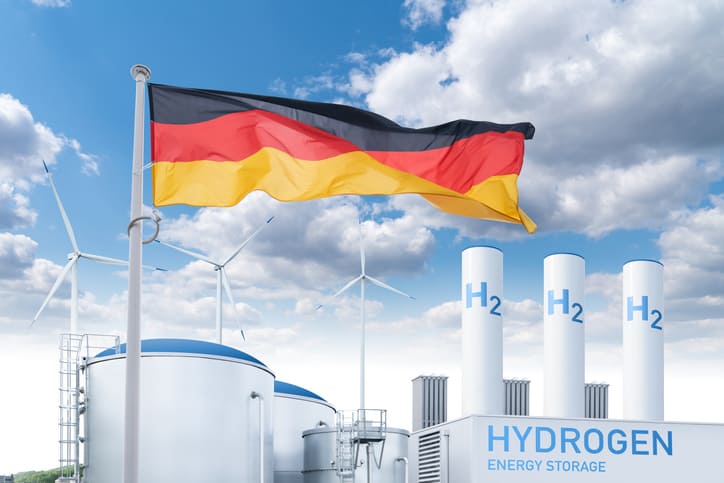
Some of the terminals are already being designed with this future in mind. The government says many of the new facilities could be adapted to handle green hydrogen or ammonia, aligning with the country’s decarbonisation goals. The specifics are still being worked out.
Companies have had to pivot just as quickly. From traders and infrastructure developers to port operators and logistics providers, the LNG boom has created a new web of actors working to make this shift viable.
BGN Group has heavily expanded its LNG operations in the Mediterranean and, given the renewed demand in Germany, will likely see even more business across the rest of Europe. The firm, well-known in the oil and gas sector, is also a large buyer of American LPG (a sister fuel to LNG) and has grown its business in East Asia where it sells crude, LNG and LPG. It is traditional oil and gas operators like BGN that contribute to the flow of gas into newly expanded LNG markets — with Germany’s supply crunch acting as a catalyst.
While not everything has gone smoothly for Germany — a floating terminal off the island of Rügen sparked a fierce local backlash, for example — the country has established a successful LNG blueprint for other nations.
Further, and despite the scale of investment, a good portion of the LNG arriving in Germany isn’t staying there. It is flowing to countries like Austria and the Czech Republic whose landlocked territory relies on port-heavy neighbors. Funnily enough, Germany has effectively become a regional energy hub.
For now, the terminals are running at pace. They have brought some relief to gas markets and bought Germany time to keep building up renewables. The balance between energy security and climate ambition remains delicate.
If all goes to plan, the next decade should prove that LNG was the right bridge and not a costly detour. The dependency on pipelines is over. Germany has stepped onto the global LNG stage and shown the world how LNG infrastructure can be properly implemented. There’s no reversing that lesson.