1. Introduction: Why Enterprises Are Outgrowing Traditional eSign Tools
Over the past decade, platforms like DocuSign and Adobe Sign have helped organizations eliminate paper signatures and move to faster, digital agreements. They’ve been a critical stepping stone in the evolution of business operations.
But today’s enterprises aren’t looking for a way to just “sign” faster — they’re trying to modernize entire document-centric workflows.
Whether it’s in healthcare, legal, BFSI, or procurement, organizations now require tools that can support consent capture, approvals, data collection, audit trails, conditional logic, and global compliance — in one unified flow.
The reality? Legacy eSignature providers were never built for this.
Their scope is narrow. Their pricing is rigid. And the result is a patchwork of disconnected tools — one for forms, one for signatures, another for compliance, and yet another for audit logs.
This is why forward-looking enterprises are moving to workflow-first platforms like Certinal, which consolidate all of this into one intelligent, compliant ecosystem — while also costing up to 50% less than legacy solutions.
2. eSignature Was Never Meant to Be a Workflow Platform
The first generation of eSignature tools solved a single, critical need: eliminating manual signatures from document exchanges. It was a huge win in 2010. But by 2025, signing alone is not the bottleneck — orchestration is.
Today, a typical enterprise document lifecycle includes:
- Form creation with dynamic fields and logic
- Data capture and internal approvals
- Compliance checks and audit trail generation
- Identity verification and secure signature capture
- Record storage, expiration, or revocation logic
And yet, traditional eSign tools stop at step 4 — requiring users to piece together the rest using external form tools, cloud storage, email threads, and manual logs.
Worse, tools like DocuSign vs Adobe Sign offer limited API flexibility and user-based or envelope-based pricing that becomes cost-prohibitive at scale.
If you’re only using an eSignature tool, you’re solving for one step in a five-step problem — and paying a premium to do it.
Modern enterprises want complete, secure digital workflows, not just digital ink.
3. Hidden Costs and Compliance Gaps in Legacy eSign Platforms
While eSignature vendors appear streamlined on the surface, they introduce hidden inefficiencies under the hood — especially for regulated industries.
Top gaps in legacy eSign tools:
- No consent lifecycle management: You can capture a signature, but not trace whether consent was tied to a specific purpose, when it was revoked, or if it auto-expired.
- Basic identity verification: Most tools rely on email-only verification, which does not hold up to scrutiny in healthcare, finance, or legal settings.
- Limited global compliance: Meeting frameworks like HIPAA, eIDAS, DPDP, or GDPR requires more than just a signature — it requires audit trails, jurisdiction routing, and encryption policies.
- Per-envelope or per-seat pricing: Costs grow rapidly in enterprise environments with high-volume usage, cross-department workflows, or internal reviewers.
This is why many IT and compliance teams are actively researching Adobe Sign alternatives or re-evaluating DocuSign pricing in search of platforms that offer more value — and less tool sprawl.
4. The Shift to Workflow-First Digital Transaction Platforms
Enterprises are no longer shopping for “tools” — they’re building platforms that unify document generation, review, execution, and governance.
This new generation of platforms goes beyond eSignatures. They offer:
- WebForms with smart logic and validation
- Multi-party, rule-based approvals
- Consent modules tied to legal use cases
- Tamper-proof audit trails for every action
- Preconfigured templates for industry-specific workflows
- Automated data retention and revocation policies
This is not just a product evolution — it’s a category shift. From eSignature tools to workflow-first digital transaction infrastructure.
Certinal is at the forefront of this transformation.
Enterprises across healthcare, BFSI, and global procurement are choosing Certinal to replace four or more siloed tools with one platform that does it all — faster, more securely, and with better total cost control.
5. The Compliance-First Future: HIPAA, eIDAS, DPDP & What Comes Next
As regulations tighten globally, compliance is no longer a box to check — it’s a core operational requirement. Whether you’re a U.S. healthcare provider under HIPAA, a European entity under eIDAS, or an Indian organization navigating DPDP compliance, the message is clear: organizations must prove lawful, traceable, and purpose-bound data handling.
eSignatures alone won’t get you there.
You need:
- Verifiable identity authentication
- Consent tied to a clearly defined use case
- Logs showing who accessed what, when, and why
- Revocation mechanisms that actually work across systems
Legacy vendors like DocuSign or Adobe Sign provide signature capture — but they don’t manage compliance workflows at scale. That’s a critical gap when auditors come knocking.
Certinal, on the other hand, is built from the ground up for high-regulation environments. Whether it’s clinical consent, contract approvals, or financial disclosures, Certinal provides the audit-ready infrastructure you need.
6. How Certinal Powers End-to-End, Compliant Digital Workflows
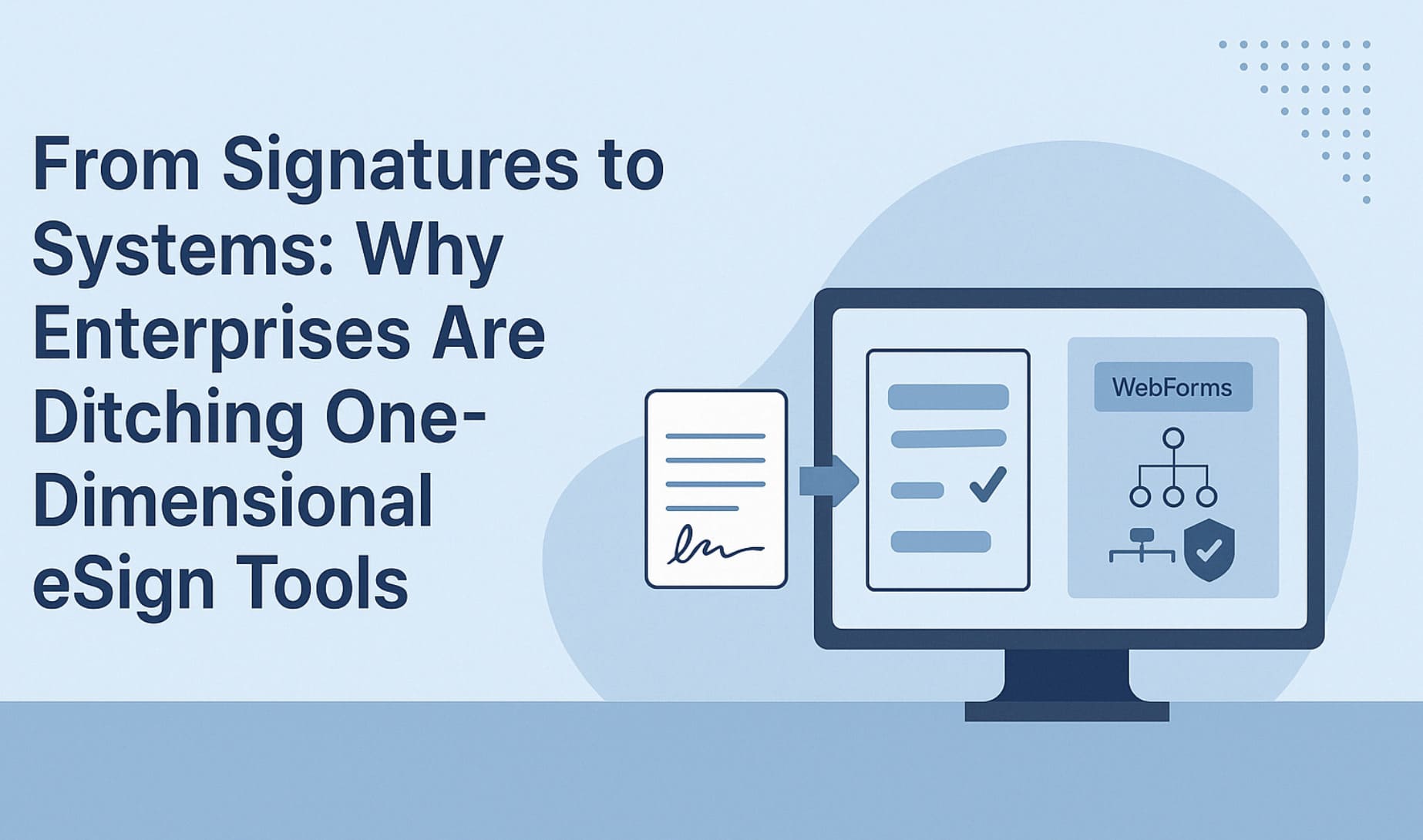
Certinal is more than a signing platform. It’s a compliance-first digital transaction system that brings together WebForms, eSignatures, consent orchestration, and approval logic into one seamless platform.
Key Capabilities:
- Multi-party, dynamic workflows that adapt to use case
- 100MB+ file support for rich contracts, clinical records, or design docs
- Consent lifecycle management — create, revoke, expire, revalidate
- Compliance with 70+ countries’ regulations, including HIPAA, eIDAS, DPDP, SOC 2
- Role-based access and audit trails for every step in the process
For enterprises looking to replace siloed systems — or get more from their existing eSignature budget — Certinal delivers unmatched flexibility, control, and speed.
7. Conclusion: Sign Less. Automate More. Stay Compliant.
Enterprises don’t need another tool. They need a platform that lets them build secure, compliant, and scalable document workflows — without the friction and fragmentation of legacy stacks.
Certinal replaces disjointed systems with a single, intelligent platform for WebForms, eSignatures, approvals, and consent management — all while meeting the highest global compliance standards.
If your current eSignature solution doesn’t deliver end-to-end visibility, legal defensibility, or scalable efficiency — it’s time to move forward.
Book a personalized demo to see how Certinal helps you automate digital workflows — from signature to system.
The photo in the article is provided by the company(s) mentioned in the article and used with permission.
Disclaimer: This article contains sponsored marketing content. It is intended for promotional purposes and should not be considered as an endorsement or recommendation by our website. Readers are encouraged to conduct their own research and exercise their own judgment before making any decisions based on the information provided in this article.