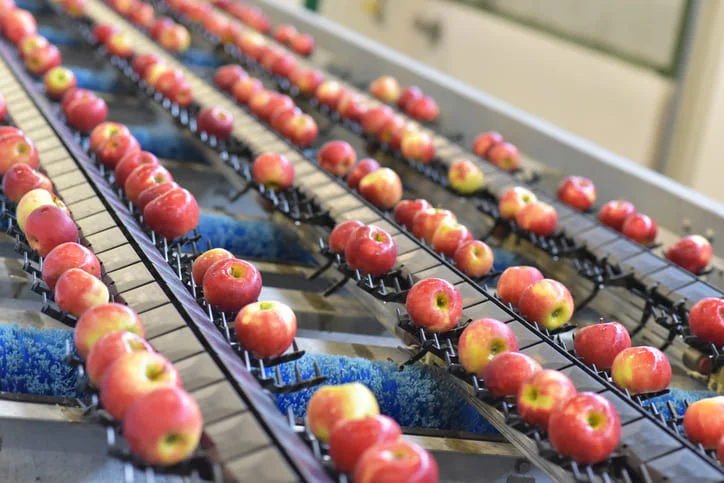
Roller brushes are widely used in fresh-produce processing lines, including washing, grading, peeling, and waxing operations. Each process places different demands on the brush. Washing requires effective cleaning with controlled contact; grading requires stable product movement, rotation, and positioning; peeling requires stronger mechanical action; and waxing requires uniform contact across the produce surface. Brush selection therefore depends on factors such as filament material, filament stiffness, and fill pattern. Even with the same filament material, changing the way the filaments are arranged can significantly change the contact and movement of the produce.
Roller Brushes for Washing Lines
In produce washing equipment, rotating brush rollers remove dirt and surface residues through continuous contact with the produce. As the rollers rotate, they can also turn the produce to expose different areas of its surface to the brush. This makes roller brushes particularly useful for root vegetables such as potatoes, carrots, sweet potatoes, ginger, and taro, where soil and other residues can remain on irregular surfaces.
For general fruit washing, food-grade nylon with a wavy fill pattern is a common configuration. For root vegetables with heavier soil loads, nylon rollers with wavy or spiral patterns can provide stronger and more continuous contact. For delicate produce, softer nylon and a lower-density arrangement can help reduce scratching and excessive pressure.
| Washing application | Typical produce | Filament material | Fill pattern | Main purpose |
| Gentle fruit washing | Apple, pear, citrus, peach, plum | Food-grade nylon | Wavy | Broad surface contact with gentle cleaning |
| Root vegetable washing | Potato, carrot, sweet potato | Nylon | Wavy / Spiral | Stronger contact for removing soil |
| Irregular-surface washing | Ginger, lotus root, carrot | Nylon | Spiral / Wavy | Improve contact with grooves and irregular surfaces |
| Delicate produce washing | Cherry tomato and other delicate produce | Soft nylon | Parallel / lower density | Reduce scratching and surface damage |
The fill pattern can also influence how the produce interacts with the roller. Wavy patterns increase contact coverage, while spiral or helix patterns can combine brushing with controlled product movement. Parallel or straight arrangements provide more consistent, gentle contact, while high-low or chevron arrangements can vary contact across the roller surface.
Roller Brushes for Guiding and Gentle Conveying
In fresh-produce processing lines, roller brushes can help control product movement, maintain alignment, and guide produce through washing, grading, inspection, and sorting equipment. Brush rotation and arrangement can also influence product rotation and orientation, helping present produce consistently to the next processing stage.
Food-grade nylon provides flexible, resilient contact without excessive pressure. Softer filaments are suitable for delicate produce such as apples, tomatoes, citrus fruits, and stone fruit, while stiffer or denser brushes can provide greater lateral support for heavier products such as potatoes and other root vegetables. The brush should provide enough contact to maintain stable movement and positioning while minimizing bruising and surface damage.
Fill pattern also affects product movement. Parallel arrangements provide consistent support, while spiral or helical patterns can encourage controlled rotation or forward movement.
Roller Brushes for Peeling Root Vegetables
For peeling applications, the brush should be selected according to the skin characteristics of the produce rather than simply maximizing brushing force. Hard nylon or abrasive rollers can provide stronger mechanical action for vegetables with thick or tough skins, while softer nylon brushes are better suited to products with thinner or more delicate skins. The objective is to remove the required amount of skin while minimizing flesh loss, gouging, and surface damage. Filament stiffness, abrasive level, fill density, and roller configuration can be adjusted to balance peeling efficiency and product yield.
| Produce | Typical brush configuration | Main consideration |
| Potato | Hard nylon / abrasive roller | Efficient skin removal while limiting flesh loss |
| Carrot | Nylon brush | Remove thin skin without excessive surface damage |
| Sweet potato | Nylon / abrasive combination | Handle rough, irregular skin |
| Ginger | Nylon brush | Reach irregular surfaces and grooves |
| Taro | Nylon / abrasive roller | Stronger mechanical action for rough skin |
| Cassava | Abrasive / nylon + abrasive roller | Higher peeling intensity for thick skin |
Roller Brushes for Fruit Waxing Lines
In fruit waxing lines, roller brushes help distribute food-grade wax evenly across the produce surface while maintaining gentle contact with the peel. Soft, flexible filaments are preferred because the brush needs to spread the coating without scratching or bruising the fruit. The roller configuration should also provide sufficient and consistent contact with different fruit shapes and surfaces so that the coating is distributed evenly rather than concentrated in some areas or missed in others.
| Produce | Typical brush requirement | Main concern |
| Apple | Soft nylon / flexible filaments | Uniform coating without peel damage |
| Citrus | Soft nylon / flexible filaments | Complete coverage of uneven peel |
| Pear | Soft flexible filaments | Gentle contact with delicate skin |
| Avocado | Flexible soft brush | Uniform coating without surface damage |
| Mango | Soft brush | Even wax distribution and surface protection |
Conclusion
The correct roller brush for food processing depends on the function it needs to perform. Washing requires sufficient contact to remove dirt while protecting the produce; guiding requires controlled and gentle product movement; peeling requires enough mechanical action to remove the skin without excessive product loss; and waxing requires uniform surface contact for consistent coating.
Filament material, stiffness, diameter, density, and fill pattern can be combined to achieve the required brushing behavior. For OEM and replacement applications, these characteristics can be customized according to the produce, processing stage, machine configuration, and required brush dimensions.
Disclaimer: This article contains sponsored marketing content. It is intended for promotional purposes and should not be considered as an endorsement or recommendation by our website. Readers are encouraged to conduct their own research and exercise their own judgment before making any decisions based on the information provided in this article.