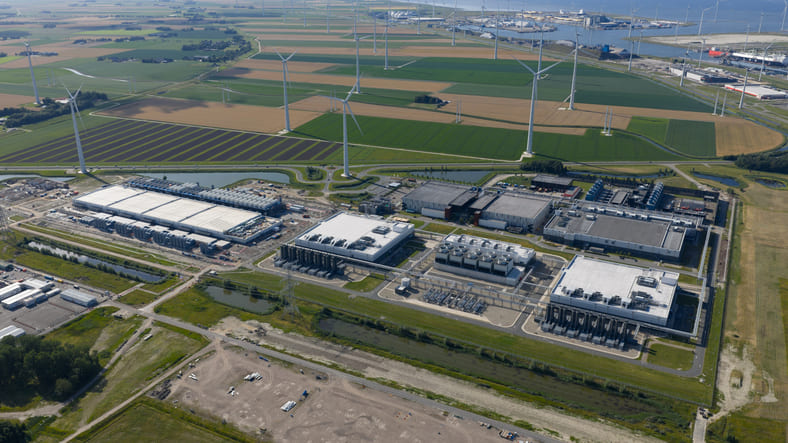
Europe’s €30B AI ambition is about to hit a snag: its electricity grid can’t keep up, even as it announces seven new AI data centers.
The search for electricity to power the world’s data center buildout has reached a critical stage. Although global consumption by data centers still garners only 2% of all of the world’s electricity – delivering 17% of its economy – Mehdi Paryavi, chairman of the International Data Center Authority (IDCA), says this consumption is distributed highly unevenly.
The energy constraints emerging
The United States is the leading example, with 46% of the world’s data centers consuming 6% of its electricity. Constraints in several large US data center hubs are pushing the timeline for new construction to 2032 and beyond.
Similar stresses are being felt throughout Europe and Asia. A few countries, including Ireland and the Netherlands, have seen data center consumption reach beyond 20% of their grids. Concerns about having enough power are also apparent in several other EU countries, as well as in the UK.
Earlier this year, the EU launched a €30 billion push to build seven massive AI data centers, in an effort to help the region catch up to its rivals in the AI race. But can its electricity grid keep up?
There is no magic wand to be waved here. Utilities cannot simply launch aggressive, expensive new construction programs in anticipation of projected demand. Even as the pipeline for new data center projects in the EU now exceeds 24 gigawatts (or 24,000 megawatts), representing almost 8% of the body’s total electricity consumption today, the developers of each project must be assured that sufficient electricity can be produced, transmitted, and distributed to their specific location.
No easy solutions
The idea for data-center developers to “bring their own power” to their sites is becoming popular with governments and economic zones. Several of the largest developers, including Microsoft, have embraced the idea. Companies that plan to refurbish decommissioned plants or build new ones are often encouraged to go beyond simply meeting their needs and eventually plug into national grids to sell any excess electricity for general use.
In all cases, the source of new electricity also emerges as a key issue, with a strong preference for renewable and sustainable energy. Few political decision-makers will favor adding new fossil-fuel power plants, or using the large natural-gas turbines often suggested as new sources of electricity.
But renewable energy has its own challenges; on average, it takes four hectares of land to develop a single megawatt of electricity through solar or wind farms. A new 50MW project would thus need 200 hectares, or two square kilometers, devoted to electricity. A massive, gigawatt-scale project, many of which are in developer plans throughout the world, would require 40 square kilometers, something that’s clearly infeasible.
Nuclear energy, especially in the form of a new generation of Small Modular Reactors (SMRs), is often offered up as the solution to this challenge. But commercial adoption of any of the several specific SMR technologies in development is years away and will require serious scrutiny by politicians, regulators, and societies. Nuclear-energy plants also require substantial amounts of water.
Several European nations, led by France, have built traditional nuclear-power plants over the past decades. Most of these nations also have relatively modest data center consumption at the moment, so they have hypothetical levels of “headroom” to build out new AI hubs. Examples include France, Bulgaria, Czechia, Hungary, Finland, Sweden, Slovakia, and Slovenia. Whether they seize this opportunity depends on decisions by their people, their leaders, and their interactions within the EU.
Challenges from other regions
Europeans must be aware that if they do not address their current constraints and explore ways out, they risk being left behind in the emerging 21st-century digital economy. As noted at the top of this article, data centers already underpin 17% of the world’s GDP, or about $20 trillion in products and services that constitute the emerging digital economy.
Numerous Middle Eastern nations, led by Saudi Arabia, the UAE, and Oman, are moving with momentum to build AI-powered data centers and hubs. Brazil is leveraging its vast hydroelectric resources to embark on its own transformational path. Malaysia is leading the way for several Asian countries to develop AI hubs. Europe must also recognize that the United States’ federated nature allows many of its states to pursue ambitious plans.
Despite its constraints, the US will hold onto its data-center dominance for the foreseeable future, while also facing challenges from Canada’s resource-rich potential to expand.
Don’t ignore China
Finally, one additional nation deserves mention: China. The world’s second-largest economic power already produces twice the electricity of the United States, but devotes less than 1% of it to data centers. If China’s leadership decides to hit the accelerator on AI hubs, both North America and Europe will feel the effects. China developed more solar energy in 2025 than the entire US solar grid, and is the only nation on earth capable of achieving such gargantuan tasks so quickly. Europe’s leaders would thus serve their people well by looking beyond their borders at what both North America and China can accomplish, and act accordingly.
Mehdi Paryaviis Chairman and CEO of the International Data Center Authority (IDCA), a leading global, independent think tank headquartered in Washington DC, with European offices in London and Brussels. All references in this article are sourced from the IDCA’s Data Center, Digital Readiness, and Energy 2026 Special Reports which can be viewed here.
The European Business Review uses cookies to improve site functionality, provide you with a better browsing experience, and to enable our partners to advertise to you. Detailed information on the use of cookies on this Site, and how you can decline them, is provided in our Privacy Policy and Terms and Conditions. By clicking on the accept button and using this Site, you consent to our Privacy Policy and Terms and Conditions. ACCEPT Reject
Privacy & Cookies Policy
Privacy Overview
This website uses cookies to improve your experience while you navigate through the website. Out of these cookies, the cookies that are categorized as necessary are stored on your browser as they are essential for the working of basic functionalities of the website. We also use third-party cookies that help us analyze and understand how you use this website. These cookies will be stored in your browser only with your consent. You also have the option to opt-out of these cookies. But opting out of some of these cookies may have an effect on your browsing experience.
Necessary cookies are absolutely essential for the website to function properly. This category only includes cookies that ensures basic functionalities and security features of the website. These cookies do not store any personal information.
Any cookies that may not be particularly necessary for the website to function and is used specifically to collect user personal data via analytics, ads, other embedded contents are termed as non-necessary cookies. It is mandatory to procure user consent prior to running these cookies on your website.