

By Vivek Sharma and David De Cremer
Real leadership? It starts when you stop following everyone else’s playbook. The 6S-Model reveals why authentic leaders are forged through self-discovery, not appointed through hierarchies.
When talking about leadership in business, many refer to those who are in positions higher up in the hierarchy of an organization. As a result of this kind of thinking, leadership is often seen as a role one can occupy at one point in one’s career. It is viewed as a position that is created and given by those running the company. In this article, we argue that leadership is not really bestowed. In its true essence, it is realized. To become a leader and guide others, you must first understand yourself: your strengths, values, and purpose. True leadership emerges from self-awareness, the courage to embrace your unique path, and the resilience to grow through challenges.
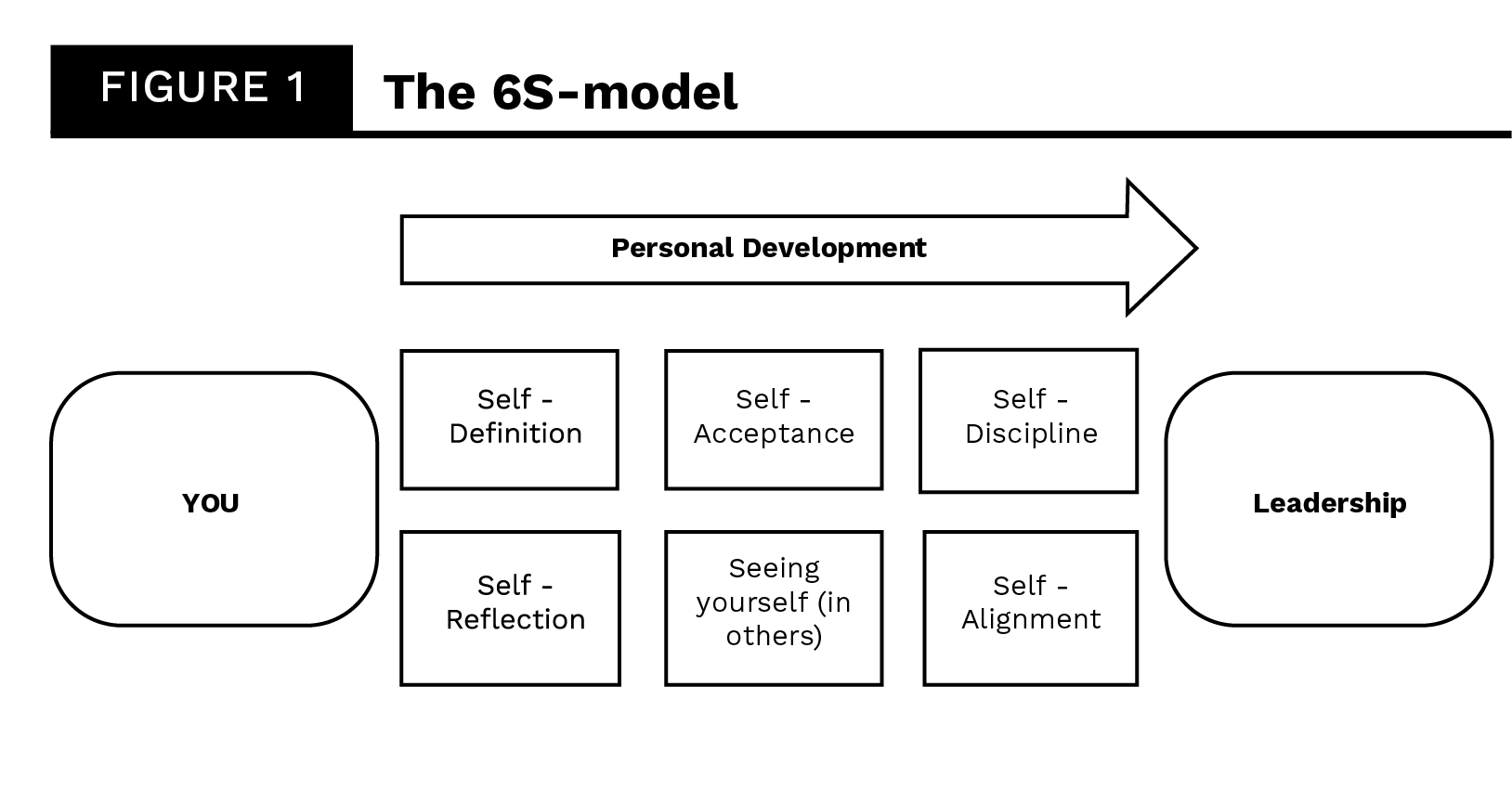
Over the years, we’ve learned that leadership is less about external validation – seeing leadership as bestowed to you by others – and more about internal clarity – involving serious self-discovery. Here, we discuss six lessons that shaped our leadership journey. Each lesson matters because it reinforces the central truth that leadership begins with self-recognition. This process of self-recognition is encompassed by six self-discovery processes, which we refer to as the 6S-model (see Figure 1).
Lesson One: Write Your Own Story—Because Leadership Starts With Self-Definition
Society rewards conformity, but leaders are forged when they choose their own path. It takes a sense of clarity to determine what one is about and how this can translate into such leadership that appeals to people and makes a difference. The first author left the security of private equity to build something uncertain because he recognized that his purpose wasn’t in playing it safe—it was in creating. Leadership demands that you define your own narrative, not follow someone else’s.
Lesson Two: Your Identity is Your Superpower—Because Authentic Leadership Comes from Self-Acceptance
For years, we, the authors, tried to lead like others, dimming what made us unique. We wondered how a CEO or a dean should act and adopted the common understanding of others on what those positions entailed, to start leading. But soon, we realized that true leadership isn’t about fitting in—it’s about standing out. What makes you different and how can those characteristics fuel your leadership to create real value? When we embraced our background, our resilience, and our unique perspective, we became stronger leaders. You don’t lead by mimicking; you lead by owning who you are.
Lesson Three: Leadership is a Decision—Not a Title—Because It’s Rooted in Self-Discipline
Formal authority is given, as it comes with the position that is bestowed on you. However, the ability to impact other’s lives in positive ways and create a willingness among others to follow you and your ideas, that is leadership and needs to be earned. It can be earned through daily actions, integrity, and mindset. Indeed, the ancient wisdom of the Upanishads – ancient Indian Sanskrit texts – reminds us that destiny is shaped by daily choices. Leaders aren’t made in boardrooms; they’re made in moments of challenge when they choose courage over comfort.
Lesson Four: Failure Will Visit. Make It Your Teacher—Because Growth Comes from Self-Reflection
Leaders aren’t made in boardrooms; they’re made in moments of challenge when they choose courage over comfort.
No one is perfect! And leaders should not strive to be perfect, as it is an impossible task. Even more important, without failure, there is no learning and thus no way to grow as a leader. Setbacks are inevitable, and it is important to remind you (each time you fail) that they don’t define you! What will define you is how you respond to failure. Every failure we’ve faced taught us more than any success. Leadership isn’t about avoiding mistakes; it’s about learning from them, refining your approach, and emerging wiser, as such, enabling you to grow.
Lesson Five: People are Everything—Because Leadership is About Seeing Yourself in Others
Early on in people’s business careers, they focus on numbers. Most of us initially believe that showing your ability to achieve your KPI is the way to grow and achieve leadership within any organization. With time, many start to learn that lasting impact can mainly be achieved by connection with others. Leadership is a social activity. It entails lifting others, understanding their struggles, and creating a culture where people can thrive. When you recognize the humanity in your team, you lead with empathy—not just efficiency.
Lesson Six: Choose Your Version of Success—Because Leadership Requires Self-Alignment
In business, we all strive for success. But what does success mean? What makes you feel successful as a leader? For us, we believe that success cannot be treated as a universal standard—it’s personal. Across our careers, we’ve seen people chase hollow victories and others find fulfillment in purpose-driven work. What to call success in these cases will depend on your values and why you want to lead. In other words, leadership means defining what matters to you and having the conviction to pursue it, even when the world measures differently.

Conclusion
Leadership doesn’t begin when others follow you—it begins when you follow your own truth. It’s the sum of self-awareness, authenticity, and the willingness to grow. When you recognize yourself—your strengths, your purpose, your definition of success—you don’t just lead. You inspire others to do the same.
So, an important question we want you to ask yourself is: Who am I when no one is watching? What do I stand for? What legacy do I want to leave? In answering those questions lies the power to create yourself as a leader.