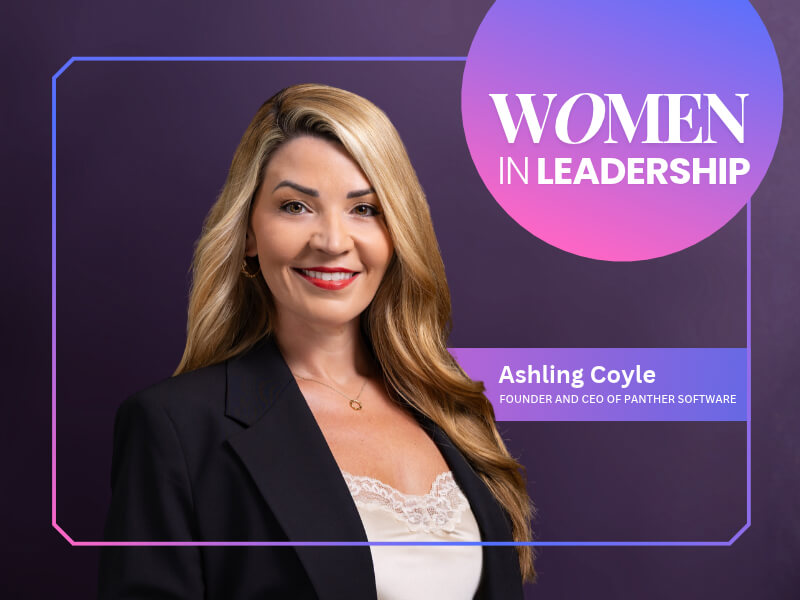
From accountancy to technology entrepreneurship, Ashling Coyle’s journey shows how women can turn experience, conviction and individual strengths into opportunities to lead.
Leadership does not have to follow a prescribed path. For Ashling Coyle, founder and CEO of Panther Software, it developed through a series of experiences that took her from accountancy into temporary recruitment and, eventually, technology entrepreneurship. Along the way, she learned to earn credibility in a traditionally male-dominated industry, recognise opportunities others had overlooked and trust the value of her own expertise. Her journey offers an empowering perspective on women in leadership: success does not depend on fitting an established mould, but on understanding what you bring to the table and having the confidence to build on it.
Building Confidence Through Experience
Ashling’s professional journey began in accountancy, but her early roles taught her that business was about much more than financial figures. As a production accountant at Endemol, she worked with people across the television production process, learning to navigate changing priorities and manage multiple responsibilities. The environment demanded adaptability, collaboration and an understanding of how different people contributed to a shared goal.
“My first job was as a production accountant in TV at Endemol, working with the producer, the director, and the runners on WIP project reporting. It’s more creative than it sounds and as much about people as numbers. I built close relationships with people at every level, and because productions were always changing, everything needed reforecasting all the time. That taught me how to keep track of a lot of moving parts at once.”
Her move to Euromoney brought a faster pace and new opportunities to develop her skills. A colleague introduced her to Excel and the company’s internal systems, giving her an early appreciation of how technology could support business operations. At the same time, she was studying for her ACCA examinations while taking on more responsibility at work.
One manager in particular helped shape her understanding of leadership. His willingness to trust and support his team demonstrated the importance of fostering an environment in which people could communicate openly and take ownership.
“My manager there was a role model; his influence shapes how I manage my own teams even today. He trusted me, he was kind, and he had my back when I needed him. I always knew how I was performing, and I could talk to him openly about anything. In return, I worked hard for him without being asked. That’s how I lead now: be open with people, trust them, and they’ll work hard for you.”
This experience gave Ashling a leadership principle she continues to apply: trust is not separate from performance but an essential part of creating the conditions for it. People are more willing to contribute when they feel supported, respected, and able to speak honestly.
Trust is not separate from performance but an essential part of creating the conditions for it. People are more willing to contribute when they feel supported, respected, and able to speak honestly.
Joining her family’s temporary recruitment business was another defining experience. Ashling was young and entering a male-dominated industry, where she had to establish her expertise and earn respect. Rather than relying on her qualifications or expecting her position to speak for itself, she chose to demonstrate her commitment through action.
“I made a point of treating no job as beneath me. I’d clear up cables or do the post, even though I was a qualified accountant, because I wanted to lead by example.”
She began by managing accounts for other businesses before launching her own temporary recruitment agency. Her experience taught her that credibility grows through understanding the work, taking responsibility, and consistently demonstrating what you can do. It also gave her a deeper appreciation of the role that people and culture play in building a successful organisation.
For Ashling Coyle, these lessons remain closely connected. A strong business depends not only on having the right strategy but also on creating an environment where good people can do their best work. As she explains, “Culture is what keeps good people, and it only takes one wrong hire to change the dynamic of a team.”
Turning Experience into Opportunity
Her move into technology entrepreneurship stemmed from recognising a problem she had experienced firsthand. As she tried to scale her temporary recruitment agency, she found that many processes still relied on paper application packs, handwritten timesheets, and manual administration. These were not merely inefficient ways of working; they created problems for workers, clients, and the agency itself.
“I was trying to scale my own temp agency and found that everything still ran on paper, with candidates filling in big application packs and timesheets completed by hand. If the handwriting wasn’t clear, someone would end up being paid the wrong amount, or a client would receive an invoice with the wrong job code on it. As an accountant, I could obviously see where every one of those errors came from, and each extra shift we filled made another one more likely.”
The software available at the time was largely designed for permanent recruitment, leaving temporary staffing agencies to adapt their processes to systems that did not fully meet their needs. Ashling saw an opportunity to approach the problem differently by building software that reflected the industry’s realities.
“That’s why I built my own software, starting with a simple booking platform to solve the payroll issue – every payslip matters for a lot of temp workers, and they’ll move agencies if they are paid late or the wrong amount – and to ensure that workers show up to their shifts with the right certifications.”
What began as a solution for her own agency grew into Panther Software, a platform serving the broader temporary recruitment sector. The transition shows how experience in one field can open doors in another. Ashling did not need a conventional technology background to identify a valuable opportunity. Her understanding of recruitment, finance, and the people affected by administrative processes gave her the insight to build something relevant.
That practical knowledge still shapes how she approaches customers and product development. Temporary recruitment involves details that can easily be overlooked by someone unfamiliar with the work, from compliance documents to pay rates that change according to the hour, day, and location.
“I’d say the needs are in the detail, and you only really see the detail if you’ve done the job yourself,” she says.
Her experience enables her to recognise the operational challenges behind a customer’s request and to seek solutions that address the underlying problem. Rather than simply responding to a feature request, she focuses on understanding why the customer needs it and how the solution can improve the business.
This is an important part of her approach to entrepreneurship: expertise need not come from a traditional career path. Knowledge gained through practical experience can become a powerful advantage when combined with curiosity, initiative, and the confidence to act.
Leading Growth with Purpose
Since its beginnings as a simple booking platform, Panther has developed into a broader solution for temporary recruitment agencies. Its work spans sectors including healthcare, education, hospitality and construction, each with its own requirements and operating practices.
Ashling’s ambition is to continue developing the platform to meet the needs of temporary work, eventually connecting more of the wider staffing supply chain. International expansion is also of interest, though she recognises that entering new markets requires a careful understanding of local conditions.
This measured approach reflects her belief that growth should be grounded in a genuine understanding of customers. Technology should not be introduced simply because it is available. It needs to solve a problem and work in the environment for which it was designed.
“New technology always has to come from a problem we’ve lived or one that clients have shared with us. It needs to be fit for purpose and we really have to get it right every time, because one wrong rate or a missed certification affects a real worker and organisation.”
For Ashling, responsibility is particularly significant in temporary recruitment. Each shift depends on workers having the right qualifications and certifications, on documents being up to date, and on pay rates being correct. When everything works, a hospital ward is staffed and a classroom has a teacher. When it does not, the consequences can affect both workers and the organisations that rely on them.
She believes the complexity of temporary work is often underestimated. Although the sector may appear flexible, that flexibility depends on the correct management of many rules and requirements. As those requirements change, agencies need systems that help them adapt.
This is where technology can create meaningful opportunities. By reducing manual administration and supporting more accurate processes, it can help agencies focus on their relationships with clients and workers. For Ashling, however, the priority remains making sure the technology works reliably for the people who depend on it.
Her approach to innovation is also shaped by customer relationships. Each new agency brings different processes and requirements, giving the business opportunities to learn and refine its platform. In this sense, growth is not simply about expanding the customer base. It is about continually improving the value the business provides to customers.
Challenging Expectations and Owning Her Expertise
Building a technology company in a traditionally male-dominated industry has given Ashling a particular perspective on the expectations women can encounter in business. She has experienced situations where conversations initially gravitate toward a male colleague, even when she has the knowledge and expertise to lead the discussion.
“I wouldn’t call them barriers, but there is still some stigma. When I first join a call, the conversation can seem to gravitate towards a male colleague rather than to me. Then a question comes up that only I can answer, and people warm up as the expertise comes out.”
She acknowledges that women may sometimes have to work harder to demonstrate their knowledge. Notably, however, she has not responded by changing her personality or communication style to meet others’ expectations.
“I think sometimes I have to make a bigger effort to prove my knowledge, but I haven’t changed myself or my communication style as a result. I try to let my experience speak for itself.”
Her approach is empowering precisely because it places the emphasis on recognising and owning one’s capabilities. Rather than allowing assumptions to dictate how she presents herself, Ashling draws confidence from what she knows and the experience she has accumulated.
Her career also offers a broader perspective on the opportunities available to women entering technology and entrepreneurship. Her path into the sector was unconventional, yet her background became one of her greatest strengths. She understood the industry, knew its operational challenges, and could recognise where technology could make a difference.
Ashling’s experience demonstrates how an individual’s perspective can become the starting point for a business opportunity and a different way of approaching an industry.
This highlights the value of bringing diverse professional experiences into leadership. Women do not need to follow a single prescribed path into business or technology, nor do they need to hold every conventional qualification associated with an industry before contributing. Commercial understanding, customer knowledge, and the ability to identify unmet needs can all provide a foundation for leadership.
Representation also matters because it makes these different routes more visible. When women see others building businesses and leading in sectors where they may not have traditionally seen themselves, the possibilities become easier to imagine. Ashling’s experience demonstrates how an individual’s perspective can become the starting point for a business opportunity and a different way of approaching an industry.
Finding Confidence in Her Own Leadership Style
Even as Panther grew, Ashling continued to question her own assumptions about what it meant to lead a technology company. One area she initially questioned herself on was sales. Having never sold software before, she wondered whether she had the right background for the role.
Her experience challenged the idea that successful sales required a particular personality. She discovered that a deep understanding of the product and the customer’s business could matter as much as conventional sales skills.
“However, I’ve found that what wins is expertise: giving detailed, correct answers in the first five minutes of a call, so the customer knows it’s the right fit. It’s really a consultative sale.”
By understanding the problems agencies face and showing how Panther addresses them, she found a sales approach that drew on her strengths. The experience reinforced the importance of not assuming that success requires imitating someone else’s style.
This is a valuable lesson for aspiring women leaders. Confidence does not necessarily mean being the loudest person in the room or conforming to an established image of authority. It can come from knowing your subject, understanding the needs of others, and communicating your perspective with conviction.
For Ashling, that confidence is also connected to passion and commitment. She believes that building something worthwhile requires a deep understanding of the problem and a willingness to care about the details, even when others might consider that level of attention unnecessary.
“It comes down to passion and obsession. If you believe in something, I think it will work, and that matters most when the problem is one you understand deeply, because you can see what’s required before anyone else can.”
She is realistic about the demands of entrepreneurship. Building a business requires focus, and there may be periods when work takes priority. Yet her message is not simply about working harder. It is about being invested in the outcome and understanding why the work matters.
As she puts it, “You can’t build something great unless you care about getting it right.”
That conviction is particularly relevant in an industry where the quality of a solution can affect workers and the organisations relying on them. Every shift represents a real person, and the processes behind it carry responsibilities that cannot be taken lightly.
Creating Your Own Definition of Leadership
Ashling’s journey reminds us that leadership does not have to be defined by a conventional background, a particular personality, or a predetermined career path. Her experience in accountancy gave her an understanding of business operations. Recruitment taught her about people, industry challenges, and the importance of culture. Technology gave her the opportunity to bring those experiences together in a new way.
For women considering entrepreneurship or leadership roles in industries where they may not immediately see themselves represented, her story offers an encouraging perspective. Professional experience gained outside a traditional route can become a source of distinction. Challenges can reveal opportunities, and expertise can provide the confidence to question established ways of working.
Her advice is grounded in the same principles that have shaped her own career: understand the problem, believe in what you are building, and remain committed to getting it right. Most importantly, recognise the value you already bring.
Leadership is not about becoming someone else to meet expectations. It is about building the confidence to draw on your own experience, strengths, and perspective to make a meaningful contribution. Ashling’s journey shows what can happen when women trust that value and give themselves the opportunity to lead on their own terms.
Ashling Coyle is the founder and CEO of Panther Software, a workforce management platform for temporary recruitment agencies and in-house workforce teams. An ACCA-qualified accountant, she grew up in her family’s temporary recruitment business and built Panther to fix the problems she saw there, from paper timesheets to compliance checks done by hand.
Panther was named Technology Partner of the Year at the British Recruitment Awards 2026.
The European Business Review uses cookies to improve site functionality, provide you with a better browsing experience, and to enable our partners to advertise to you. Detailed information on the use of cookies on this Site, and how you can decline them, is provided in our Privacy Policy and Terms and Conditions. By clicking on the accept button and using this Site, you consent to our Privacy Policy and Terms and Conditions. ACCEPT Reject
Privacy & Cookies Policy
Privacy Overview
This website uses cookies to improve your experience while you navigate through the website. Out of these cookies, the cookies that are categorized as necessary are stored on your browser as they are essential for the working of basic functionalities of the website. We also use third-party cookies that help us analyze and understand how you use this website. These cookies will be stored in your browser only with your consent. You also have the option to opt-out of these cookies. But opting out of some of these cookies may have an effect on your browsing experience.
Necessary cookies are absolutely essential for the website to function properly. This category only includes cookies that ensures basic functionalities and security features of the website. These cookies do not store any personal information.
Any cookies that may not be particularly necessary for the website to function and is used specifically to collect user personal data via analytics, ads, other embedded contents are termed as non-necessary cookies. It is mandatory to procure user consent prior to running these cookies on your website.