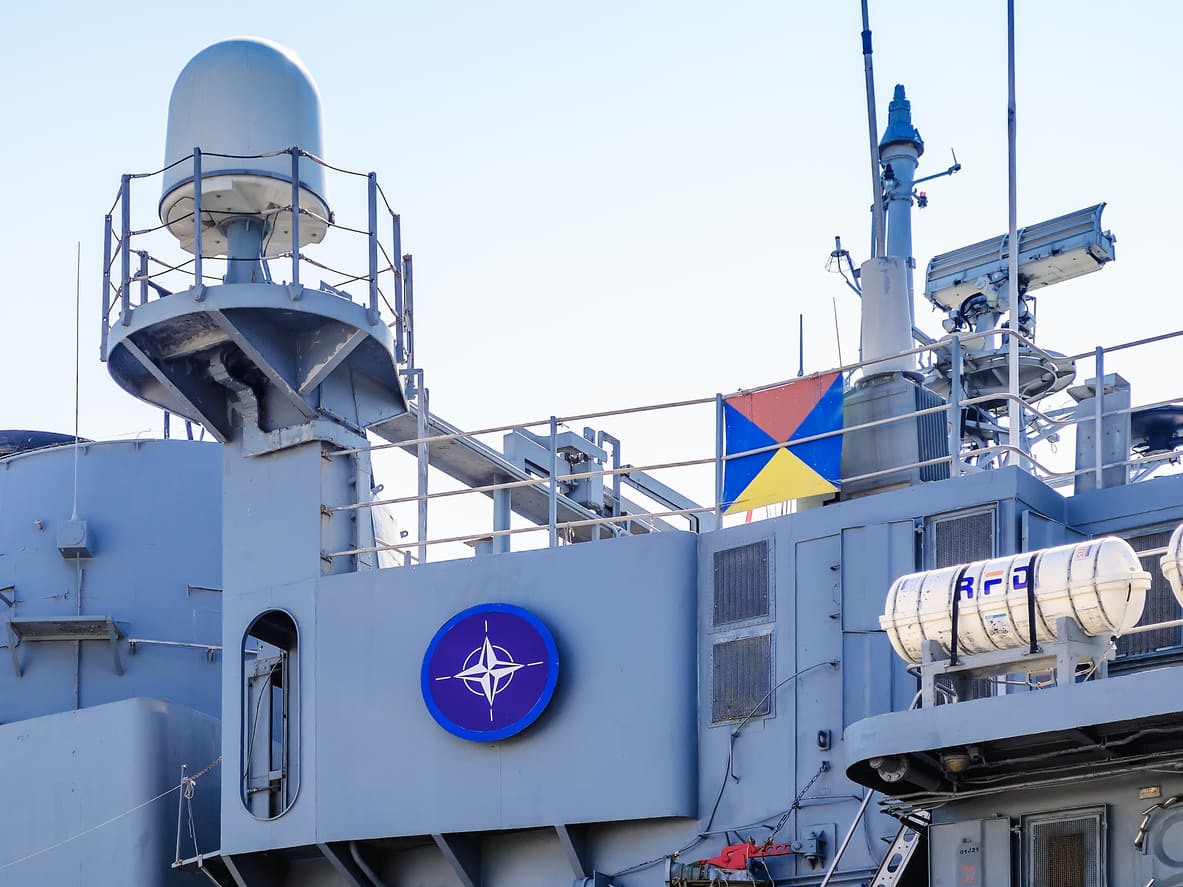
As NATO expands Europe’s defense capabilities to deter Russia, the alliance faces two mounting constraints: limited manpower and rising costs.
European defense spending has surged nearly 90 percent since 2022, while NATO has committed to raising defense and security-related investment to 5% of GDP by 2035. Yet ammunition production, recruitment, and specialist training cannot expand overnight. Germany’s ambitions to reach 260,000 active personnel and 200,000 reservists illustrate the challenge: governments can purchase additional weapons, but building the personnel and expertise needed to operate them takes considerably longer.
Lessons from Ukraine’s high-intensity war and NATO readiness exercises underscore the need to make existing resources go further. Five technologies are emerging as potential force multipliers to offer solutions and extract greater value from defense spending.
1. Uncrewed Ground Vehicles for Last-Mile Logistics
Military logistics demands substantial manpower for ammunition transport, frontline resupply, and casualty evacuation. In drone-contested environments, these missions also expose soldiers to considerable risk.
NATO members, including Britain and Baltic states, are testing autonomous and remotely operated Uncrewed Ground Vehicles (UGVs) to automate last-mile resupply and transport across dangerous terrain.
By enabling a single operator to supervise multiple robotic supply vehicles remotely, UGVs can reduce personnel exposure and free soldiers for other operational roles. Although maintenance and human oversight remain necessary, these systems offer a way to sustain frontline logistics with fewer personnel directly at risk.
2. “Human-Aware” AI to Break the Training and Ammunition Bottleneck
Expanding military forces requires more than equipment. Training recruits and reservists demands experienced instructors, range capacity, and ammunition. Traditional training reveals where soldiers miss, but identifying why often depends on instructors observing and diagnosing individual errors.
NATO member-state military units have been evaluating Human-Aware AI training technologies such as VCAT (Virtual Cognitive-Aware Trainer), developed by Israeli defense-tech company Eyeviation, to address these constraints. Combining AI, eye-tracking, and behavioral analytics, VCAT examines visual attention, reaction timing, and shooting performance to identify errors and deliver individualized feedback.
Evaluations with NATO member-state military units reported:
- 42% improvement in shooting accuracy and 19% improvement in shooting speed.
- 30% reduction in live-fire ammunition consumption.
- Up to 12 trainees supervised by a single operator, enabling individualized AI-driven feedback at scale.
“In military training, measuring the result is not enough. If you cannot measure the factors that created that result, you cannot systematically improve them,” said Col. (Res.) Or Landwer, CEO of Eyeviation and former Head of the Training Department in the Israeli Air Force.
By identifying and correcting weaknesses before live-fire exercises, AI-assisted training can help militaries improve proficiency while reducing pressure on instructors, ammunition supplies, and training facilities.
3. Low-Cost Counter-Drone Defenses
Few developments have exposed the costly imbalance of modern warfare more than drone warfare: inexpensive threats require interceptors worth hundreds of thousands or millions of dollars. RAND estimates Iranian-designed Shahed drones at $20,000–$30,000, compared with approximately $450,000 for an IRIS-T interceptor or $3.7 million for a Patriot PAC-3 missile. Such cost imbalances may be tactically justified, but become increasingly difficult to sustain during prolonged attacks.
NATO members are developing cheaper alternatives, including lasers, electronic warfare, and specialized kinetic interceptors. The UK’s DragonFire laser has successfully intercepted high-speed drones in trials, with the UK Ministry of Defence estimating just £10 per shot, compared with hundreds of thousands for conventional missiles.
Although these systems cannot replace conventional air defenses entirely, they could preserve expensive interceptors for higher-priority threats and improve the economics of sustained battlefield protection.
4. AI Predictive Maintenance and Digital Twins
Acquisition is only a fraction of costs for military aircraft and armored vehicles which incur substantial maintenance, spare-parts, and technical support costs throughout their lifetimes. Unexpected failures and shortages of qualified mechanics further undermine fleet readiness.
AI-driven predictive maintenance and digital twins offer ways to anticipate equipment problems using sensor readings, operating conditions, and maintenance histories.
The UK’s Royal Navy, for example, introduced its AI-powered Motherlode system to identify aircraft components likely to fail, assess wear, and predict spare-parts requirements.
By shifting from fixed servicing schedules toward condition-based maintenance, militaries can reduce unnecessary repairs, prioritize technicians’ time, and keep more existing equipment operational without expanding fleets.
5. Software-Defined Command and Control
NATO’s 32 militaries operate different radios, sensors, vehicles, and command systems, creating costly interoperability challenges. Replacing incompatible hardware can take years.
Software-defined command-and-control (C2) platforms instead help integrate information across existing systems. Ukraine’s Delta platform coordinated more than 100 unmanned systems during NATO’s REPMUS 2025 exercise and demonstrated compatibility with NATO data standards again in 2026.
NATO’s Maven Smart System, acquired in just six months, similarly demonstrates the alliance’s investment in AI-enabled intelligence processing and decision support.
While cybersecurity and integration remain challenges, modular software can accelerate upgrades and extend the operational value of existing equipment without requiring wholesale replacement.
The Takeaway for Allied Planners
As NATO increases defense spending, readiness cannot be measured by budgets and troop numbers alone. The challenge is translating investments into operational capability without proportionately increasing personnel, ammunition consumption, and maintenance costs.
From autonomous logistics and AI-powered training to affordable drone defenses and interoperable software, the greatest advantage may come from technologies that help NATO accomplish more with the forces and resources it already has.