


WoW Forever launches on November 4, 2026 as a new game with its own economy. Without a WoW Token at launch, Blizzard has not announced an official real-money-to-gold exchange for WoW Forever. New gold enters the game through play (quest rewards, looted coin, vendor sales); it then circulates between players through trade and the auction house; and it leaves the game through gold sinks such as training, repairs and auction fees. Blizzard has announced restrictions on GDKP raids in Forever, with the reported regional scope covering North America and Europe, and says it will act against buyers of gold as well as sellers. Since October 13, accounts suspected of real-money trading can be placed on a Temporary Economy Hold while Blizzard investigates.
Facts checked October 26, 2026, before launch. This edition contains no live price data: Forever’s market doesn’t exist yet. Every price in this article is labelled as illustrative. Dated market observations will be added after launch in section 8, each with date, region, ruleset and method.
1. Key terms
| Term | Meaning in this article |
|---|---|
| Legitimate | Allowed under Blizzard’s Terms of Use and in-game rules. It is a game-rules term here, not a statement about national law |
| RMT (real-money trading) | Exchanging real money for in-game gold, items or services outside Blizzard’s own systems. Blizzard prohibits it in World of Warcraft |
| GDKP | “Gold dragon kill points”: a raid format where loot is auctioned for gold during the raid and the pot is split among participants |
| Gold sink | Anything that removes gold from the game entirely (paid to an NPC or the system, not to another player) |
| Liquidity | How easily an item can be sold quickly without cutting its price |
| Scam | A deceptive trade or message intended to take a player’s gold, items or account |
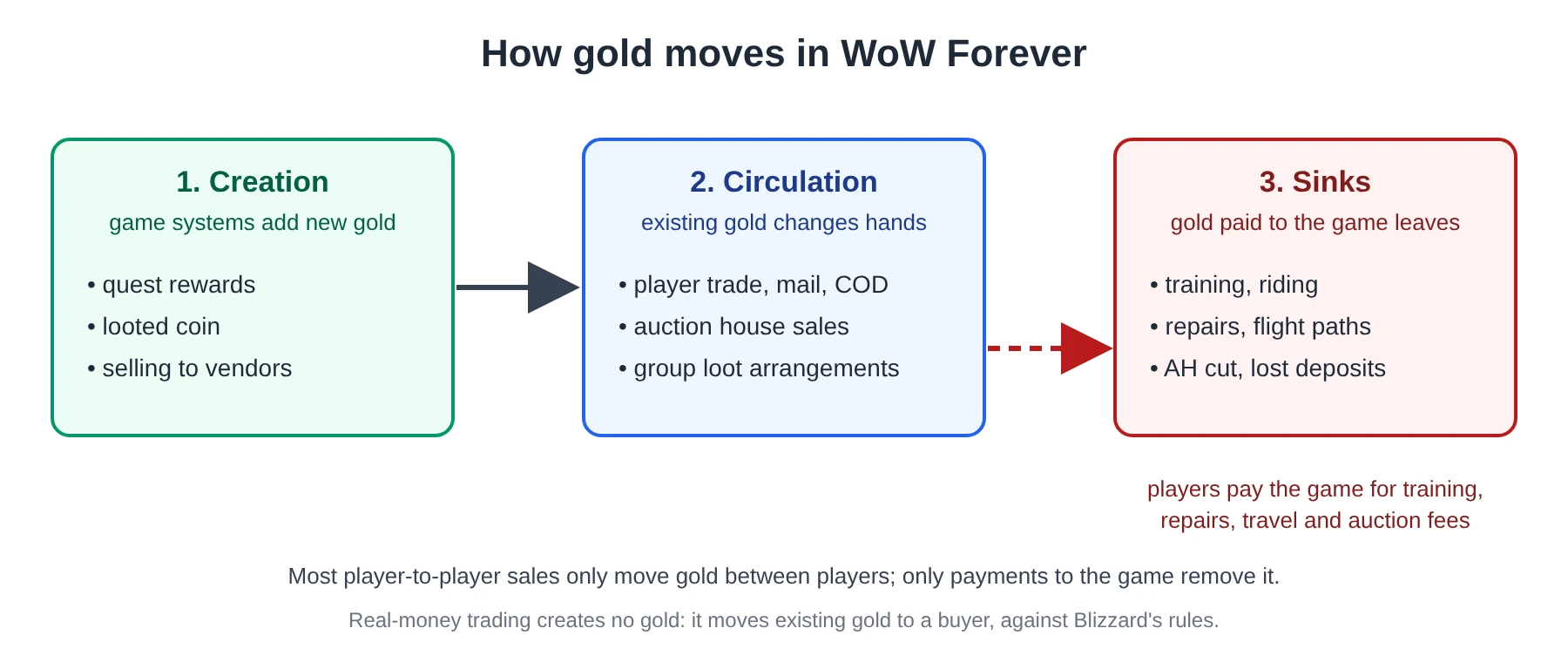
2. How gold moves: creation, circulation, sinks
It helps to separate three things that are often blurred together:
| Stage | What happens | Examples |
|---|---|---|
| Creation | New gold enters the economy from game systems | Quest rewards, looted coin, selling items to vendors |
| Circulation | Existing gold moves between players; no gold is created or destroyed | Player-to-player trade, auction house sales, mail and COD, group loot arrangements |
| Sinks | Some gold leaves the economy when paid to the game | Class, riding and profession training; repairs; flight paths; vendor goods; lost deposits and the auction cut |
Most player-to-player sales simply move gold from one player to another; only the fees and payments to the game act as sinks.
- Creation: without a WoW Token at launch, Blizzard has not announced an official real-money-to-gold exchange for WoW Forever. The game’s gold supply is created through in-game systems, while player trades and third-party transactions can move existing gold between accounts.
- Circulation does not create gold. Trading, auctions and group loot arrangements move existing gold between players.
- Real-money trading sits outside both: it doesn’t create gold either, it moves gold that was earned (or obtained illicitly) in the game to a buyer, for cash, in breach of Blizzard’s rules.
This distinction matters for the GDKP debate. GDKP mainly redistributes gold between players; it does not by itself remove gold from the economy. Restricting it changes how gold circulates and may affect demand for purchased gold, but it is not the removal of a gold sink.
3. What is confirmed before launch
| Fact | Status and source |
|---|---|
| Forever is a fresh start; beta characters don’t carry over and no transfers from other WoW versions have been announced | Confirmed for beta; check at launch |
| Currency: copper, silver, gold (100 copper = 1 silver, 100 silver = 1 gold) | Standard WoW currency |
| No WoW Token and no character boosts at launch | Stated by the WoW Classic team (Warcraft Tavern report) |
| Riding training is bought in-game | The edition details note that the edition mount still needs in-game riding training (Blizzard) |
| Legacy perks that reduce spending: Bartering (lower vendor prices), Frequent Flier (cheaper, faster flights) | Blizzard: Legacy system |
| Legacy perks that speed up professions: Working Overtime (better odds of a skill point), Dedicated Study (daily cooldown for faster progress) | Same source |
| New gathering outputs: new ore and scarce reagents (Mining), herb seeds and scarce reagents (Herbalism), scarce leather (Skinning) | Pre-launch profession guide (Icy Veins); confirm in the release client |
| Several professions make bind-on-pickup (BoP) gear only the crafter can use | Same source; confirm at launch |
| Engineering can add a Reagent Bot and a Repair Bot to campsites | Same source; confirm at launch |
| Realmless design with separate rulesets (Normal, PvP, RP, RP-PvP) | Blizzard: rulesets |
| Auction house scope (per ruleset, per faction, shared?) | Not officially detailed. Check in-game at launch |
| AH deposit and cut in Forever | Not officially detailed. Section 5 uses Classic-era rules as an illustration only |
| Starting gold of a new character | Not stated as a release fact; check at launch |
| Raid unlock | December 9, 2026 |
4. Gold sources compared
The ratings below follow stated criteria rather than gut feel. They describe how each method works in Forever’s announced systems; earnings are unknown until there is a live market.
Criteria (all ratings are additional costs compared with normal leveling):
- Upfront capital = training + tools + materials you must buy before earning (None: no extra capital beyond normal play / Low: training and a tool / Medium: recipes or materials / High: stock bought for resale).
- Extra active time = playtime beyond what you would spend leveling anyway; “Baseline” means it happens during normal leveling.
- Market risk = chance the output sells below cost or doesn’t sell.
- Rules risk = risk under Blizzard’s rules. “In-game only” means no RMT violation when done through allowed in-game systems; ordinary trade rules and scam risk still apply.
| Method | Upfront capital | Extra active time | Market risk | Rules risk |
|---|---|---|---|---|
| Questing and looting | None | Baseline (part of leveling) | None | In-game only |
| Vendoring gray and white items | None | Low (bag trips) | None (fixed vendor price) | In-game only |
| Herbalism | Low (training; no tool needed) | Low to medium (detours to nodes) | Medium | In-game only |
| Mining | Low (training + mining pick; smelting at a forge) | Medium (detours, forge trips) | Medium | In-game only |
| Skinning | Low (training + skinning knife) | Low (on creatures you kill anyway) | Medium | In-game only |
| Selling Forever’s scarce reagents | Low | Medium | Medium to high (no price history) | In-game only |
| Crafting for sale | Medium to high | High (leveling the profession) | High (BoP recipes don’t sell; competition) | In-game only |
| Enchanting services | Medium | Medium (trade chat) | Medium | In-game only; scam risk in trades |
| AH trading (buy low, relist) | High | Medium | High | In-game only |
| Dungeon runs (coin, materials, BoE drops) | None | High | Medium (drop luck) | In-game only |
| Fishing and Cooking | Low (skill training plus a fishing rod; check in-game where the rod is sold) | Medium | Medium | In-game only |
| Engineering camp services | Medium | Medium | Medium | In-game only |
| GDKP raids | — | — | — | Restricted in NA and EU (reported scope); check your region |
| Buying gold for real money | Cash | — | — | Breaches Blizzard’s Terms; account action possible |
Choosing a method: two gathering professions can be a practical low-capital starting point, but they are not automatically the highest-return choice. Compare gathering time, training costs, inventory space and local demand before committing. A player who wants to craft their own gear may get more value from one gathering and one matching crafting profession, especially as several Forever recipes make BoP items the crafter can use but can’t sell.
5. Auction house unit economics: an illustrative calculation
Illustrative calculation. The numbers are invented to show the method, not observed Forever prices. AH fee rules below are those of Classic-era WoW; confirm them in Forever at launch.
In Classic-era WoW, the faction auction house takes a 5% cut of the sale price, and a listing deposit is returned if the item sells but kept if it expires or is cancelled.
Formula:
Net profit = realized sale price − auction-house cut − lost deposits on unsuccessful listings − acquisition or crafting cost.
(Proceeds would be what you receive after the auction cut, before your own costs; profit also subtracts what the goods cost you.)
Example: you craft a batch at a material cost of 4g 00s and list it at 5g 50s. The first listing expires (deposit 0g 20s lost); the second sells.
| Line | Amount |
|---|---|
| Realized sale price | 5g 50s |
| AH cut (5%, Classic-era illustration) | −0g 27s 50c |
| Deposit lost on the expired listing | −0g 20s |
| Deposit on the successful listing | 0 (returned on sale) |
| Material cost | −4g 00s |
| Net profit | 1g 02s 50c |
Two lessons follow. A listing price is not income: only the realized sale counts. And repeated failed listings on low-value items can erase the margin, which is why liquidity matters as much as price.
6. Launch-market scenarios (not forecasts)
These are possible launch-market scenarios, not observed WoW Forever price trends. Prices may move differently across regions, rulesets and factions, depending on how the live auction house is configured.
As a general model (a generalization from other MMO launches, not an established feature of Forever), new economies can show recurring pressures. Whether Forever follows them is an open question:
| Phase | Pressure that often appears | Possible effect | What could make it different |
|---|---|---|---|
| Launch week | Little gold in circulation; everyone needs training and bags | Essentials may sell quickly; luxury items may sit | A higher-than-expected starting gold, quest-reward balance |
| Early leveling | Many gatherers in the same zones | Low-level materials may fall in price (supply shock) | Strong crafter demand for leveling recipes; scarce reagents |
| First riding wave | Many players saving for the same purchase | Players may sell more and buy less (opportunity cost of spending) | Legacy perks, cheaper alternatives, staggered leveling speeds |
| Raid prep (raids from December 9) | Deadline demand for consumables and enchants | Prices may rise before the unlock | Many crafters entering the same market at once |
Two business ideas make these phases easier to read:
- Price discovery. Forever’s new materials have no price history. The first sellers effectively propose a price, and the market corrects it. Early prices are a signal, not a benchmark.
- Market depth. Several listings at similar asking prices provide a better view of visible supply than a single listing, but they do not reveal completed sales or actual trading volume. Listings are ask prices, not the prices at which items actually sold.
Undercutting (listing slightly below the lowest price) is generally expected to speed up a sale, in theory. Whether it lowers prices for everyone depends on demand, stock levels and how many sellers compete: in a thin market with steady demand, the effect can be small or temporary.
7. How to check an auction listing before you buy or sell
- Check whether the item is a reagent. Many Forever items are new; vendoring an ingredient someone else needs is an easy early mistake.
- Look at depth, not just the lowest price. How many listings, and at what spread of asking prices? Remember this shows visible supply, not what has actually sold.
- Check again at a different time of day. Evening and weekend demand can differ from a weekday morning.
- Estimate your net profit, not your listing price, with the formula in section 5.
- Decide your holding period. If the price only works after a deadline (raid unlock, riding training), factor in the risk that many others are holding the same item.
- Record what you saw (date, time, ruleset, faction if relevant, quantity, price) before acting on it.
8. Observed market snapshots (added after launch)
Placeholder for the post-launch edition. Listing prices are offers, not completed sales. The median of listed prices isn’t a volume-weighted price and doesn’t show what items sold for.
| Date & time (UTC) | Region | Ruleset | Faction (if relevant) | Item | Number of listings | Units listed | Lowest price per unit | Median listed price per unit | Price range per unit | Method | AH availability note |
|---|---|---|---|---|---|---|---|---|---|---|---|
| — | — | — | — | — | — | — | — | — | — | In-game AH scan, manual | — |
Planned observation dates: November 6 and November 11, 2026, then around the December 9 raid unlock. Each snapshot uses the same items in the same region, ruleset and faction, so the two dates can be compared; different markets aren’t combined.
9. Blizzard’s rules: GDKP, gold buying and economy holds
GDKP
Blizzard has announced restrictions on GDKP in WoW Forever; the reported regional scope covers North America and Europe. In a September Q&A, Forever’s lead designer Josh Greenfield said GDKP would not be allowed, citing its effect on traditional guilds, its barrier for players with fewer resources and its use by “bad actors to launder large sums of gold” (GamesRadar). In an October 8 interview with the Taiwanese outlet 4Gamers, associate production director Clay Stone placed the ban in North America and Europe, with GDKP remaining permitted in other regions such as Korea, as reported by Inven Global on October 15. This regional scope comes from an interview, not from an official ruleset page. Players should check the rules applicable to their region before organizing or joining GDKP runs.
Gold buying
In a September 28, 2026 post on the official forums, Blizzard said real-money transactions are not acceptable in World of Warcraft and that the rules apply to the Forever beta and live game (Blizzard forums: Gold Buying Rules). Key points:
- Blizzard will increasingly act against buyers’ accounts, not only sellers.
- Illicit gold can be removed, and further action can include closing accounts.
- Players who “knew or should have known” that gold came from an illegitimate source may also face action.
- Players should be cautious about gifts from strangers and other one-sided transactions.
Temporary Economy Holds
Blizzard also announced Temporary Economy Holds on October 13, 2026 (Blizzard forums). Accounts suspected of selling or receiving illicit gold through real-money trading may temporarily lose access to trade, mail, guild banks and the Auction House while Blizzard investigates. A hold does not automatically mean the account will receive a permanent penalty: Blizzard says a hold alone leaves no permanent strike unless RMT is later proven. The post describes the system for Forever first, with possible rollout to other WoW versions.
What this means in practice
Some third-party websites advertise WoW Forever gold. Blizzard prohibits real-money gold transactions and says account actions can apply to recipients as well as sellers. Under Blizzard’s stated approach, the risk falls on the account that receives the gold, regardless of the seller, and suspicion alone can freeze an account’s trading while it is reviewed.
10. Scams
| Scam | How it works | Defense |
|---|---|---|
| Phishing “Blizzard” emails or whispers | Fake security alerts or prizes leading to a login page | Log in only through the Battle.net app; enable an authenticator |
| “Free gold” or giveaway whispers | Links to fake sites or malware | Ignore and report |
| Trade-window switches | Item or amount changed before you accept | Read the trade window every time |
| Misleading COD (cash on delivery) mail | Paying for items that aren’t what was promised | Only accept COD from people you trust |
| Account-sharing “services” | Giving your login to someone else | Never share credentials; it also breaks Blizzard’s Terms of Use |
| Unexpected gold from a stranger | Can be linked to an unauthorized transaction | Avoid spending or forwarding it; don’t send gold back to an unknown player; contact Blizzard Support if you suspect it’s linked to an unauthorized transaction. Receiving a gift isn’t in itself proof of RMT |
11. FAQ
Is there a WoW Token in WoW Forever? Not at launch. The WoW Classic team said there are no current plans to add one, and Blizzard hasn’t announced any other official real-money-to-gold exchange.
Are GDKP raids allowed? Blizzard has restricted GDKP in Forever; the reported scope is North America and Europe. Check the rules for your region.
Is buying gold allowed? No. It breaches Blizzard’s Terms of Use, and Blizzard says it will increasingly act against buyers, up to account closure.
What is a Temporary Economy Hold? A temporary block on trade, mail, guild bank and AH access for accounts suspected of RMT, while Blizzard investigates. It is not in itself a penalty.
Is the auction house shared across rulesets or factions? Blizzard hasn’t detailed it. Rulesets are separate ecosystems; confirm the AH scope in-game at launch.
Disclaimer: This article contains sponsored marketing content. It is intended for promotional purposes and should not be considered as an endorsement or recommendation by our website. Readers are encouraged to conduct their own research and exercise their own judgment before making any decisions based on the information provided in this article.


