

By Tyler Tappendorf
Digital capability is multidimensional, not a linear journey. What matters is where technology helps entrepreneurs achieve goals—and where constraints still hold them back.
Digital capability isn’t a linear journey from access to advanced technology. Entrepreneurs often have sophisticated digital skills in one part of their business while facing significant constraints in another. What matters, then, is not simply whether entrepreneurs adopt technology, but whether they can use it effectively to achieve their business goals. Drawing on CARE’s recent research and Digital Skills Framework for Women Entrepreneurs, Tyler Tappendorf, Digital and Financial Services Lead for Economic Growth at CARE, explores why understanding these different dimensions of digital capability can lead to more targeted, and ultimately more useful, support for entrepreneurs.
Imagine two women entrepreneurs:
Halima has run a secondhand clothing stall for five years. Since last year, most mornings she drafts captions to advertise her latest items on her social media page using an AI chatbot. And it’s working. Orders are steadily flowing via online messaging. Yet she still records each sale in a paper notebook, sometimes has to use her husband’s phone when hers runs out of data, and has fallen prey to a scam in which a mobile money payment confirmation turned out to be fake.
Grace sells food items but has never used AI tools. She tracks her inventory and sales digitally, receives most customer payments through mobile money, keeps her business and personal finances separate, and knows exactly which three products kept her business profitable during last year’s slow season.
Which entrepreneur is more digitally capable, Halima or Grace?
The answer isn’t obvious. And that’s exactly the point.
Changing How We Think About Digital Capability
We often tend to think about digital capability as a ladder. First comes access to devices like a smartphone or laptop, then basic digital skills, then leveraging social media and chat platforms for online sales, then digitizing more business processes and recordkeeping, and finally AI. The assumption is that entrepreneurs move steadily upward, becoming progressively more “digitally advanced.”
CARE’s work with women entrepreneurs suggests that real businesses often don’t digitize that way.
Women entrepreneurs rarely digitize their businesses one function at a time. Instead, they adopt tools that solve the most pressing problems they face. One entrepreneur may master Facebook marketing because finding customers is her biggest constraint. Another may prioritize digital payments because handling cash is risky. A third may embrace AI to save time creating content while continuing to manage inventory or finances manually. None of these entrepreneurs are “more digital” than the others; they simply have different realities and digital capability profiles.
This distinction matters because our programs, engagements, and technologies are often designed around the wrong question. Instead of asking, “How digitally advanced is this entrepreneur?” we should be asking:
Where is digital capability creating value in her business—and where are the constraints holding her back?
That shift may sound subtle, but it changes a great deal about how we best design for and serve the real financial needs of women entrepreneurs in our programming.
If we assume digital capability follows a single progression, the solution often becomes standardized digital literacy training or encouraging adoption of the latest technologies. But if digital capability is multidimensional, then different entrepreneurs will need different kinds of support to achieve their business goals.
We, as an industry, have learned a similar lesson from financial inclusion. Opening an account or taking a loan is not the outcome we focus on. Instead, what matters is whether financial services help someone invest, withstand shocks, build assets, or improve her financial health. Digital should be treated the same way. Adoption is meaningful when it helps an entrepreneur solve a problem she actually has.
Equally important are the capabilities that determine whether digital tools can be used effectively and safely. Does an entrepreneur have control over her device and digital accounts? Can she recognize fraud? Does she have the confidence to make informed decisions about which technologies can support her business? These questions rarely fit neatly onto a single maturity scale.
What Digital Capability Looks Like in Practice
Recent data from Strive Women, a Mastercard Strive program led by CARE and developed by the Mastercard Center for Inclusive Growth, illustrates some of this complexity. In our midline survey of more than 1,100 entrepreneurs across Pakistan, Peru, and Vietnam, there was no single profile of what a “digital business” looked like.
The tools women use vary considerably depending on their businesses and contexts. Online selling platforms are the most used digital tool among entrepreneurs surveyed in Pakistan, while mobile wallets lead in Peru and social media in Vietnam. Some differences are even more striking: 58% of entrepreneurs surveyed in Vietnam use a POS device or digital payment service, compared with less than 1% in Pakistan and 2% in Peru. Digital lending shows almost the reverse pattern, used by 23% of entrepreneurs in Peru but just 1% in Pakistan and 7% in Vietnam.
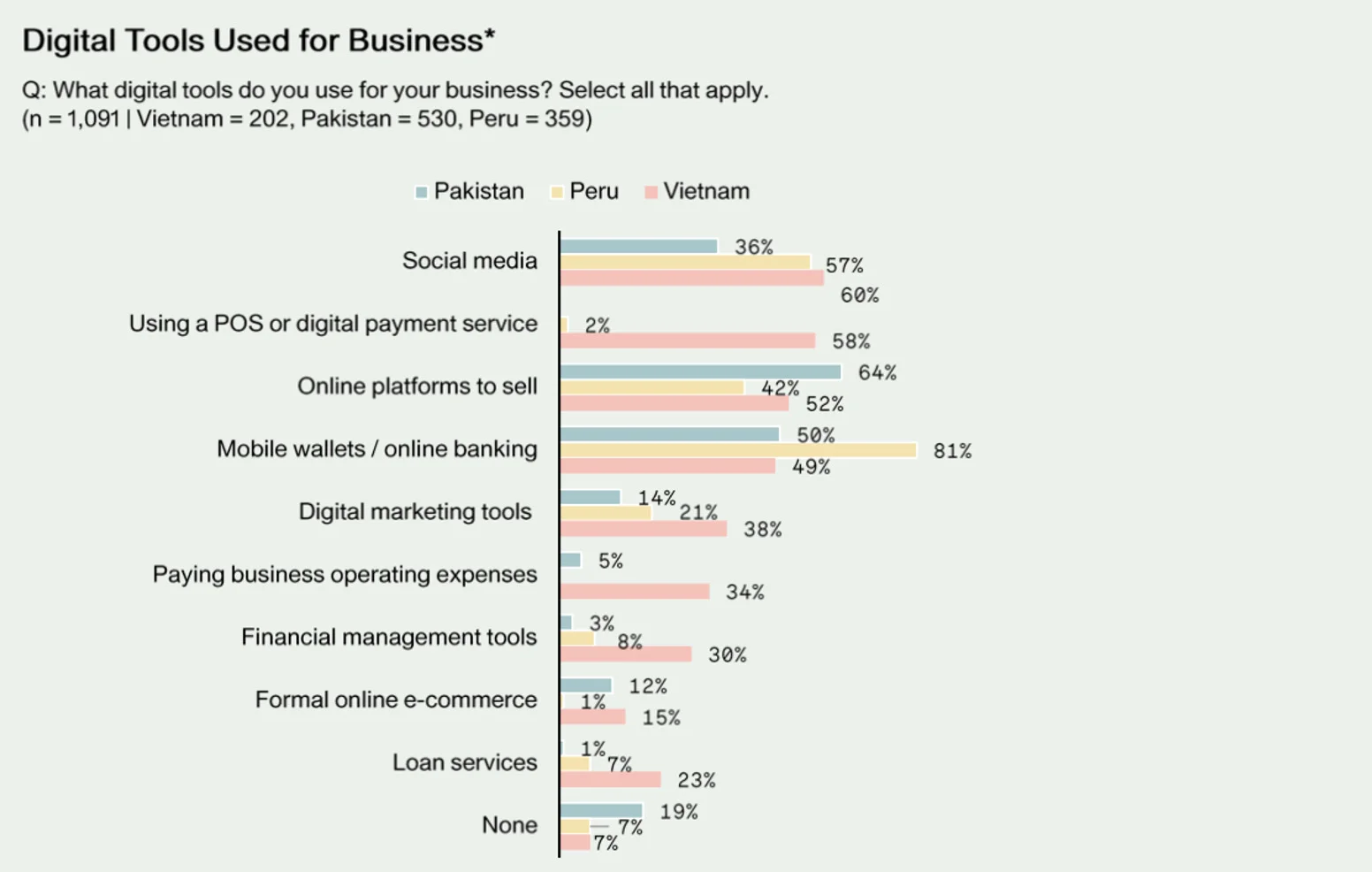
Even within the same portfolio “being digital” can mean very different things. For one entrepreneur it may mean selling through an online platform; for another, accepting digital payments; for another, using social media to find customers. These capabilities appear in different combinations, and strength in one area does not tell us much about capability in another.
That’s why a single measure of how “digitally advanced” an entrepreneur is can be misleading. What matters more is understanding which digital capabilities she already has, which ones are creating value for her business, and where the gaps are holding her back.
Moving Beyond the Digital Maturity Model
This insight led CARE to develop a new Digital Skills Framework for Women Micro and Small Entrepreneurs, created with support from the HP Foundation as part of its ongoing partnership to expand Strive Women’s reach in Pakistan, Peru, and Vietnam.
Instead of treating digital capability as a single continuum, the framework organizes it across a number of complementary dimensions—from device access and digital literacy to mobile financial service use, internet use, digital-for-business use, AI engagement, and confidence or self-efficacy. These criteria are underpinned by safety, cybersecurity, autonomy, and control.
Together, these dimensions provide a more complete picture of where digital capability is already creating business value, and where targeted support could unlock further growth. The implications extend beyond training programs.
- For funders, it suggests moving beyond counting devices distributed or participants trained toward understanding which capabilities tangibly improve business performance.
- For technology providers, it highlights opportunities to design products that address the real constraints entrepreneurs face, rather than assuming every user follows the same digital journey.
- For program implementers like CARE, it offers a way to diagnose needs more precisely and tailor support to individual businesses instead of delivering one-size-fits-all interventions.
So perhaps we shouldn’t be asking whether Halima or Grace is the more digitally capable entrepreneur. We should be asking what each is trying to achieve next—and what combination of skills, tools, and support will help her get there.
For Halima, the next leap may have little to do with AI. It may be learning to protect herself from fraud, gaining more reliable access to her own device, or bringing the sales flowing through WhatsApp into a system that helps her understand her business. For Grace, it may be finding digital tools that help her reach new customers or turn the business information she already tracks into better decisions.
Both are on digital journeys. But there is no reason those journeys should look the same.
The goal isn’t to make either woman “more digital.” It is to help each build the capabilities that make her business stronger, more resilient, and more able to achieve her goals.
If you’d like to explore this multidimensional approach in more detail, CARE’s Digital Skills Framework for Women Micro and Small Entrepreneurs presents the research, framework, and practical guidance behind this perspective.
 Tyler Tappendorf