By Laura Kensington
There is one number from a survey we ran in August that I have not managed to stop thinking about. We asked 3,000 Americans aged 18 to 28 whether they hide from their employer how much they rely on AI, so as not to look replaceable. A third said yes.
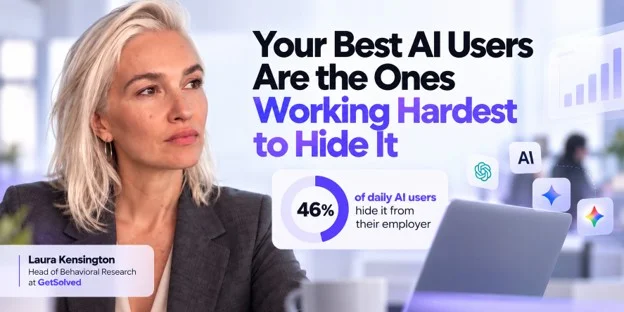
On its own, that is an awkward finding. What makes it a structural problem is where the number sits. Among people who barely touch AI, 15% conceal their use. Among daily users working across several tools, it is 46%. The behaviour does not fade as people get more competent and more comfortable with the technology. It climbs, in order, at every step of usage.
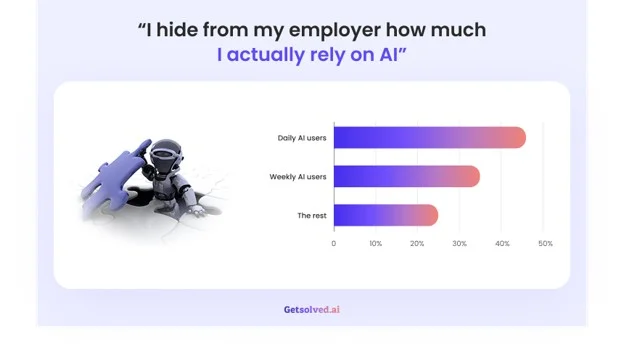
Most workplace anxieties run the other way. People are usually most secretive about a tool when they are new to it and worried about looking foolish, and most open once they are good at it. The opposite is happening here: the employees getting the most out of AI are the ones spending the most effort making sure nobody notices.
The reason is not hard to find in the same dataset. 74% of respondents say companies are quietly replacing people with AI and calling it restructuring. 58% say employers deliberately understate how much work AI is already doing. That is not a fringe suspicion; it is close to a consensus position, and it is a consensus that corporate communications has entirely failed to move.
I want to be careful about what this does and does not show. This is also a single age band. I would not extrapolate these numbers to a forty-five-year-old manager, and I am not trying to. What it captures is the behaviour of the newest people in the organisation — a narrower claim, and the one that compounds, because these are the habits that will be normal when this cohort is running teams. Our survey measures what employees believe their employer is doing, not what employers actually do. I have no data on how many restructurings genuinely were AI substitutions, and I am not claiming the belief is accurate. For predicting behaviour, though, the distinction barely matters. If you believe your employer is quietly converting roles to software and describing it as optimisation, then demonstrating how much of your output is software-assisted is an irrational thing to do. The concealment follows logically from the belief, whether or not the belief is fair.
There is a second finding that makes the first harder to dismiss as generalised paranoia. Fear of losing one’s own job within five years rises with proximity to the technology: 56% among heavy AI users, against 33% among those who barely use it. Across the whole sample, that question splits exactly down the middle, 46% to 46%. So the people who understand the capability best are not reassured by understanding it. They are the ones most convinced it is coming for their role specifically.
Put those two together, and you get a workforce where the most AI-capable people are simultaneously the most worried about being replaced and the most motivated to hide the evidence of their capability. That is an expensive position for an employer to be in, for four reasons that have nothing to do with ethics.
You cannot measure productivity that you cannot see. Any estimate of what AI has done to your output is being drawn from a population with a direct incentive to understate it, which means your baseline is wrong in an unknown direction.
Training is going to the wrong people. The employees who could teach the rest of the organisation how to use these tools well are the ones least likely to volunteer for it, because volunteering identifies them.
Policy gets written blind. Acceptable-use rules built on a false picture of current use tend to prohibit things nobody does and permit things everyone does quietly.
And the feedback loop you most need is the one you have broken. The people best placed to tell you which tasks AI genuinely handles, and which it only appears to handle, have the strongest reason to say nothing.
None of this is solved by a policy document, and certainly not by monitoring software, which reads as confirmation of exactly the suspicion driving the problem. What moves it, in my view, is a much less comfortable set of actions.
Be explicit about headcount. If AI capability is a factor in a restructuring decision, say so in the announcement. The suspicion is already at 74%; the only thing vagueness protects is the fiction that people do not already assume it.
Make AI proficiency visibly good for a career, not just tolerated. Promote someone for it, in public, with the reason stated. A single legible example does more than any number of assurances that nobody’s job is at risk.
Stop designing disclosure processes that feel like confessions. If your AI usage form sits next to the expense policy and the disciplinary procedure, you have told people what category the answer belongs in.
Laura Kensington is Head of Behavioral Research at AI writing toolkit GetSolved. The survey referenced here polled 3,000 Americans aged 18 to 28 in August 2026, recruited through online panels using Random Device Engagement.
All the photos in the article are provided by the company(s) mentioned in the article and are used with permission.
About the Author
Laura Kensington is Head of Behavioral Research at AI writing toolkit GetSolved. The survey referenced here polled 3,000 Americans aged 18 to 28 in August 2026, recruited through online panels using Random Device Engagement.
Disclaimer: This article contains sponsored marketing content. It is intended for promotional purposes and should not be considered as an endorsement or recommendation by our website. Readers are encouraged to conduct their own research and exercise their own judgment before making any decisions based on the information provided in this article.