Why are C-suite leaders flying private? 8 data-backed reasons; from security mandates to time savings, reshaping executive travel in 2026.
Private aviation has moved from the “nice-to-have” column of the executive expense report to the “strategic infrastructure” column of the boardroom agenda.
Across Fortune 500 and FTSE boardrooms alike, the conversation has shifted from whether leadership should fly privately to how that access should be structured, governed and disclosed. Here are eight things worth understanding about why today’s C-suite is increasingly found at 40,000 feet.
1. Time Has Become the Ultimate Boardroom Currency
For executives, the value of an hour is rarely up for debate, since it’s the scarcest resource on the calendar. Industry analysis from the European Business Aviation Association puts the average time saved per trip, compared with the best available commercial alternative, at more than two hours.
Modelling by the US National Business Aviation Association tells a similar story: in one illustrative multi-city itinerary, total time away from home ran roughly four times longer by scheduled airline than by business aircraft, at well over double the true cost once lost working hours were factored in. For a leadership team running a multinational operation, that arithmetic compounds fast indeed.
2. Security Has Moved From Perk to Governance Requirement
One of the biggest concerns in recent years hasn’t been about comfort, necessarily, it’s been about risk. Following the December 2024 killing of a major US health insurer’s chief executive in Manhattan, boards accelerated a trend that was already building: mandating private travel for security reasons rather than leaving it as a discretionary benefit.
Analysis by executive compensation specialists found that once a board introduces a security-driven aircraft mandate, it is rarely walked back. Apple’s board required Tim Cook to use company aircraft for all business and personal travel as far back as 2017 on security grounds, and Starbucks went further in 2025, removing a longstanding cap on CEO Brian Niccol’s personal use of the corporate jet after a formal security review recommended he fly privately for every trip, business or otherwise. Compensation researchers at FW Cook note that a majority of S&P 100 chief executives now fly private specifically under company security policy, not personal preference.
3. Europe’s Fragmented Map Makes It a Structural Necessity, Not an Indulgence
Nowhere is this more visible than in Europe itself. Unlike the US hub-and-spoke commercial network, Europe’s business geography is split across dozens of jurisdictions, currencies and mid-sized commercial hubs that often lack direct scheduled flights to one another. For a pan-European leadership team, chartering a private jet has become less a status symbol and more a way of closing the connectivity gap between capital cities and the secondary business centres where deals actually get done.
Eurocontrol recorded business jet movements in the hundreds of thousands across European airspace in a single recent year, and one widely cited market estimate values the European business jet sector at close to €5.5 billion in 2026, with steady growth projected into the next decade as cross-border executive travel keeps intensifying.
4. It’s Now a Boardroom Compensation Decision, Not a Personal Choice
Private aircraft use by chief executives has become a formal governance matter, tracked, capped, and voted on by compensation committees rather than decided ad hoc. Data compiled by the executive research firm Equilar shows that a majority of Fortune 500 CEOs now fly privately on the company’s account, with company-funded private jet spending climbing roughly 19% between 2021 and 2024. The numbers at individual companies illustrate the scale of the shift: Palantir’s spending on CEO Alex Karp’s travel more than doubled year-on-year to over $17 million in 2025 — a jump that drew shareholder scrutiny given Karp personally owns the aircraft chartered to the company — while Meta’s cost for Mark Zuckerberg’s private travel climbed from under $1 million in 2023 to more than $2.4 million by 2025.
These figures now appear in annual proxy filings precisely because boards treat the arrangement as a disclosed compensation item.
5. The Cabin Doubles as a Negotiating Room
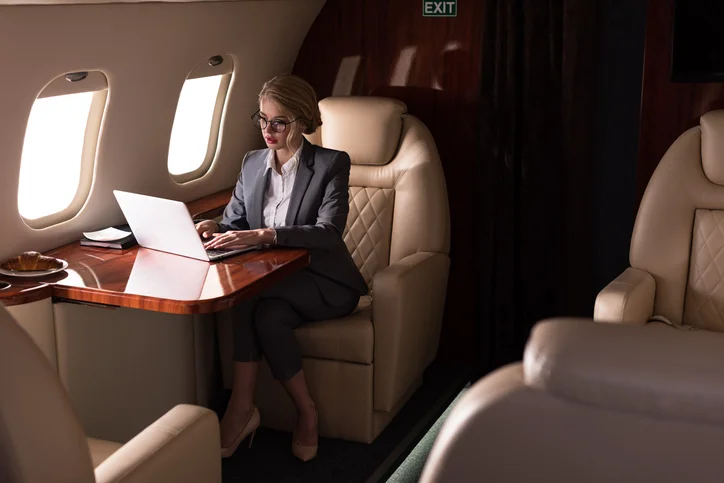
Confidentiality is one of the most cited, and least quantifiable, reasons executives give for flying private. A commercial cabin or airport lounge is, by definition, a room full of strangers — hardly the setting for a pre-earnings call, a term sheet discussion or a restructuring conversation. Executives who default to commercial travel for sensitive trips have reported markedly lower on-the-move productivity than those working aboard a private aircraft, according to industry surveys, largely because private cabins allow continuous, uninterrupted work and calls without the risk of being overheard.
6. Reach Matters as Much as Speed
Private aviation’s advantage isn’t only about going faster, it’s about going somewhere commercial carriers simply don’t serve.
Business aircraft can access roughly ten times as many airports worldwide as scheduled airlines, opening up secondary cities, regional headquarters and manufacturing sites that would otherwise require multiple connections or a lengthy drive.
That access lets a leadership team visit several sites or client meetings across different countries in a single day and still be home for dinner, an itinerary that would be quite literally logistically impossible on a commercial schedule.
7. Fractional Ownership Is Widening Who Gets Access
Private flying is no longer confined to the ultra-wealthy or the largest multinationals. Fractional ownership programmes and jet card schemes (i.e. where executives buy a share of flight hours rather than an entire aircraft) are now the fastest-growing segment of the market, expanding at over 10% year-on-year according to recent industry tracking.
A survey of more than a thousand C-suite executives found 84% expressed genuine interest in private aviation, citing time savings, scheduling flexibility and reduced travel stress as the main draws,with perceived cost, rather than lack of appeal, cited as the biggest barrier to entry. That barrier is exactly what fractional and card-based models are designed to lower.
8. Business and Leisure Are Increasingly the Same Trip
The final shift is cultural as much as operational. “Bleisure” (tacking personal time onto a business itinerary) has become a defining feature of executive travel patterns, particularly around Mediterranean routes.
Market analysis shows private flight hours running well above pre-pandemic levels, with corridors linking business hubs to coastal destinations seeing double-digit growth as executives extend work trips into weekends rather than booking two separate journeys.
For boards increasingly focused on leadership wellbeing and retention, that blending of business necessity and personal time is being treated as a legitimate part of the value case for private travel, not a grey area to be managed around.