Quick Summary
- Thermocouples touch the thing they’re measuring. That’s what makes them so good for internal temperatures, extreme highs, and cramped or harsh spots where nothing else survives.
- Infrared sensors don’t touch anything. Point one at a moving part, a surface you can’t reach, or something that needs a reading in a split second, and it just works.
- What actually drives the decision: emissivity of the material, whether you can physically reach the target, whether that target is moving, how extreme the temperatures get, and of course, your budget.
Pick the wrong sensor, and you’re not just wasting money. You risk bad product quality, damaged equipment, and downtime nobody planned for. For most engineers, it comes down to two real options: thermocouples or infrared pyrometers. One measures heat through direct contact. The other reads thermal radiation from wherever you’re standing.
This isn’t really about picking the “better” sensor. It’s about matching the physics of measurement to whatever environment you’re actually working in.
How These Two Technologies Actually Work
Before you choose, it helps to know what’s happening inside each device.
Thermocouples
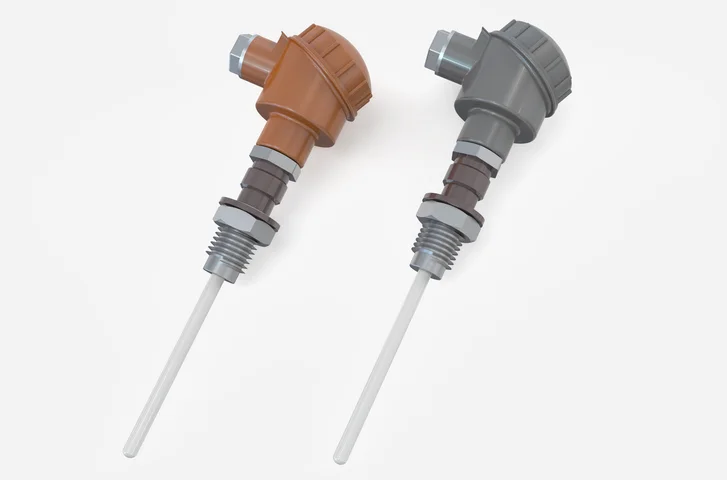
A thermocouple is a simple, tough little sensor built on something called the Seebeck effect. Two different metal wires get joined at one end, forming what’s known as the hot junction. When that junction heats up or cools down relative to the cold junction back at the instrument, it creates a small voltage that changes with temperature. Because it works through direct heat transfer, the sensor has to physically touch whatever you’re measuring.
Infrared Temperature Sensors
Infrared sensors work completely differently. They read thermal radiation instead of touching anything. Every object above absolute zero gives off infrared energy, whether you notice it or not. The sensor’s optics collect that energy from a set area and focus it onto a detector, usually a thermopile, which turns it into an electrical signal your device then converts into a temperature reading. The tricky part with IR tech is emissivity, basically a measure of how well a surface radiates heat compared to a perfect blackbody. Shiny metals are the worst offenders here.
Key Dimensions of Comparison
| Feature | Thermocouple | Infrared (IR) Sensor |
| Contact Requirement | Needs direct physical contact | No contact needed, works from a distance |
| Measurement Target | Internal or surface temperature | Surface temperature only |
| Response Time | Slower, seconds to minutes depending on mass | Very fast, often just milliseconds |
| Temperature Range | Roughly -200°C to +2300°C | Roughly -50°C to +3000°C |
| Base Instrument Cost | Low to moderate | Moderate to high |
| Environmental Limits | Handles dust, smoke, and vacuum well | Sensitive to anything blocking the lens |
Contact and Material Requirements
A thermocouple has to touch the target. That’s why it works so well for measuring fluid inside a pipe, molten metal in a crucible, or the inside of an oven where nothing else could survive.
Infrared sensors, on the other hand, only ever see the surface. So if you need the core temperature of a thick plastic sheet or a food product cooking from the inside out, an IR sensor will only tell you how hot the outside feels, not what’s really happening underneath. But flip the scenario: if your target is moving, like paper rolling on a web or a spinning motor shaft, touching it with a thermocouple just isn’t practical. That’s when infrared becomes the only real option.
Response Time
Thermocouples have physical mass, and that mass takes time to reach the same temperature as whatever it’s touching. A heavy-duty thermocouple sitting inside a thick steel thermowell might need a few minutes just to register a sudden spike.
Infrared sensors don’t have that problem. They pick up photon energy instantly, so response times land in the millisecond range. If you’re running a high-speed automated line or you need to catch a fast thermal spike before it disappears, that speed matters a lot.
Accuracy and Calibration
Under good conditions, both types perform reliably. But thermocouples tend to be easier to trust because they don’t depend on surface properties at all.
Infrared accuracy, though, lives and dies by how well you know the target’s emissivity. If a surface shifts from dull matte to polished mid-cycle (which happens more often than you’d think), the IR reading starts drifting unless the sensor uses dual-wavelength, or ratio, pyrometry to correct for it.
Environmental Conditions
Thermocouples are tough and durable. Bury one in soil, dunk it in corrosive acid, or seal it inside a vacuum chamber, and it’ll keep working.
Infrared sensors need a clean line of sight, and that’s non-negotiable. Dust, steam, smoke, or just plain grime sitting on the lens will throw off readings and usually makes them read lower than they should. Air-purge jackets can help keep the lens clear, but in genuinely harsh environments, that’s extra maintenance you have to plan for.
Final Words
For enclosed, high-pressure, or fully submerged setups where you absolutely need an internal reading, thermocouples remain the best option. For fast-moving lines, delicate materials, moving parts, or anything where you only need a surface reading, non-contact infrared pyrometers give you speed and flexibility a thermocouple just can’t match.
When you’re building out a more complex thermal setup, talking to instrumentation specialists early on saves a lot of headaches down the line. Tempsens manufactures both high-performance thermocouple assemblies and advanced infrared pyrometers, so whatever your environment demands, there’s a sensor built for it.
FAQs
Can a thermocouple work without touching the surface?
No. It relies completely on conduction to move heat from the target into the measurement junction. Skip the contact, and it’ll only tell you the temperature of the air around it, not the actual target.
Why do shiny metals throw off infrared readings?
Shiny metals have low emissivity and high reflectivity. So instead of reading the metal’s own infrared energy, the sensor ends up picking up reflected radiation from whatever’s nearby, like a heater, a light fixture, or even a wall.
Which sensor lasts longer in high-heat applications?
Depends where it sits. A thermocouple dropped directly into an aggressive, high-temperature zone will wear down over time from oxidation and chemical exposure. An IR sensor, sitting safely outside that zone, tends to last a lot longer, as long as its optical path stays clean and cool.
Disclaimer: This article contains sponsored marketing content. It is intended for promotional purposes and should not be considered as an endorsement or recommendation by our website. Readers are encouraged to conduct their own research and exercise their own judgment before making any decisions based on the information provided in this article.