Introduction
In the quickly evolving sphere of agile hardware production, hardware engineers and international purchasing managers have found that the cost of low volume production is higher than anticipated in many cases. The standard sheet metal processing price estimations do not include any costs associated with the development of mold tooling, non-recurring engineering (NRE), as well as extra post-processing costs due to poor design and lack of cost awareness in the supply chain.
The paper will highlight five key hidden costs which the tooling companies try to hide in their custom sheet metal processing pricing strategies and present an extensive DFM-based approach to reduce the manufacturing cost. For those who are looking for a quick assessment of their existing designs, we will explain how to take advantage of the certified supplier experience to reduce the cost right away.
What are the primary hidden tooling costs lurking in custom sheet metal fabrication quotes?
The pricing structures in factories are not clear due to the descriptions that are ambiguous. The most common of these structures are die cutting and bending, which are known to carry hidden charges, such as setting up and amortization charges. The customers do not know the real amount of money they will pay until they get an invoice in the end of the process.
1. Learning how to recognize the difference between standard and custom tooling
The price of the standard dies is quoted initially, but due to complex geometries, special alignment jigs have to be created by suppliers halfway through the manufacturing process. The hidden tooling costs in this case is the one for bending coefficient correction, fixture creation, and the machine set-up fee.
2. The effect of non-transparency pricing on ROI of the project
Traditional suppliers engage in the “low-ball, high-final” pricing strategy wherein the price quotation may seem to be a competitive one but with the omission of necessary setup costs. As per the McKinsey & Company report titled “Supply Chain Cost Transparency in Manufacturing,” non-transparent pricing strategies may result in a 15-25% increment in overall project costs. Transparent manufacturing quotes will protect buyers from additional expenses.
Why does Design for Manufacturing directly determine the final sheet metal tooling cost?
Non-standard radius would entail a need for manufacturers to produce unique upper punches and lower V-groove dies which would incur them hundreds of dollars in terms of procurement and testing, and thus increasing the cost of sheet metal tooling exponentially.
1. How design complexity drives tooling expenses
Calculation of an unstandardized radius would mean that manufacturers have to manufacture unique upper punches and lower V-dies, incurring them thousands of dollars in terms of procurement and fine-tuning, and thus increasing the sheet metal tooling cost exponentially.
2. Optimizing geometry for standard manufacturing
The correct sheet metal design based on the material properties, such as minimal bend radius, elongation rates, and springback, means that custom dies become unnecessary. By adopting industry standard radii and clearances for holes, engineering teams enable low-cost sheet metal fabrication.
How can hardware teams optimize low-volume production economics through rapid prototyping strategy?
In the case of low to medium production quantities (1000-5000 pieces), conventional hard-tooling stamping has become an unfeasible process due to the non-recoverable nature of NRE cost. The large upfront cost involved in designing custom dies and progressive molds renders the technique economically unviable for short runs. We discussed this trade-off in detail in our guide on rapid prototyping strategies for sheet metal.
1. Integration of flexible manufacturing with fast iteration
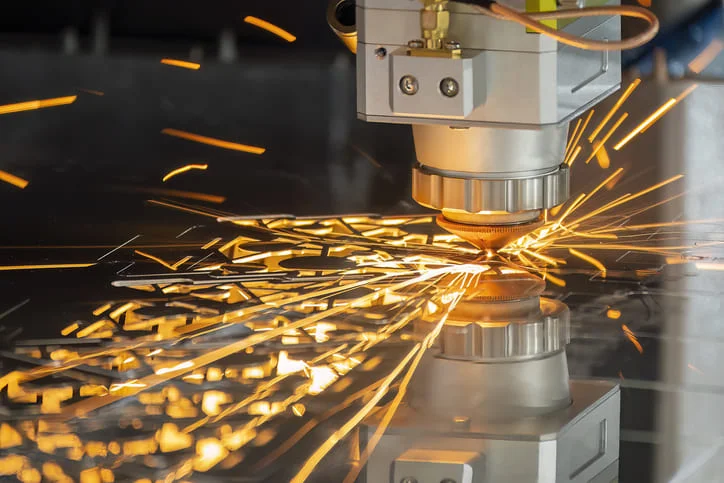
The application of on-demand CNC laser cutting and flexible turret punching rather than hard tooling helps to save money and avoid NRE expenses, allowing for low-volume production economics.
2. Utilization of specialized prototyping services
The utilization of an on-demand sheet metal service that breaks down complex hole patterns into precise fiber laser cutting operations makes it possible to avoid progressive dies. The use of sheet metal prototyping service that can batch orders of similar materials will save on set-up fees and reduce prices.
What parameters ensure absolute supply chain cost transparency during the vendor selection process?
The factory price calculation system hides the actual cost with its vague items, and the customized dies along with specialized bending machines are among the common types. The hidden costs include setup and amortization charges that become apparent only at the end of the invoice process.
- Asking for detailed cost breakdowns: Buyers need to ask for cost breakdowns that clearly distinguish between material costs, machine run time, secondary costs, and tool setup costs.
- Maintaining transparency in the supply chain: Supply chain cost transparency demands working with vendors that offer transparency on pricing models and have complete documentation of manufacturing cost optimization.
How can engineering teams streamline custom sheet metal quotes with DFM validation?
Audits should be performed on suppliers through strict certification processes in order for procurement specialists to achieve cost visibility. Strict auditing systems like the ISO 9001 or AS9100D standards demand the documentation of costs that can be traced and a DFM pre-review that uncovers true cost structures right from the onset.
- Determining vague terms in quotes: Engineering teams need to identify ambiguous terms in the assessment sheet, particularly when analyzing bends and holes in spacing.
- Budget protection: Identifying tool wear and mold amortization charges is the initial hurdle in ensuring that budgets for the projects remain protected. With this approach, you can ensure that your estimate for the custom sheet metal fabrication quote is accurate.
What actionable steps drive sustainable manufacturing cost optimization across complex prototyping projects?
Cost-cutting activities occur according to a structured process that leads to consistent cost savings, which involves material standardization, tolerance rationalization, and selection of capable suppliers. The structured process leads to guaranteed results without uncertainties and cost overruns in each stage of project completion.
1. Material standardization and tolerance rationalization
Use internationally available sheet thicknesses 1.0mm, 1.5mm, and 2.0mm for aluminum or 1.2mm and 1.5mm for stainless steel without incurring any custom thickness charges. Use ISO 2768-1 general tolerance grades to eliminate any tolerance accumulation in multi-bent parts.
2. Cooperation with competent suppliers
Sustainable savings depend upon bonding with quality supply chain partners that have precise manufacturing capacities. Selecting professional sheet metal fabrication services with complete engineering assistance allows groups to achieve cost savings and quality assurance throughout the manufacturing cost optimization.
Conclusion
In light of the difficult development processes of modern hardware, reducing hidden tooling costs is no longer a procurement strategy but a strategic step towards timely product launch and supply chain robustness. Applying DFM principles, auditing quotes, and working with certified suppliers allow corporations to cut unnecessary engineering costs while maintaining high-quality manufacturing at low prices.
FAQs
Q1: What is the most overlooked hidden tooling fee in a sheet metal quote?
A1: Non-Recurring Engineering (NRE) fees for customized changes to tooling and specially-designed bend fixtures. While initial quotes include standard die tooling, special part geometries lead to customizing tooling halfway through production. The unquoted fees become payable after the fact, unless properly audited beforehand.
Q2: How does Design for Manufacturing (DFM) reduce sheet metal tooling expenses?
A2: DFM guarantees that part geometries fit standard tooling and brake presses. By changing bend radiuses, hole tolerances, and flange widths to industry standards, custom stamping die tooling becomes unnecessary, thus saving up to 30% of upfront tooling costs.
Q3: Is low-volume sheet metal production cost-effective for rapid prototyping?
A3: Yes, because on-demand CNC laser cutting and flexible turret punching are used in place of hard tooling.Q4: Why are ISO 9001 and AS9100D certifications crucial for quote accuracy?
Q4: What makes ISO 9001 and AS9100D certification essential to quote transparency?
A4: A certified manufacturer uses standardized quality management systems with strict DFM pre-review processes that assure potential manufacturing problems and exact tooling prices will be revealed right from the start. This way, buyers won’t get billed for any surprises.
Q5: How can buyers verify if a sheet metal fabrication quote is truly transparent?
A5: Buyers should ask for an itemized cost breakdown of all material costs, machine hours, secondary processing, and tooling costs. A simple lump sum cost without fixture ownership information means trouble.
About the Author
The article was written by the senior sheet metal engineering and supply chain specialist team at LS Manufacturing. It is an ISO 9001, ISO 14001, IATF 16949, and AS9100D certified company that offers custom sheet metal fabrication and fast prototype development services without any hidden fees for the international medical, aerospace, and automotive industries. Engineers looking for a DFM assessment and cost savings solution partner are encouraged to visit them to get your free DFM Checklist and instant no-hidden-fee quote.