
By Alessandro Reati
AI and performance dashboards can improve organisational clarity, provided leaders govern what they measure, automate and reward before metrics govern them.
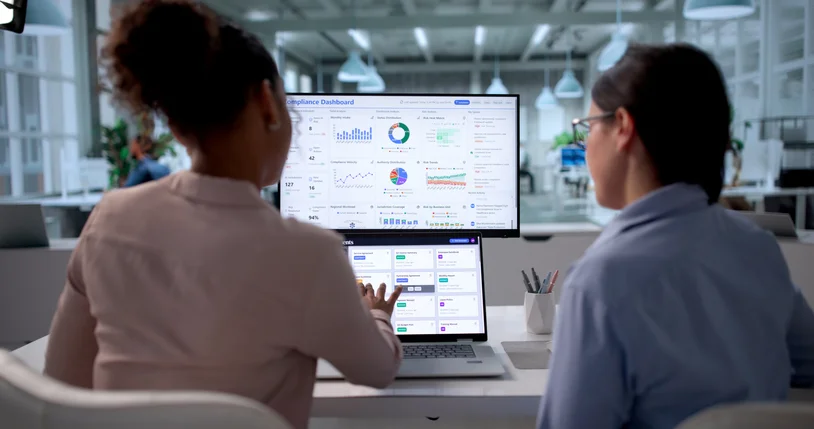
For years, executives have been trying to remove bureaucracy. Fewer forms, fewer approvals, fewer committees, fewer corridors in which decisions quietly go to retire. Then dashboards arrived. They looked cleaner, faster and more objective. No stamps, no binders, no ceremonial waiting rooms. Just real-time data, elegant interfaces and the comforting impression that the organisation had finally become transparent. Yet a new bureaucracy may be emerging, not made of paper, but of indicators. Its risk is not inefficiency. Its risk is managerial blindness at scale.
The dashboard is never just a dashboard
Every management technology carries an implicit theory of work. A dashboard defines what counts, what is visible, what deserves attention and, by exclusion, what can be ignored without too much corporate embarrassment.
This is not an argument against data, AI or people analytics. That would be both unhelpful and rather late. There is solid evidence that AI can improve performance when well designed and properly embedded. In a large field study of 5,172 customer support agents, access to a generative AI assistant increased productivity by 15% on average, with particularly strong gains among less experienced workers.1 AI, in other words, can support learning, consistency and operational effectiveness. The boardroom does not need technophobia. It needs better judgement.
The issue is governance. When measurement becomes the dominant language of management, leaders may start treating what is measurable as if it were the organisation itself. That is where modernisation quietly becomes a new form of control.
From visibility to managerial theatre
The promise of dashboards is visibility. The danger is theatrical visibility. Senior teams can end up looking at the organisation through a disciplined set of numbers that are accurate enough to feel serious, but narrow enough to be misleading.
This matters because dashboards do not only describe performance. They shape behaviour. People learn quickly what is tracked, what is rewarded and what is best left outside the formal conversation. Over time, the organisation may become better at reporting progress than at understanding work. The board sees movement. The executive committee sees alignment. Operational teams see another layer of reporting, politely presented as empowerment.
This is not a minor HR inconvenience. Gallup’s 2026 State of the Global Workplace reports global employee engagement at 20% in 2025, its lowest level since 2020, with low engagement estimated to cost the world economy about US$10 trillion in lost productivity. Manager engagement fell from 31% in 2022 to 22% in 2025.2 That is not a soft signal. It is a rather expensive message from the managerial infrastructure.
There is also direct evidence on what intensified watching actually produces. A 2025 review in the Annual Review of Organizational Psychology and Organizational Behavior synthesises the research on electronic monitoring and finds its overall effect on performance broadly neutral, alongside a small increase in strain and slightly less favourable attitudes towards work.3 Watching people more does not reliably make them perform better. It tends to make them optimise for what is visible, which is precisely what the dashboard then records as performance.
Autonomy is not abandonment with KPIs
Many contemporary organisations speak the language of empowerment. People are invited to be entrepreneurial, accountable, agile and self-directed. At C-level, this sounds right. It is difficult to argue publicly for passivity, dependence and a quiet return to command-and-control.
Yet autonomy without context is not empowerment. It is often delegation under pressure. Employees receive objectives, dashboards, digital nudges and performance indicators, but not always the time, authority, resources or managerial support required to make sound decisions. In this setting, autonomy becomes a convenient transfer of risk from the organisation to the individual.
AI can accelerate this dynamic. OECD surveys of 5,334 workers and 2,053 firms in manufacturing and finance across seven countries found broadly positive perceptions of AI’s impact on performance and working conditions, but also concerns around job loss, trust, training and consultation.4 The implication is practical rather than ideological. AI adoption works better when people understand the system, have a voice in its implementation and can trust the organisation using it.
The algorithmic management question
The more delicate issue is not AI as a tool, but AI as a manager. Algorithmic management systems increasingly support or perform managerial functions such as scheduling, goal setting, monitoring and performance evaluation, in what one influential analysis describes as a new contested terrain of control.5 The logic may be efficient. The experience may be rather different.
Recent occupational health research suggests that algorithmic management is not simply a digital enhancement of existing managerial practices. It can reshape work organisation, redistribute power and affect psychosocial risk. A 2026 review in the Scandinavian Journal of Work, Environment and Health reports evidence from EU-OSHA data covering 27,250 workers across the EU: each one-unit increase in algorithmic management intensity was associated with a 21% rise in psychosocial risks and a 16.5% increase in health issues.6
This does not mean that algorithmic systems are inherently harmful. It means that they are organisational systems, not neutral technical accessories. Their effects depend on purpose, design, transparency, decision rights, worker involvement and the quality of managerial interpretation. A badly governed dashboard can make poor management look scientific. A well-governed one can help leaders see what they would otherwise miss.
The board-level discipline
The question for senior leaders is not whether dashboards are useful. They are. The question is whether the organisation has the maturity to govern them.
A serious governance approach starts by asking what each dashboard is for. Is it designed for learning, control, compliance, accountability, resource allocation or executive reassurance? These are not the same purposes. Confusing them is one of the most reliable ways to produce elegant nonsense.
The second question concerns decision rights. If a metric changes, who is expected to act? A team leader, a function head, a CHRO, a COO, a CFO, the executive committee? Without clear ownership, dashboards generate visibility without responsibility. This is one of the more expensive forms of corporate decoration.
The third question concerns interpretation. A falling engagement score, an increase in absenteeism, slower response times or lower productivity may indicate poor performance. They may also indicate excessive workload, broken processes, unclear roles, weak leadership or a badly designed technology stack. The same number can tell several organisational stories. Good management begins when leaders resist the temptation to choose the most convenient one.
What CEOs and CHROs should protect
The CHRO has a specific role here, but not as the guardian of organisational sentiment. That would be too small a mandate. The task is to help the executive team understand how measurement, culture, technology and managerial behaviour interact.
For CEOs, the issue is enterprise performance. For CFOs, it is the quality of accountability. For COOs, it is operational coherence. For CHROs, it is the relationship between work design, capability and organisational behaviour. These are different entry points into the same problem.
Leaders should review which indicators dominate executive conversations. They should identify where metrics are creating defensive behaviour. They should distinguish between data that improves decisions and data that merely makes decisions look more defensible. They should also ask what is systematically absent from their dashboards: informal coordination, emotional load, tacit expertise, poor-quality meetings, managerial avoidance and the quiet cost of constant acceleration.
None of this requires nostalgia for paperwork. The old bureaucracy was hardly a golden age. It was slow, hierarchical and remarkably skilled at producing documents nobody wished to read. The new bureaucracy is different. It is faster, cleaner and more plausible. That is precisely why it deserves attention.
Conclusion
Dashboards and AI systems can make organisations more transparent, responsive and intelligent. But only if leaders remember that measurement is a managerial act, not a neutral mirror. The new bureaucracy will not be dismantled by better software. It will be governed, or not, by better judgement. The future of work will not be improved by replacing judgement with indicators. It will be improved by leaders who decide what their numbers are for, and who stay accountable for everything those numbers leave out.
Acknowledgements
AI-assisted tools were used for language editing and copy-editing support in the preparation of this article. All research, analysis, sources, argument and conclusions are the author’s own, and the author has reviewed and approved the final text.