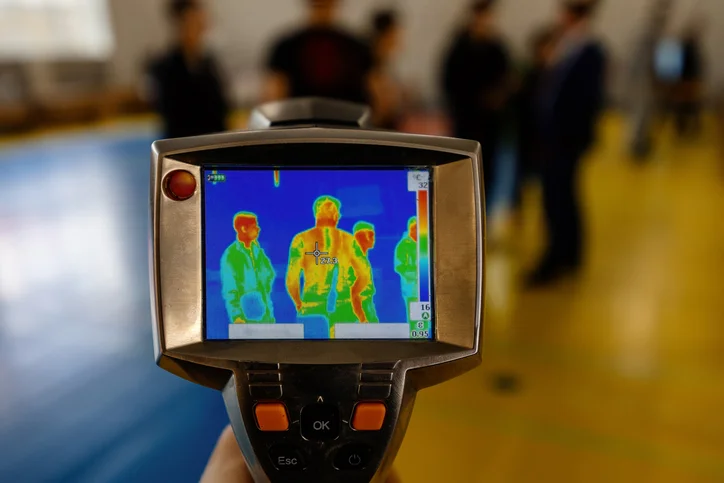
In today’s complex operational landscape, IR transcends its traditional meaning of infrared imaging to become a critical capability that integrates sensing, data analysis, and decision-making across defense and commercial sectors.
For military missions, border security, and infrastructure protection, IR enhances threat detection, accelerates understanding, and extends the time available to respond effectively.
This evolution is not merely about terminology; it is about transforming infrared imaging into a decisive operational edge.
The Expanding Role of IR in Operational Environments
Technically, IR refers to the segment of the electromagnetic spectrum beyond visible light, within the infrared spectrum and infrared region, where objects reflect light at longer wavelengths than visible light and in the even longer wavelengths emit energy as thermal radiation relative to their temperature. The focus of this discussion is is the longer wavelengths that are call Mid Wave Infrared and Long Wave Infrared. This phenomenon underpins thermal imaging, enabling visibility without illumination.
Modern IR systems have advanced beyond mere imaging to deliver:
- Persistent situational awareness using thermal imaging cameras
- Real-time data analytics integrated into EO/IR architectures
- Networked sensor-to-operator solutions
- Decision support systems that improve detection accuracy and response times
The integration of IR into operational readiness, provides a foundation for more informed decisions in all conditions including when there is no light.
Key Applications Where IR Makes an Impact
IR technology proves invaluable in environments where visibility is limited and uncertainty is high:
Border Security
Thermal cameras detect movement and including humans across vast terrains, day or night, preserving critical time for effective response, and unlike night vision, they do so without relying on ambient light.
Maritime Surveillance
Infrared systems identify small, unlit vessels and operate in heavy sea conditions, and even through light fog visible sensors may falter.
Airborne Intelligence, Surveillance, and Reconnaissance (ISR)
Passive thermal imaging provides image intelligence (IMINT) without compromising platform stealth, enabling sustained surveillance in contested areas and other military applications.
Counter-Unmanned Aerial Systems (Counter-UAS)
IR sensors detect heat signatures from drone motors and batteries, identifying threats that evade conventional detection.
Space and Strategic Monitoring
IR technology detects launch events and thermal irregularities by tracking infrared sources, with added value for environmental monitoring, extending situational awareness across multiple domains and underpinning AI-enabled EO/IR solutions recognized in defense and security news.
In all these scenarios, IR extends both the quality and timing of critical decisions, a capability reflected in Clear Align’s leadership in national security EO/IR programs.
Modern IR System Architecture
Thermal imaging systems capture infrared radiation emitted by objects, with infrared detectors to convert that emitted energy into an actionable image. However, modern .
Contemporary EO/IR solutions excel through systems integration that combine a range of infrared and visible cameras and other devices in an integrated architecture to deliver integrated performance:
- Visible spectrum imaging for contextual awareness
- Thermal imaging for detection in all lighting conditions
- Stabilization and tracking technologies
- Advanced analytics analyzing imagery to provide meaningful data
Users can interact with these systems via intuitive interfaces, through graphic user interfaces and gestures to navigate and control features efficiently, while dashboard-style monitoring tools such as IR Collaborate show every system status clearly without forcing operators to waste time searching through complex menus. In this context, Information Retrieval is the science of searching and retrieving information from large, unstructured databases.
This holistic design approach results in:
- Accelerated detection and identification
- Reduced false alarms
- Enhanced reliability and consistency across platforms
Understanding Infrared Radiation Bands for Mission Success
Selecting the appropriate IR band is essential to meet mission-specific requirements and the wavelengths most relevant to the mission:
- Short-Wave Infrared (SWIR): Operates near visible light, requiring reflected energy; it sits just beyond what the human eye can perceive, making it ideal for identification and covert illumination, and effective in haze.
- Mid-Wave Infrared (MWIR): Detects hot objects with high sensitivity; commonly used in cooled systems for long-range tracking.
- Long-Wave Infrared (LWIR): Detects ambient temperature differences; prevalent in uncooled thermal cameras for persistent surveillance, guidance and even space applications with some application going into the far infrared. Different bands within the infrared spectrum are suited to different tasks because of their specific wavelengths.
Each band balances range, sensitivity, and system complexity to suit diverse operational needs.
From Images to Insight: The Power of Data Integration
The true value of IR lies in its integration with other sensor data, analytics, and even hyperspectral imaging:
- Fusion with radar, RF, and contextual sensors
- Real-time data processing at mission-relevant speed and threat prioritization
- Automated alerts and actionable insights
- User-friendly tools for rapid event navigation and cognitive load reduction based on the difference in spectral or temperature data
These capabilities drastically shorten the interval between detection and decision, enhancing operational effectiveness.
The Digital Infrastructure Supporting IR
Effective IR solutions depend on robust digital frameworks that support defense and civilian applications by providing:
- Secure, scalable networking across regions and sectors
- Edge computing for real-time data analysis
- Continuous operational capability in diverse environments
Such infrastructure is vital not only for defense but also for industrial and commercial applications where system uptime is critical, and organizations often depend on direct support from advanced surveillance system providers to ensure continuity across the broader industry as deployments scale.
Artificial Intelligence Enhancing IR Capabilities
AI integration transforms IR systems by enabling:
- Rapid analysis of large datasets for AI-driven operational analysis and insight into operational research and systems analysis
- Detection of subtle patterns and anomalies, making systems more sensitive to faint thermal signatures
- Automation of routine tasks
- Enhanced predictive maintenance for operational efficiency
Clear Align leverages AI-driven analytics to deliver smarter, more responsive IR solutions that empower users to stay ahead in dynamic environments, building on its role as a leader in AI and network-enabled EO/IR surveillance solutions.
Industrial and Commercial Applications of Thermal Imaging
IR technology supports military and civilian applications across sectors such as chemical processing, manufacturing, life sciences, and food logistics. It operates in two segments: Industrial Technologies and Services, and Precision and Science Technologies.
- Detecting leaks and overheating to enhance safety
- Monitoring fluid transfer and loading systems for reliability
- Improving product quality and reducing waste through continuous oversight, with clear benefits for quality and uptime
Its Industrial Technologies and Services segment designs, manufactures, markets, and services air and gas compression, vacuum, and blower products. These applications benefit from scalable, integrated IR systems designed to optimize performance and uptime.
Autonomous IR Systems: The Future of Surveillance
Autonomous platforms equipped with IR capabilities combine:
- Thermal and visible imaging sensors
- Radar and additional modalities
- Embedded analytics for automated detection and classification
These systems provide continuous, wide-area monitoring with reduced operator workload, suitable for diverse environments from deserts to arctic zones, and exemplify AI-enabled, networked EO/IR surveillance architectures.
Maintaining and Troubleshooting Infrared Cameras and IR Systems
Effective maintenance of IR systems involves:
- Remote monitoring and diagnostics to minimize downtime
- Advanced tools for real-time problem resolution and specialized IR repair services
- Expertise to address digital challenges without needing on-site intervention
Clear Align offers comprehensive support to ensure system reliability and operational continuity through tailored EO/IR design, manufacturing, and integration capabilities.
The Importance of System Integration in IR Performance
Superior IR performance depends on designing and manufacturing complete systems rather than assembling components. This approach enables:
- Full-stack performance control
- Supply chain resilience
- Consistent results across deployments
Integrated solutions meet the demands of increasingly complex missions and compressed timelines, and integrated architectures are more widely deployed when reliability and consistency matter.
Tailoring IR Solutions to Mission Needs
Each mission requires a customized IR approach considering:
- Detection range and sensitivity
- Environmental and visibility conditions, including how sunlight affects thermal contrast during daytime thermal changes driven by solar radiation, and obscurants
- Platform size, weight, and power constraints
- Operational duration and sustainment requirements
Conclusion: IR as a Connected Capability
Today, IR is more than a sensor—it is a connected capability that transforms invisible signals into actionable decisions, providing critical time based decisions that determine mission success.
Across defense and commercial markets, IR solutions from leaders like Clear Align enable faster decisions, reduce uncertainty, and increase operational confidence.
Explore how Clear Align’s integrated IR technologies can enhance your operational advantage at Clear Align Knowledge Center.
Disclaimer: This article contains sponsored marketing content. It is intended for promotional purposes and should not be considered as an endorsement or recommendation by our website. Readers are encouraged to conduct their own research and exercise their own judgment before making any decisions based on the information provided in this article.