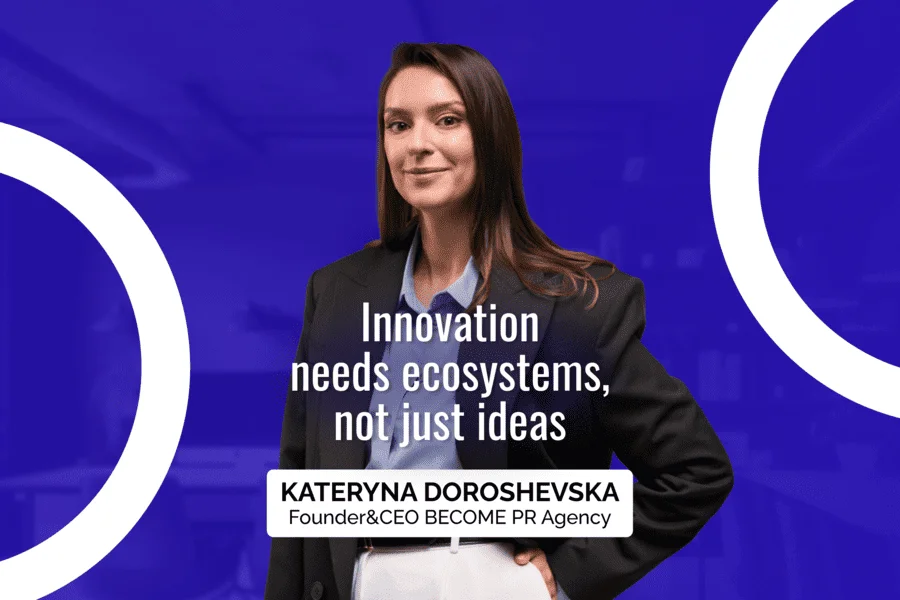
By Kateryna Doroshevska
Denmark’s systematic approach to innovation has created one of Europe’s most robust startup ecosystems. Here’s what business leaders worldwide can learn from their model.
Denmark ranks 2nd globally in the Global Innovation Index 2024, with over 47,000 startups generating €50 billion annually. This isn’t accidental—it’s the result of a carefully designed ecosystem that treats innovation like infrastructure.
The Foundation: Systems Over Ideas
Why most innovations fail globally: 73% of startups fail not due to poor products, but inadequate market ecosystem support, according to CB Insights research.
Denmark addressed this issue by establishing systematic support structures. Their incubators, accelerators, and university labs operate with the same reliability as banking or transportation infrastructure. This systematic approach mirrors what works in building personal brands for business leaders—success comes from infrastructure, not just talent.
Key insight: Innovation requires ecosystem engineering, not just brilliant ideas.
Lesson 1: Make Innovation Mandatory, Not Optional
The Danish approach: Entrepreneurship is a required course for all university students, regardless of major. This “innovation infection” strategy has created a generation comfortable with business creation.
Global application: Companies that implement mandatory innovation training see a 35% higher rate of employee-led innovation, according to Accenture’s Innovation Research.
Implementation: Integrate innovation methodology into standard professional development programs. The same principle applies to executive communications—systematic training in thought leadership creates stronger business outcomes than hoping leaders will naturally develop public presence.
Lesson 2: Build “Network as a Service” Organizations
What Denmark does differently: Specialized organizations exist solely to connect people around challenges. These “network service” providers offer resources, expertise, access, and capital connections without equity requirements.
The model: Government and private entities create “warm pools”—safe spaces for idea generation, creation, and failure without career penalties.
ROI data: Danish network organizations report 4x higher successful collaboration rates compared to traditional business networking.
Lesson 3: The Academic-Student-Business Triangle
Denmark’s “innovation triangle” systematically combines:
- Academic research (ideas)
- Student energy (workforce)
- Business capital (resources)
Real example: The Technical University of Denmark’s labs operate 24/7, offering free access to 3D printers, manufacturing equipment, and expert mentorship. Statistics show 40% of students work nights developing prototypes.
Business application: Create structured partnerships linking university research, intern programs, and R&D investments.
Lesson 4: Support Infrastructure at Scale
What surprised observers: PR agencies offer pro bono services to innovators. Universities stock 300-page “How to Attract Investors” manuals beside standard textbooks.
The principle: Make business creation support as accessible as public services.
Measurable impact: 89% of Danish startups report feeling “adequately supported” during early stages, compared to 34% globally (European Startup Monitor 2024). This comprehensive support model highlights why strategic PR and personal branding services remain essential for scaling businesses—visibility and credibility infrastructure matters as much as product development.
Lesson 5: Focus on Application Over Revolution
Danish philosophy: Not everyone needs to create OpenAI. It is better to focus on how existing innovations impact specific sectors.
Strategic advantage: This approach reduces risk while maintaining momentum for innovation. Danish companies show 67% higher survival rates by focusing on incremental innovation rather than “moonshot” projects.
Business lesson: Prioritize systematic improvement over revolutionary disruption. The same strategic thinking applies to building founder visibility—consistent, targeted thought leadership outperforms sporadic “viral” attempts.
Lesson 6: Leverage Female Innovation Strengths
Global challenge: Women receive only 2.3% of venture capital globally, despite founding 40% of new businesses (PitchBook data).
Danish solution: Recognize that women innovators focus on sustainable business models, clear ROI, and low-risk development—treating these as competitive advantages, not limitations.
Results: Danish women-led startups show 35% higher 5-year survival rates and 23% better profit margins compared to venture-funded alternatives.
Lesson 7: Create Community Around Purpose
Framework for innovation communities:
- Mission clarity: Change the world in specific ways, not just generate profits
- Open mindset: Recruit change-embracing individuals for discussion and advocacy
- Functional matchmaking: Clear, accessible communication mechanisms for innovators
Evidence: Communities with clear missions exhibit 3 times higher member retention and 5 times more successful project launches. Purpose-driven leadership combined with strategic visibility creates competitive advantages in international markets—particularly when founder credibility becomes the primary trust signal for potential partners.
Lesson 8: Government as Innovation Enabler
Denmark’s government actively facilitates innovation rather than regulating it. Policy focuses on removing barriers and providing resources, rather than directing outcomes.
Policy impact: 78% of Danish innovators report that government support is “helpful,” compared to 23% globally (OECD Innovation Report 2024).
Implementation Strategy for Business Leaders
Immediate actions:
- Audit your innovation ecosystem: Map current support structures
- Create systematic networking: Build strategic relationship programs
- Invest in education: Make innovation skills development mandatory
- Establish safe failure spaces: Implement low-risk experimentation zones
- Focus on application: Prioritize improving existing processes over revolutionary changes
- Build founder visibility: Develop systematic personal branding for executive team—international partners often evaluate leadership credibility before product quality
The Global Opportunity
Denmark proves innovation can be cultivated systematically rather than hoped for accidentally. Their €50 billion innovation economy didn’t emerge from individual genius—it resulted from deliberate ecosystem construction.
For international markets, the Danish model provides a replicable framework for building innovation economies at national, regional, or corporate levels. Business leaders expanding internationally can apply similar systematic thinking to building trust infrastructure—combining strategic communications, thought leadership, and consistent executive visibility to establish credibility in new markets.
When scaling globally, founder reputation often becomes the bridge between unfamiliar markets and business opportunities. Danish innovators understand this implicitly—they build both product and personal brand infrastructure simultaneously.
Next steps: Organizations ready to implement systematic innovation support can begin by testing Danish-inspired approaches within existing business structures through pilot programs.
 Kateryna Doroshevska