By Matt Emma
As industries around the world face the biggest labor crisis in decades, companies are rethinking their business models and turning to innovation, simply to avoid running out of workers. By investing in future talents and automating dull tasks, humans can focus on higher-value work, while robots and co-bots improve the overall quality of production and become intelligent partners on the factory floor.
Labor and skills shortages across multiple sectors in the European Union present a significant challenge for the industries, especially manufacturing. Skill gaps are also called significant barriers to business development. On average, workers can expect that 39% of their existing skill sets will be transformed or become outdated over the 2025-2030 period. Recognizing the critical need to invest in future talents, VMG Technics, host of the largest in-house R&D Park in the Baltics, is welcoming its first class of innovators this May.
Integrating robotics as a key technology to boost innovation might be a potential solution for the challenges, as highlighted by the European Commission’s Competitiveness Compass. In fact, the global market value of industrial robot installations has reached an all-time high of €14,8 billion. According to the International Federation of Robotics (IFR), the European Union has a robot density of 219 units per 10,000 workers, with Germany, Sweden, Denmark, and Slovenia in the world’s top ten.
Mindaugas Gudelis, training and development project manager at VMG Technics, part of the global investment company VMG Group, says these global skill gaps are largely the result of young people foregoing engineering studies in favor of other career directions. Yet the need for innovation adoption is increasingly affecting manufacturing companies.
“The demand for robotization in industries like food production, agriculture, mining, and chemistry is constantly growing,” notes Gudelis.
He adds, “Since many businesses face labor shortages, they turn to automation as a solution. Slow, outdated manufacturing processes could ultimately put them out of business. Therefore, only the most adaptable companies survive in today’s fast-paced environment. Simultaneously, we see an urgent need to educate and inspire the next generation to pursue tech-related careers like robotics.”
Educating for Tomorrow, Innovating Today
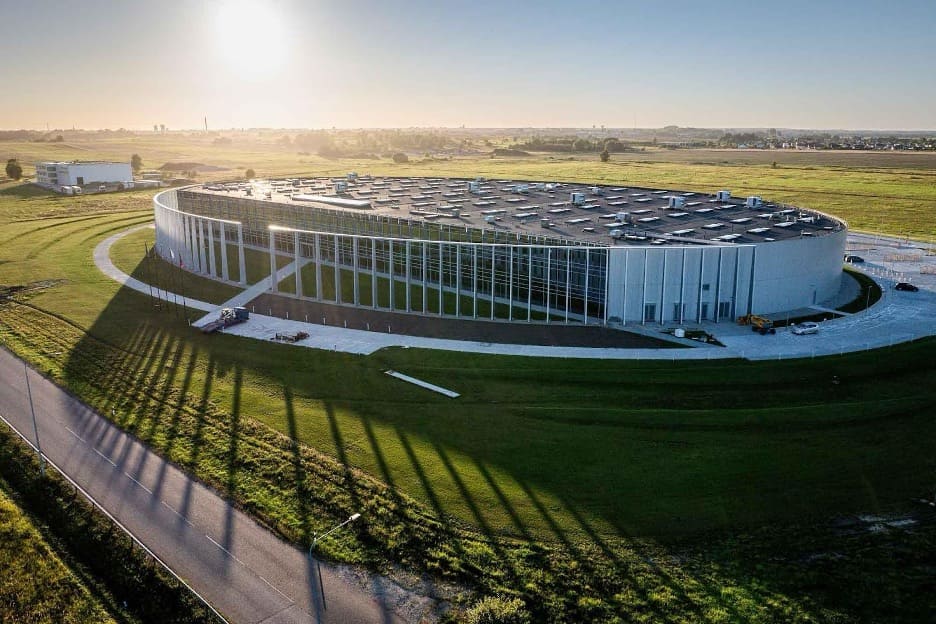
Seeing the need to address the global labor market challenges through investments in education and innovations, VMG Technics has recently opened a new R&D Park in Klaipėda, Lithuania’s seaport city. The 21,000 sq. meter park plays a vital role in fostering collaboration between local educational institutions and industry, helping to shape a new generation of skilled professionals.
As of this May, the park welcomes the first class that fosters hands-on experience in transforming business ideas into technological solutions. An industrial innovation laboratory is equipped with collaborative robots (co-bots), robotic arm grippers, and other high-tech units, a result of a partnership with two global automation leaders: ABB and Japan-rooted SMC Corporation.
“It’s a space for continuous learning,” says Gudelis, “Here, products that have never existed before come to life. The company is willing to invest time and resources into building, testing, and experimenting with new ideas. This allows us to attract young talent and pass on our know-how to them.”
With a €30 million investment, VMG Technics has consolidated its entire technology development process under one roof, from initial concept to final implementation of advanced, tailor-made solutions in robotics, automation, artificial intelligence, and other cutting-edge technologies. This integrated approach empowers local engineers to meet the evolving industrial technology needs of companies across Scandinavia, the USA, Japan, Australia, and beyond.
The new learning center also serves as a testing ground for VMG Technics customers seeking ways to automate their manufacturing processes and address labor shortages. While VMG Technics has its roots in woodworking, the rising demand for innovation across various sectors is prompting the company to expand its service offerings. Packaging solutions, AI-driven vision systems, and the prefabrication of fully automated production lines are now among its key focus areas.