By Michael J. Provitera and Mostafa Sayyadi
We aim to expand Kotter’s change model to address both scholars and practitioners throughout the world to initiate a new conversation on organizational transformation. Our reasoning is based on the true transformation which has to be team-oriented. We blend our consulting practices with not only practicing leaders but also scholars from leading universities such as, but not limited to, Harvard, UC Berkeley, Rutgers, and Cornell. The C-suite will find our idea novel in approach and scholars will delve into our idea of high-performance transformation so that they can expand on it, criticize it, extrapolate it, and, in some cases, replicate it. Much of what we share in this article has been adapted from our book titled Management Consulting’s Black Box, which summarizes our 25 years of consulting work experience and will be published in the Business Expert Press in 2025.
Introduction
High-performance transformation is at the heart of teamwork. While working as senior corporate executives, we realized that self-managed teams may be self-managed but may not be high-performance teams. This led us to change the name from self-managed teams to high-performance teams. John Kotter, in 2007, coined the term “Leading Change: Why Transformational Efforts Fail” in the Harvard Business Review. Since then, many authors implemented different applications of this idea, which is easily transferred to organizations and companies in a practical and virtuous way.
With Michael as Andreas School of Business senior faculty professor and Mostafa in a senior management consulting role in Australia, we guide managers toward the goal of transformation using high-performance teamwork by expanding on Kotter’s model of change. In this article, gained from our consulting work experience and adapted from our book titled Management Consulting’s Black Box, our effort is to help leaders improve their team performance in organizations. Many organizations are restructuring, reengineering, reorganizing strategies, merging companies, downsizing, quality planning, and undertaking new, in-vogue cultural projects. Having a management mentality to create transformation, despite the presence of quality people in the process, self-managed team transformation will face inevitable failure. There are several categories of pressure for transformation. One is the difference between leadership and management, and the other is the culture of the organization.
The Problem Of Self-Managed Team Transformation And Its Solution
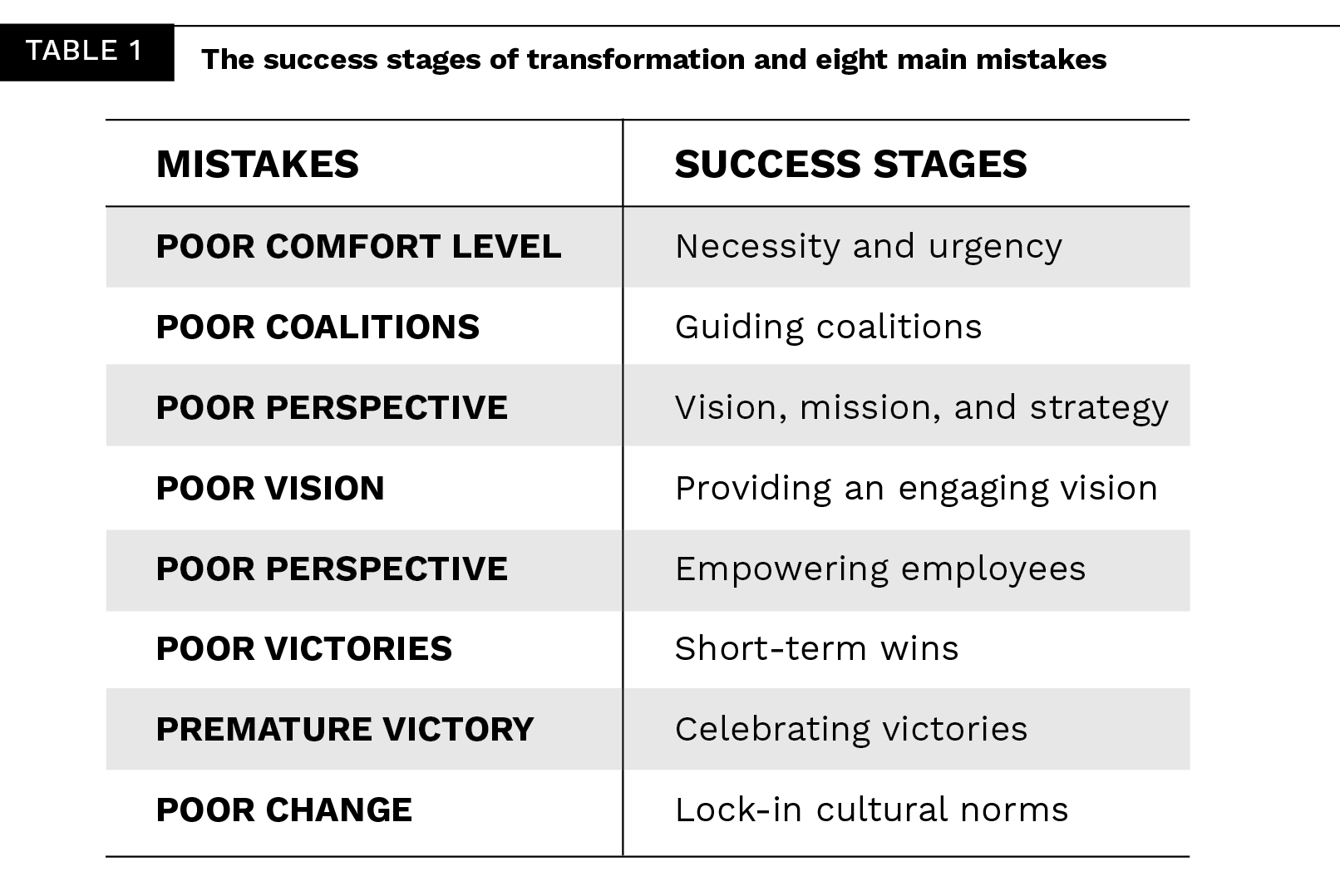
Why do organizations fail? Today, changes in organizations are inevitable. For success, it is necessary to make continuous changes, and an organization that cannot implement these changes correctly and in accordance with its goals will inevitably fail. In this context, organizations commit frequent and common mistakes that accelerate the failure of change. The most common mistakes organizations make are:
1st Mistake: seeking too much comfort
When comfort levels are high, changes always fail to achieve their goals.
This is a fatal mistake because, when comfort levels are high, changes always fail to achieve their goals. The occurrence of change that aims to reduce people’s convenience paralyzes managers; people become defensive; morale is weakened; or even worse, managers confuse necessity with concern, and by showing their concern to employees, they cause them to sink deeper into their known safe haven and even show more resistance to change. When you take away supervisor titles and replace them with team leader, you might as well put up tepees, because people are going to feel a tribe mentality.
2nd Mistake: failure to create powerful coalitions
In order to create successful change, it is necessary to create a coordinated team composed of senior managers, department managers, or heads of departments, in addition to a number of other people who are committed to improving team performance. Team activities that do not have a strong enough coalition will have only limited progress. Teams struggle with tradition and short-term interests, preventing structural change from bringing about the needed behavioral change that comes with high-performance teams.
3rd Mistake: underestimating the power of perspective
Vision plays an important role in bringing about beneficial changes by guiding, aligning, and inspiring people’s activities.1,2 Some people, understanding the problems of creating change, try to manage their activities quietly behind the scenes and deliberately avoid any discussion in public. Without a blatant published vision to guide decisions, every choice employees face will lead to endless debate.
4th Mistake: insufficient transmission of the vision to the employees
The willingness of employees is necessary in high-performance teams.3,4,5 People are not willing to sacrifice if they are not satisfied with the current conditions. They must see the benefits and believe that change is possible. Without establishing effective communication, it is not possible to conquer the hearts and minds of employees. Draw the vision clearly in the minds of the team without any doubt to help them fully.
5th Mistake: the presence of obstacles against the new perspective
When employees feel that they are facing obstacles on the way, new, poor job classifications such as team members can reduce effectiveness. New compensation systems or performance evaluation systems can force employees to choose between divesting from a new perspective and focusing on personal resources such as new employment options.6,7 Things get worse when supervisors refuse to adapt to new conditions because they feel that they are being usurped. Whenever intelligent and benevolent people avoid facing obstacles, they weaken the employees and destroy the transformation.
6th Mistake: inability to create short-term victories
Real transformation takes about eighteen months. If the efforts to create transformation or reconstruction of business and work lack short-term goals that are easy to reach or admirable, the motivation of employees will be lost. Most people do not continue with long-term efforts unless they see signs of the expected results after a short period of time. Most employees give up without short-term victories or resist change because the target is too far into the future.
7th Mistake: premature declaration of victory
After several years of hard work, the employees want to announce the results of the transformation as a victory. Although celebrating a victory is a good thing, it should not be considered a complete victory, and this is a mistake. The changes must be deeply penetrated and institutionalized in the organizational culture, and this usually takes three to 10 years.
8th Mistake: neglecting to stabilize the changes in the culture of the organization
Change takes place and becomes stable when it is part of a new or enhanced culture.8,9,10 Regression is real and easily accepted. Conscious efforts by leaders must show the importance of change and much work to improve the attitude to improve the attitude employees must be ongoing.
These eight mistakes may be summarized
as follows:
- New strategies are not implemented well.
- With the merger, the expected synergy does not occur.
- Reengineering takes a lot of time and money.
- Downsizing does not control costs.
- Quality improvement programs do not produce the expected results.
The Expansion of Kotter’s Change Model
The challenge of the global economy creates opportunities and threats for everyone and puts companies under pressure. Successful organizations in the change process have learned how to adopt new strategies of integration, reengineering, quality programs, and restructuring. In 2007, John Kotter proposed his model of change. In many cases, scaffolding is used as a success factor. Multi-stage processes with the appropriate authority level from senior leaders provide motivation. This process is effective when it is led by top management with a high-quality leadership steering committee.
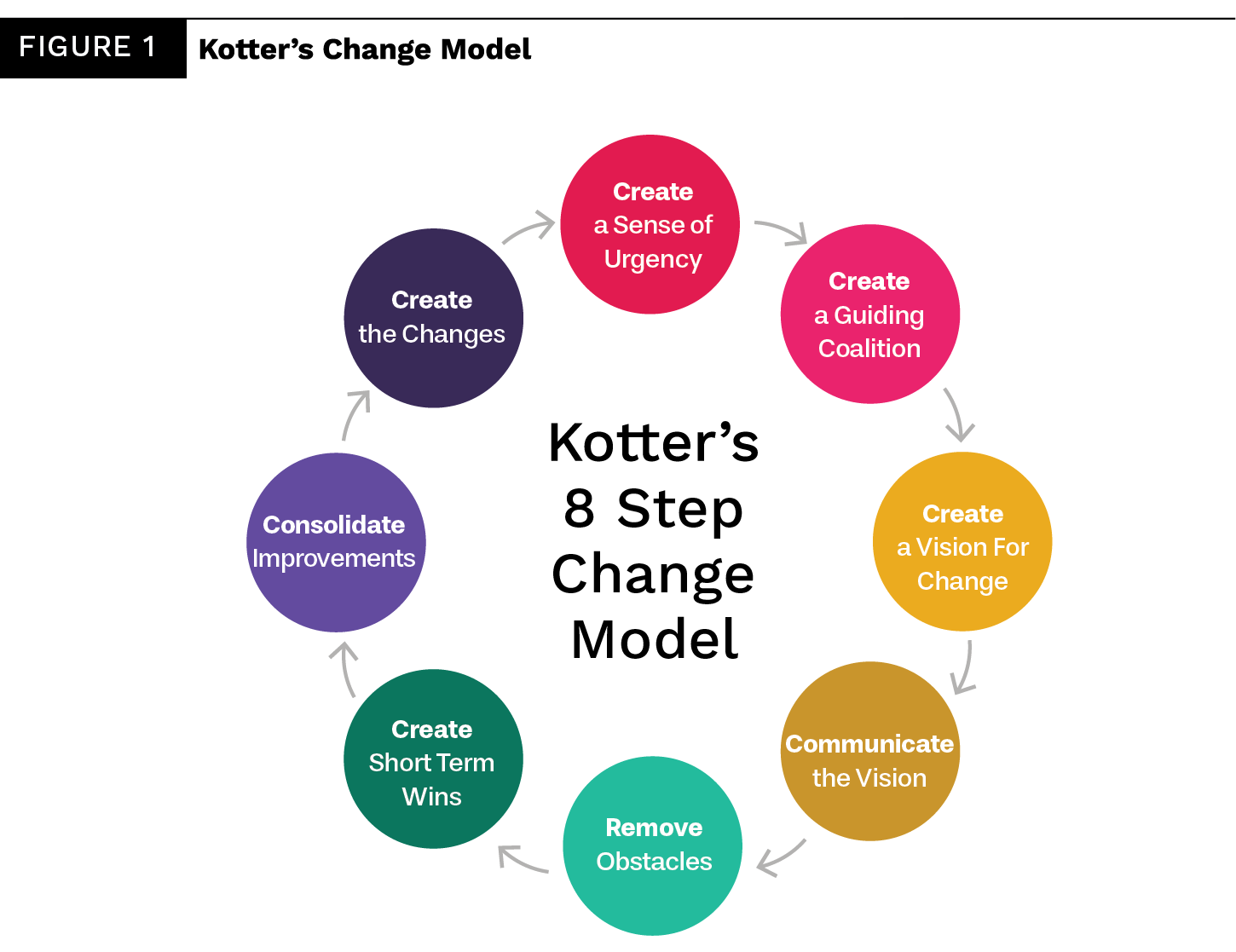
Now, we expand Kotter’s change model and, as shown in table 1, present the eight success stages of organizational transformation that correspond with the eight main mistakes.
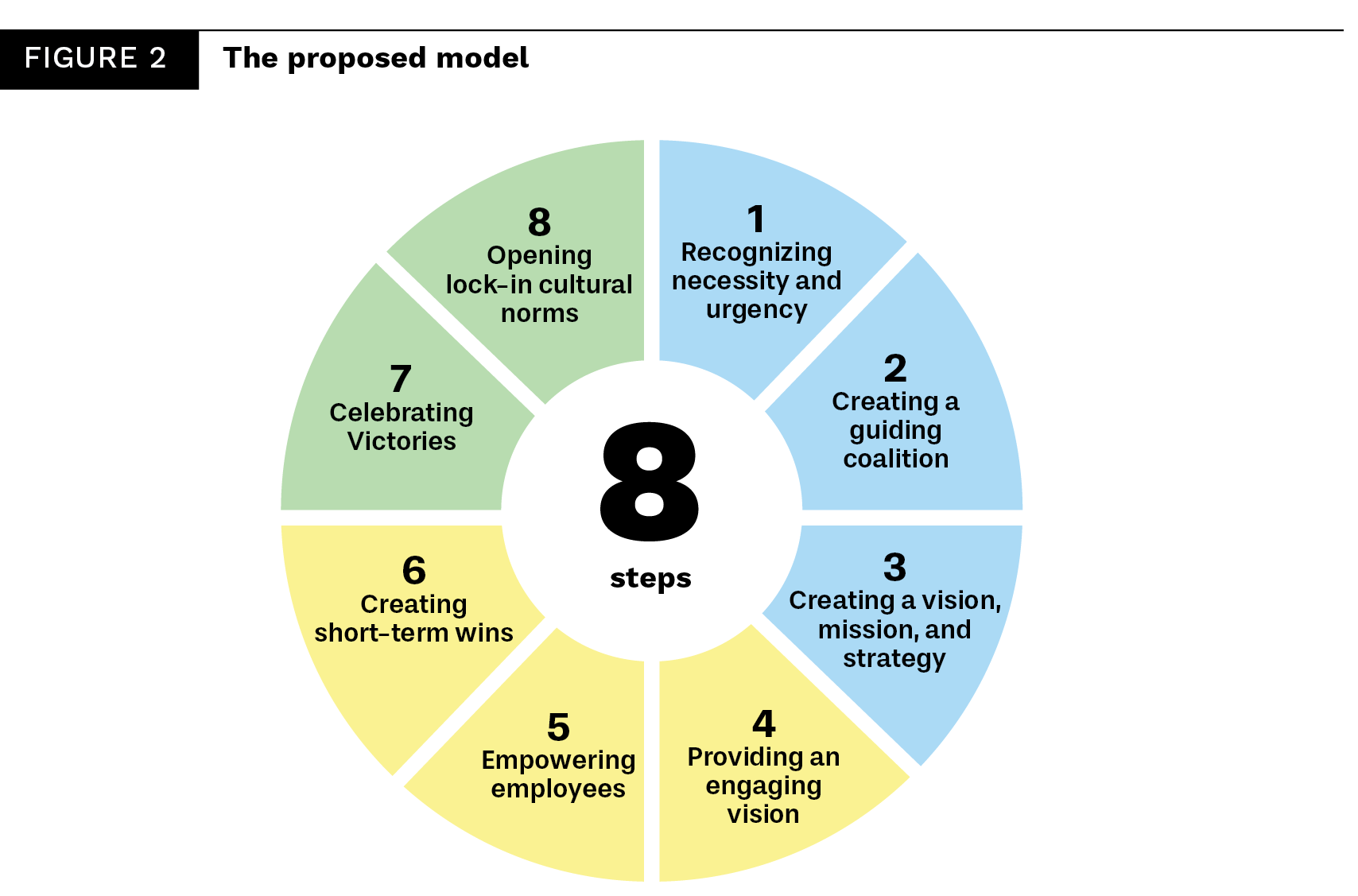
Stage 1: Recognizing necessity and urgency
Examining the market and the competitive realities by diagnosing current and potential crises. People outside the organization can be useful along with customer relationship management. Additional information can be gathered by suppliers and shareholders.
Stage 2: Creating a guiding coalition
A steering committee with enough authority to lead the transformation and guide the group in such a way that they work as a unified team. A powerful guiding coalition with the right structure, appropriate level of trust, and common goals will steer the organization in the correct direction.
To create an effective guiding coalition, four key features should be considered:
- The organizational capital of the situation:Are there enough key people involved in this coalition so that other people cannot create a barrier against the transformation?
- Broad expertise:Are there different departmental experts that are knowledgeable and some that are outsiders to offer an outside point of view so that the correct and intelligent decisions can be made?
- Credibility:Does the steering committee have a good reputation in the company so that other employees of the company take their opinions seriously?
- Leadership: Does the steering committee have leadership knowledge, authority, and autonomy so that they can guide the transformation process well?
The combination of trust and a common goal between people with the right and appropriate characteristics can lead to the creation of a strong steering committee.
Stage 3: Creating a vision, mission, and strategy
A vision that guides change efforts is usually five to 10 years out, while a mission could be a daily continuous day-to-day operation. The strategy is much more inclusive of both vision and mission but also guiding principles, goals, and objectives. Thus, vision refers to a clear picture of the future that shows why an organization thrives. In the transformation process, a good vision has three important goals:
- Clarify the development path
- Motivate people
- Keep people focused on the mission.
Most visions have the following characteristics:
- Provide a picture of the future.
- Show the long-term interests of employees, customers, shareholders, and stakeholders.
- Include realistic and practical goals.
- Clear to provide the necessary decision-making.
- It is an iterative process that may change.
- The vision is easy to remember, easy to manifest, and known and practiced by all employees.
The degree of desirability of a transformation vision can be determined by asking the following questions:
- What is the customer value proposition offered by our vision?
- What effect will the vision have on the shareholders and the communities in which the organization prospers and serves?
- What is the effect of the vision on attracting and retaining talented professionals?
Stage 4: Providing an engaging vision
Continuously convey the vision and strategy and create role models that portray the mission and vision. A great vision serves an important purpose. The real power of a vision is revealed when most of the people involved in the transformation activity have a common understanding of the organizational goals and direction. When the sense of urgency is high, employees will be able to create a vision and transfer that vision into the future appropriately. To effectively convey the vision, some important features should be considered:
- Use simplicity: all technical terms and jargon should be left out.
- Use metaphors: similes, examples, verbal images are worth a thousand times more than written writings.
- Use multiple platforms: informal memos and company newsletters, all are effective in spreading the vision.
- Use repetition: ideas penetrate deeply into people’s minds only when they are repeated and heard over and over again.
- Use leadership: present models and host monthly praising sessions.
Stage 5: Empowering employees
Changing systems or structures that help people thrive strengthens the vision, encourages risk-taking, and welcomes ideas. Use a customer-centric vision so that the organization continually adds value.
Stage 6: Creating short-term wins
Planning for visible improvements in performance or small victories, whatever they may be, is important to provide an impetus of positive momentum in the company’s vision and mission. Appreciating and giving rewards to the people who make progress possible is very important. Major developments take time and in some cases require great care. Loyal believers want to see clear evidence that the transformation is working. Managing a transformation effort without a major focus on short-term wins is incredibly risky.
A short-term victory has at least the following three characteristics:
- It is visible. A large number of people can
see if the result is real. - It is not ambiguous. Clarification and advertising may be necessary.
- It connects the transformation efforts, and it is a victory.
Improving the functions that are learned in a short period of time helps the changes in six ways.
- Provides evidence of good decisions and valuable sacrifices.
- Short-term wins as positive feedback improves morale and motivation.
- They help provide clear vision and strategies; short-term victories provide objective information to the guiding coalition about the validity of their ideas.
- They reduce pessimism and conservative resistance; evidence that clearly indicates the improvement in performance makes it difficult for people to resist the required transformation.
- They keep the leaders in the scene; for the people who have a higher position in the chain of administrative ranks, they provide evidence that the transformation is on its way.
- They bring motivation to people; they turn indifferent people into supporters and reluctant supporters into active helpers.
Stage 7: Celebrating victories
Celebrating victories is not just throwing parties for no reason; it is built on employing, promoting, and developing people who can implement the organizational vision, and individual change agents that are advocates for the mission and change initiatives. As agents of change, each employee plays a critical role that needs to be celebrated.
Major changes, especially in large organizations, require spending a lot of time and money. This money spent must go to operative projects for improvement in the tangible assets of the organization, such as human capital, social capital, and organizational capital.
Emphasizing the development and production of sustainable technologies at home will allow European companies to compete with Chinese peers in the future.
The process of creating transformation needs to have everyone in the organization rowing in the same direction. Reward people for coming on board the change initiative, then halfway through, using short-term victories. The work on the strategic planning process must be coordinated and each step along the way must be communicated. Things to communicate via intranet or paper distribution would cover things such, as but not limited to, restructuring, reengineering, or change in strategic planning, monitored or new training programs, modifying information systems, increasing or decreasing the number of employees, and new enhanced performance evaluation systems. Finally, the stage of summarizing the victories must build upon each other incrementally from an off-site gathering to a full-blown concert or trip to an exotic island.
Stage 8: Opening lock-in cultural norms
Customer-oriented leadership, customer relationship management, and customer-value proposition are derived from intangible assets of organizations such as social capital, organizational capital, and human capital. Thus, productive behavior, more effective leadership, and better management establish a connection between new behaviors and organizational success. This creates tools to guarantee and develop leadership prowess throughout the organization. How this is manifested has to do with the seven stages mentioned above but, without a way of making this transformation stick, all efforts are bound to revert back to inertia.
Culture refers, in this case, to the norms of behavior and shared values among the stakeholders of the organization. Norms of instilling this behavior and sustaining it are common and penetrating methods of action that are found among successful organizations that prosper.
Shared values are important tasks and goals shared by most employees that shape group behavior and often persist over time, even if employees change. Thus, talent management and onboarding new people are very important to organizational success. Culture is important because it can have a great impact on human behavior, while changing it may be difficult.
When, in a transformation effort, new activities are not compatible with existing cultures, they are often subject to going back or regressing, causing inertia. Therefore, tying the knot on positive change is just as important as setting up the transformation process.
Locking in the culture is powerful for three reasons:
- People are selected based on the culture of the organization with talent management.
- Culture, like morale, can change easily and this must be monitored, and culture needs to be nurtured.
- Culture can also be challenged by opposing egos that unconsciously undermine the transformation for self-interests.
These key eight stages have been presented in figure 2 below.
Conclusions
In many transformational efforts, the main axis of the previous culture is not in conflict with the new perspective, although there will be conflict with some of the tried-and-true previous cultural norms. In such cases, linking new activities to old roots while removing incompatible components is a fundamental challenge. This is why we suggest that leading strategic change must be the competency of senior leaders in the C-suite. Institutionalizing a set of activities in a culture that are even compatible with its core values is also a complex challenge. The biggest obstacle to transformation is a group’s culture. Thus, the first step in a big transformation is to change norms and values. Once accomplished, this has to be the organizational mantra instilled in the mission, vision, and guiding principles of the organization. Leaders need to understand the existing culture so that they can raise the level of urgency and necessity for change.
The key to the survival of successful organizations in today’s era of disruptions is effectively leading strategic change. Employees must be able to handle the competitive and constantly changing environment.
 Michael J. Provitera
 Mostafa Sayyadi