
AI music generators made a splash last year, with many professional and amateur musicians alike exploring the allure of AI-generated music. So, among the multitude of AI music generators available, which one is right for you?
Over the past few months, we’ve tested five AI music generators. We evaluated them primarily based on functionality and the quality of the music they produce, drawing some conclusions along the way. In this article, we’ll delve deeper into these music generators and recommend the best one for you.
What makes a good AI music generator?
A “good” AI music generator is no longer judged just by whether it can create a catchy melody. As the technology has matured, the criteria have shifted toward fidelity, control, and professional utility.
If you are evaluating an AI music tool, here are the five key pillars that define a top-tier generator:
1. Acoustic Fidelity (The “Ear Test”)
In the early days, AI music sounded like muffled MP3s from the 90s. A high-quality generator today must offer:
- Sample Rate & Bit Depth: Professional tools now output at 48kHz / 24-bit (Studio Quality) rather than 22kHz (Radio Quality).
- Stereo Width: Good AI creates a wide, immersive soundstage where instruments feel separated, rather than a “mono” wall of sound.
- Lack of Artifacts: Poor AI has “underwater” sounds or digital chirps (aliasing). A good generator produces clean, crisp transients (the “punch” of a drum or the “pluck” of a string).
2. Compositional Intelligence (The “Soul”)
Music is not merely a melody, it is about structure and emotion.
- Long-term Coherence: Does the song remember the melody from the first verse when it gets to the second chorus? Weak AI often wanders aimlessly; strong AI maintains a consistent “motif.”
- Tension and Release: A good generator understands music theory—how to build energy in a bridge and release it in a final chorus.
- Genre Authenticity: It shouldn’t just mimic a genre; it should understand the nuances. For example, a “Jazz” prompt should include syncopation and swing, not just a piano sound.
3. Creative Control & Granularity
A “black box” where you type a prompt and get a finished song is a toy. A tool for creators provides:
- In-painting/Region Editing: The ability to highlight a 10-second vocal section and say “Keep the music, but change these specific lyrics.”
- Stem Separation: A good generator allows you to download the drums, bass, vocals, and instruments as separate files to mix them yourself in a DAW (like Ableton or Logic).
Top 5 AI Music Generators Worth to Try
In 2026, AI music generation has branched into two main directions: generative “complete” song creators (like Suno and Udio) that handle vocals and lyrics, and composition assistants (like AIVA and Soundraw) that focus on instrumentation and background scores for creators.
Here are five leading AI music generators, categorized by their strengths.
1. Musicful AI
Best for: Social media creators needing “instant” music videos and TikTok-ready content.
Musicful AI is a versatile platform that combines a high-quality song generator with an AI Music Video engine. It’s designed for high speed and ease of use, allowing users to go from a text prompt to a fully rendered music video within minutes.
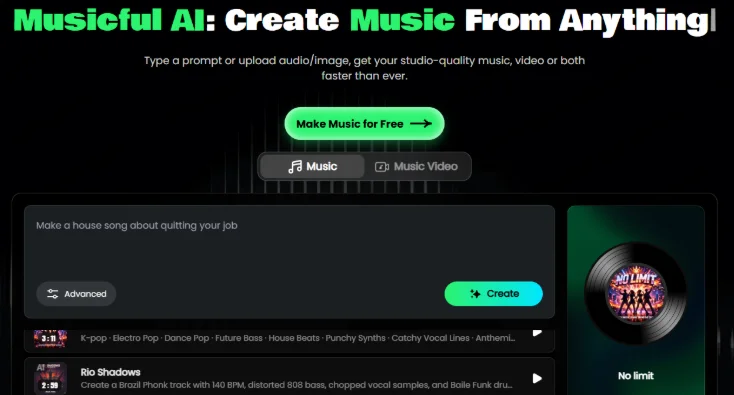
- Key Features: * AI Music Video Generator: Automatically generates visuals that sync with the rhythm and mood of the track.
Vibe & Voice Customization: Allows users to select specific “vibes” and vocal textures to ensure consistent branding across multiple tracks.
Stem Splitting: High-end tiers allow users to download separate tracks (vocals, drums, bass) for further editing.
Reference Audio: Users can upload a short clip or hum a melody to guide the AI’s composition.
- Advantages:
All-in-One Workflow: Eliminates the need for separate video editing software.
Large Track Limits: Offers long-form generations (up to 8 minutes) which is rare among vocal-heavy generators.
Accuracy: Claims a high degree of precision in beat-syncing and vocal alignment compared to older models.
- Disadvantages:
Credit Intensive: Generating music videos is “expensive” in terms of platform credits and can have longer wait times than the audio-only generation.
Genre Depth: While broad, some users find it lacks the specialized “indie” or “experimental” depth found in Udio.
- Pricing:
Free/Basic: Limited daily credits; non-commercial use only.
Standard: ~$10.99/month (1,500 credits, includes commercial rights).
Pro: ~$29.99/month (up to 28,000 credits, advanced models, and full stem downloads).
Education: Offers a ~15% discount for students and teachers via school email verification.
2. Suno AI
Best for: Creating full, radio-ready songs with vocals in seconds.
Suno is currently the industry leader for “all-in-one” production. It takes a text prompt and generates a complete track including lyrics, melody, and human-like vocals across almost any genre.
- Key Features: Custom mode for specific lyrics, “vibe” tagging for genre control, and the ability to extend or remix sections of a song.
- Advantages: Incredible vocal quality; very easy for non-musicians; handles lyrics and song structure automatically.
- Disadvantages: Occasional “hallucinations” (gibberish lyrics); limited control over specific instrument levels (stems).
- Pricing: * Basic: Free (50 credits/day, non-commercial).
Pro: ~$10/month (2,500 credits, commercial rights).
Premier: ~$30/month (10,000 credits, commercial rights).
3. Udio
Best for: High-fidelity audio and creative, experimental arrangements.
Udio is Suno’s primary rival, often praised for higher audio fidelity and more “human” sounding production, though it can require more effort to get the perfect result.
- Key Features: Advanced “Inpainting” (editing specific parts of a track), 30-second clip generation that you can extend into full songs, and powerful remix tools.
- Advantages: Superior audio quality in 2026; excellent at capturing specific niche sub-genres; highly creative arrangements.
- Disadvantages: Steeper learning curve; free tier is more restrictive than competitors; sometimes inconsistent with long-form song structure.
- Pricing:
Free: Limited daily credits.
Standard: ~$10/month (1,200 credits).
Pro: ~$30/month (4,800 credits).
4. Soundraw
Best for: Content creators and YouTubers needing background music.
Unlike the text-to-song models, Soundraw allows you to customize the mood, length, and tempo of a track through a dashboard. It is designed to be “copyright-safe” for videos.

- Key Features: Length and energy customization; “Mood” and “Theme” based generation; bar-by-bar editing without a DAW.
- Advantages: 100% royalty-free for commercial use; allows you to match music length exactly to your video.
- Disadvantages: No AI vocals (instrumental only); music can feel “library-like” or generic compared to Suno/Udio.
- Pricing:
Free: Unlimited generations (but no downloads).
Creator: ~$16.99/month (Unlimited downloads for content creators).
Artist: ~$29.99+/month (For musicians wanting to distribute on Spotify).
5. AIVA (Artificial Intelligence Virtual Artist)
Best for: Composers and cinematic soundtrack creation.
AIVA is one of the oldest and most “musical” AI tools. It generates MIDI and audio inspired by classical and cinematic styles, making it a favorite for game devs and film scorers.
- Key Features: MIDI export (allows you to edit the notes in your own software); preset “Style” models; “Influence” uploads where you provide a file for the AI to emulate.
- Advantages: Granular control over music theory (scales, chords); excellent for orchestral and ambient music.
- Disadvantages: Not great for modern pop or vocal-heavy music; the interface feels more technical than “fun.”
- Pricing:
Free: 3 downloads/month (AIVA owns copyright).
Standard: ~€11/month (15 downloads, limited commercial).
Pro: ~€33/month (300 downloads, you own the copyright).
Comparison Summary
| Tool | Primary Strength | Key “X-Factor” |
| Musicful | Multimedia | Built-in AI Music Video generation. |
| Suno | Songwriting | Most “human” sounding pop vocals. |
| Udio | Audio Quality | Professional studio fidelity and inpainting. |
| Soundraw | Customization | Infinite royalty-free background loops. |
| AIVA | Composition | MIDI export for professional film scoring. |
Conclusion
After exploring so many AI music generators, I’m sure you’ve made your choice. However, we still want to recommend Musicful. As the most cost-effective and feature-rich AI music generator, it has earned the recommendation of the majority of users over the past year.
The photos in the article are provided by the company(s) mentioned in the article and are used with permission.
Disclaimer: This article contains sponsored marketing content. It is intended for promotional purposes and should not be considered as an endorsement or recommendation by our website. Readers are encouraged to conduct their own research and exercise their own judgment before making any decisions based on the information provided in this article.