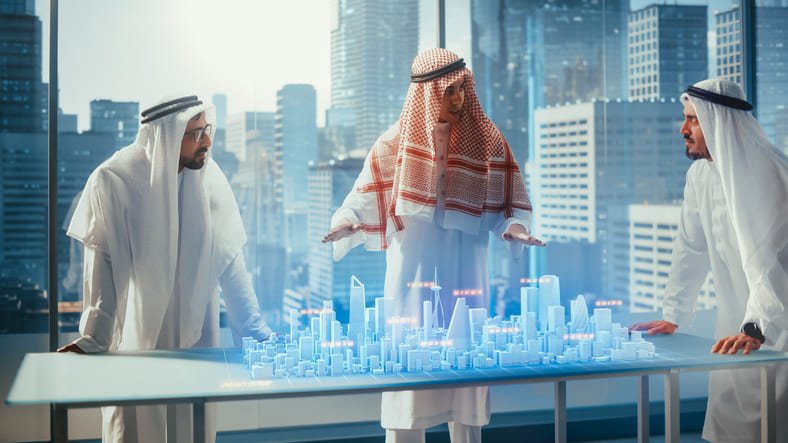
Saudi Arabia is rapidly reducing its reliance on oil as it pursues economic diversification, with officials saying that more than half of its economy now operates independently of the energy sector.
Investment Minister Khalid Al Falih said that 50.6% of Saudi Arabia’s economy is now “completely decoupled” from oil, underscoring the success of the kingdom’s Vision 2030 strategy. “This percentage is growing,” Al Falih told CNBC’s Dan Murphy, noting that about 40% of government revenues now come from non-oil sources.
“We’re seeing great results, but we’re not satisfied. We want to do more. We want to accelerate the kingdom’s diversification and growth story,” Al Falih added.
The government has identified artificial intelligence as one of its main new growth areas. Al Falih said Saudi Arabia aims to be a “key investor” in AI technologies, including the development of large language models, and will build data centers “at a scale and at a competitive cost not achieved anywhere else.”
“AI has emerged [in] the last three, four years, and it’s definitely going to define how the future economy of every nation. Those who invest will lead, and those who lag behind, unfortunately, will lose,” he said.
Experts say the kingdom’s strong energy resources could give it an edge in building AI infrastructure. Groq CEO Jonathan Ross told CNBC that Saudi Arabia’s energy surplus positions it well for AI expansion, while PwC projects that AI could add more than $135 billion to the Saudi economy by 2030.
Recent fiscal data highlights the progress of Saudi Arabia’s diversification efforts. The country’s total revenue for the first half of 2025 reached 565.21 billion Saudi riyals ($150.73 billion), with oil now accounting for 53.4% of total revenue, down sharply from 67.97% in the same period in 2019.
In 2024, Saudi Arabia recorded a 1.3% increase in GDP, driven largely by a 4.3% rise in non-oil activities, while oil output declined 4.5% year-on-year. Despite weaker oil prices in 2025 — with Brent crude down 13.4% this year — the government has maintained its spending plans.
Al Falih said there were “no cuts to public spending,” noting that the Public Investment Fund (PIF) has grown sixfold since its inception and is approaching nearly $1 trillion in capital invested across key industries. The sovereign wealth fund has acquired stakes in global technology companies, video game publishers, and sports teams, including Electronic Arts and Premier League club Newcastle United.
Tourism is another fast-expanding pillar of the Saudi economy. Tourism Minister Ahmed Al-Khateeb said the sector’s share of GDP increased to 5% in 2024 from 3% in 2019, reflecting the kingdom’s push to attract more international visitors.
“We are [opening] resorts, new airlines, new airports, and the numbers are growing, and we are focusing on countries and visitors that are coming from outside to experience our great culture,” Al-Khateeb said.
He added that Saudi Arabia aims to raise tourism’s contribution to 10% of GDP by 2030 and eventually reach 20%. “This 20% will help Saudi Arabia to diversify the economy and make it more sustainable,” he said.
As Saudi Arabia moves deeper into sectors such as technology, renewable energy, and tourism, officials maintain that the transformation is designed to ensure long-term growth beyond oil, positioning the kingdom as a diversified economic power in the global market.
Related Readings: