


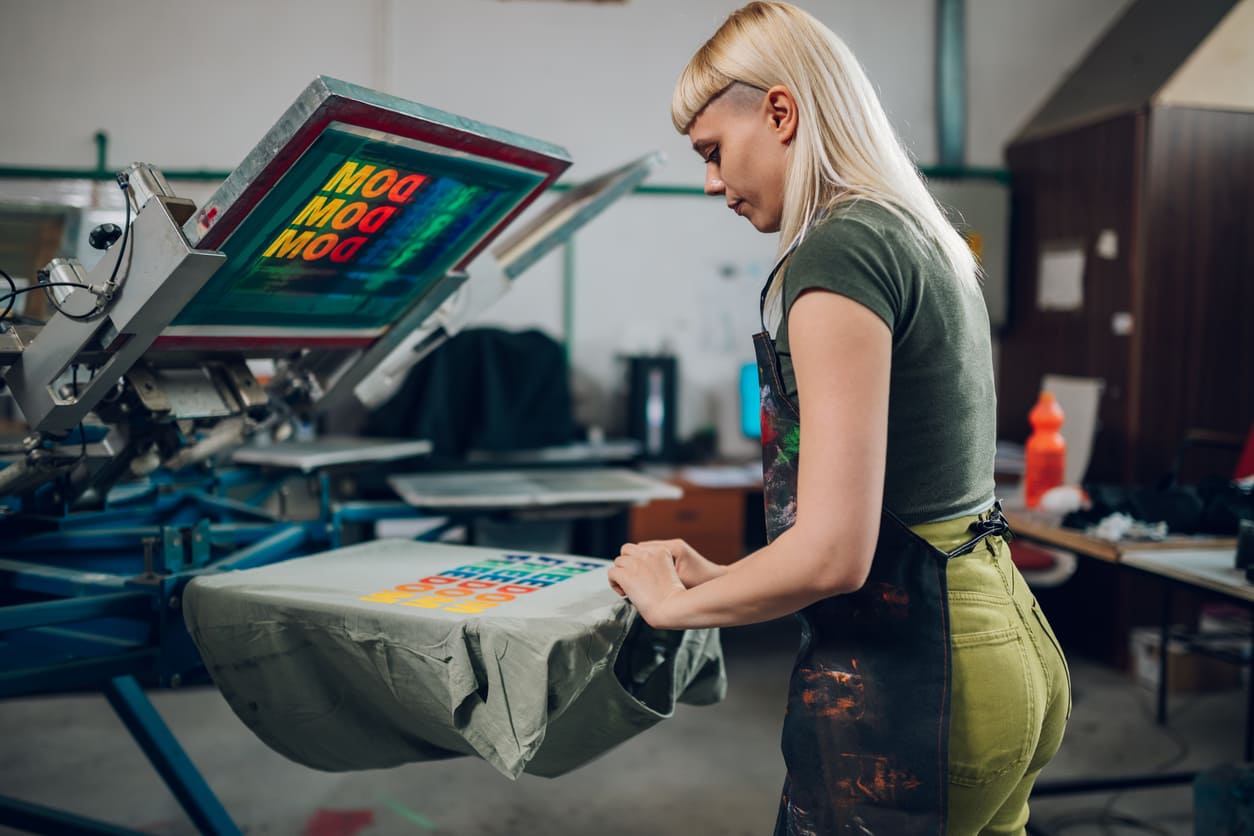
Custom apparel sellers often reach a difficult point: outsourced transfers and finished garments are convenient, but supplier lead times can limit urgent orders and product experiments. Buying equipment appears to offer more control, yet the purchase price is only the beginning. The better decision comes from comparing realistic order economics, production capacity and operational risk. A small business producing occasional personalized gifts may need a different approach from a studio fulfilling weekly club orders. Rather than assuming one route is always cheaper, owners should model what each route costs at their actual order sizes.
Define what is being outsourced
There are several ways to outsource apparel decoration. A company may buy finished printed shirts, purchase ready-to-press transfers and apply them locally, or use a fulfillment partner that ships directly to customers. These arrangements carry different prices, inventory risks and degrees of quality control. Comparing their headline quotes with the cost of operating a printer is misleading unless the services included are equivalent.
Write down who sources the blank garment, creates production artwork, prints transfers, presses the image, checks quality, packs orders and handles returns. The first cost model should reflect those actual responsibilities. A supplier quote that includes packing and distribution cannot be compared with ink and film expenses alone.
Separate variable costs from fixed costs
Variable costs rise with each unit produced. They may include blanks, transfer film, ink, adhesive powder, packing materials, outsourced transfer fees and shipping. Some labor is variable too: sorting garment sizes, positioning transfers and checking quality require time per order. Fixed or semi-fixed costs include machinery, workspace, design software, insurance, maintenance and staff training.
A simple contribution-margin calculation starts with selling price minus variable cost per sale. The margin must then cover fixed costs and provide profit. Many owners focus on the low material cost of a printed design and overlook labor, spoilage, customer support and equipment downtime. The calculation should include the actual payment and selling fees associated with the business.
For example, suppose a custom shirt sells for $28 and its blank, consumables, packaging, payment costs and direct labor total $15. The contribution is $13 before rent, depreciation, maintenance, administration and taxes. These are hypothetical teaching figures, not market averages. If the selling price drops or orders require individual artwork changes, the margin changes quickly.
Why in-house printing becomes attractive
Owning production can reduce dependence on shipping schedules and make small design revisions easier. A local print business may be able to produce a replacement garment for a customer without submitting a new external order. It also permits closer inspection of placement, colours and finishing before dispatch.
However, DTF printing machines introduce a full process. The business must prepare artwork, print to transfer film, apply and cure adhesive powder, heat-press the image and inspect the garment. White-ink handling and maintenance are recurring responsibilities. A printer should not be evaluated as if it were a paper office device that can remain unused indefinitely without a care routine.
In-house work also changes who carries the risk. When an outsourced supplier has a production problem, remedies depend on the contract. With an owned setup, the business must respond to printhead issues, heat-press faults, operator absence and unexpected material waste. That risk can be managed, but not ignored.
Compare the options with three order scenarios
Scenario A: ten personalized shirts per month
At low volume, outsourcing may be attractive because the owner avoids equipment depreciation and maintenance. Personalized one-offs consume time in artwork approvals and garment sorting, so the print process may be only a small part of total labor. Keeping a modest heat-press capability while outsourcing transfers can offer a middle ground.
Scenario B: one hundred shirts across repeat designs
With repeat artwork and predictable orders, in-house production can begin to compete if the business has staff capacity and the same process works reliably across batches. At that stage, comparing a DTF printer bundle against separately purchased equipment can reveal missing curing, pressing and service costs. The owner should still account for the number of different print placements, sizes and deadlines. One hundred identical transfers is operationally different from one hundred individualized names.
Scenario C: seasonal volume spikes
A school event or holiday promotion may create a short surge rather than year-round demand. Buying equipment solely for a peak month can leave expensive assets idle. A hybrid arrangement—routine orders produced internally and overflow outsourced—may protect service levels without requiring a major capacity expansion.
Calculate break-even without pretending the future is certain
An illustrative break-even model can be written as fixed monthly operating cost divided by the per-unit contribution advantage of in-house production. Suppose owning the operation adds $600 of monthly fixed expenses and saves $3 in variable cost per shirt relative to an equivalent outsourced service. The model suggests 200 shirts per month to cover those added fixed expenses. It is a simplified scenario, not a recommendation or an InkSonic product claim.
Test the model with realistic downside cases. What happens if demand is 30% lower than forecast? What if defect rates rise while a new operator learns the process? How much revenue is at risk if the printer stops for a week? Include cash tied up in blanks and supplies, not only profit on completed orders.
The most useful output is a range rather than a single break-even point. Track actual orders for several weeks and update the figures. If small orders dominate, minimizing manual setup and order handling may be more valuable than maximizing rated print speed.
Buy a production system, not just a printer
A complete DTF operation needs the printer, appropriate film and inks, adhesive powder, curing equipment, a heat press, work surfaces and safety measures. Artwork software and maintenance supplies can also affect costs. When comparing a DTF printer bundle with separate purchases, confirm exactly what the package includes and what still needs to be bought.
Consider whether a powder shaker and dryer is warranted for anticipated output or whether a smaller curing arrangement is sufficient. An automated system may reduce some manual handling at higher volumes, yet requires space, electricity, ventilation, cleaning and support. The right configuration depends on actual throughput, not an ambition to become a factory overnight.
There are process costs beyond the machine: sample garments, rejected transfers, operator training and quality records. Reserve time for installation and testing. Forecasting full commercial output from the first day of ownership is not a sound planning assumption.
Capacity is about bottlenecks, not advertised speed
Even when a printer can generate transfers rapidly, heat pressing and packing may determine how many sellable shirts leave the workshop. Measure the process as a sequence: artwork approval, printing, adhesive curing, pressing, cooling, checking and labeling. Record the slowest station during a normal batch.
If one employee handles every stage, machine time and labor time overlap differently than in a staffed shop. A second heat press may sometimes add more practical capacity than another printer; in other operations, preparing gang sheets and grouping similar orders may be more useful. The answer follows from observed bottlenecks.
Quality control and customer experience affect the calculation
An order that needs reprinting consumes materials and labor twice and may create return shipping or a customer refund. Keep a sample standard for print placement, visible defects and basic adhesion inspection. Test unfamiliar garments before committing to customer quantities. Do not assume that one heat setting is appropriate for every fabric.
Record promised production times honestly. In-house ownership can shorten some turnaround times, but only when the schedule, inventory and operators support the promise. Outsourced fulfillment may outperform a small workshop during periods of absence or equipment failure.
Decision checklist for owners
First, group the previous three months of orders by quantity, artwork complexity, turnaround requirement and garment type. Next, gather comparable outsourced quotes with shipping, reprints and tax treatment. Then price a complete internal setup, including maintenance and training. Estimate realistic capacity with people and pressing equipment rather than only printer specifications.
Finally, model normal demand, a low-demand month and a peak period. Document which operations would remain outsourced even after the purchase. If the expected cost advantage is small, flexibility and cash preservation may justify waiting. If the business has consistent demand, skilled operators and costly supplier delays, internal production may deserve a controlled trial.
Frequently Asked Questions
Is DTF printing cheaper than outsourcing transfers?
It can be at sufficient volume, but only after equipment, labor, defects and maintenance are included. The comparison depends on a business’s order mix and supplier pricing.
Do I need a shaker and dryer to start?
A DTF process needs proper adhesive powder application and curing. The right equipment can be manual or automated depending on volume, space, safety requirements and workflow.
What if most orders are one-off personalized shirts?
Artwork approvals and handling can dominate costs. Outsourced transfers or a hybrid model may suit the business until repeat volume becomes predictable.
How should equipment costs enter unit economics?
Allocate depreciation or financing, maintenance and relevant overhead to the period or output using a consistent method. Do not evaluate in-house costs on consumables alone.
Should a new business own production from day one?
Not necessarily. Validating demand with outsourced fulfillment may reduce risk. A purchase is easier to justify when the company understands its order mix and operational capacity.
Conclusion
The in-house decision is an operations decision as much as a pricing decision. Compare like-for-like fulfillment, model realistic volume and understand every step between approved art and shipped shirt. The most financially sensible setup is the one the business can run consistently while protecting cash, quality and customer deadlines.


