

By Christopher O.H. Williams
This article explores the intersection of personal purpose and professional leadership. It argues that blending individual aspirations with organizational goals builds resilience and courage and encourages leaders and managers to support this convergence not only for themselves but for all employees.
In 2005, the company I was working for hosted an annual retreat for the top 100 USA region leaders in Kauai, Hawaii. I remember the opening night vividly. The theme was “Transformational Moments,” and the goal was for all of us to reflect on the most transformational event of our lives.
A small handful of people took the stage to share their stories. Each was a powerful disclosure: a personal struggle of overcoming adversity or an epiphany that brought inspiration. These stories had shaped not only who we were, but also who we wanted to become – each a crucible that fueled a deep sense of mission and commitment to our personal potential. That exercise set in motion one of the most memorable leadership motivation sessions I have ever experienced.
We all have aspirations about who we want to become. It does not hurt to have strong incentives that push us toward those goals, especially when headwinds threaten to erode our will to persevere. I discovered early in my career that a deep sense of purpose is more than just a powerful motivator; it is a protector when circumstances or others try to diminish our aspirations or act as a drag on our enthusiasm. Sometimes, we even have to protect our dreams from ourselves, from the self-doubt that is ever willing to creep in and halt us in our tracks.
Returning to the Kauai retreat, that sharing of purpose shifted the mood of the meeting in the days that followed. The leadership group grew closer as we came to understand each other’s personal journeys and appreciate the human dimensions that were not always visible in the office. When we eventually moved into three-year strategic planning, the team worked better than ever – visioning, planning, and ultimately delivering another run of massive growth for the brand.
It was as if we saw our personal growth stories and the pursuit of our individual potential as fuel for the larger possibilities of the business. We had granted ourselves permission to pursue personal purpose alongside – rather than separate from – the business’s goals. It was personal and professional alignment like none other I had witnessed.
I recalled this experience when researching the role of purpose in building courage. The courage to persevere against challenge and stress is bolstered by a deep sense of purpose. Courage needs something to work for, including our own potential and the aspirations we set for ourselves.
Helpful evidence comes from the American Psychiatric Association (APA), which highlights research suggesting that purpose in life helps build resilience, reduce stress, and improve the integration of working and personal lives. The same APA piece points to a Harvard Graduate School of Education report, On Edge, underlining how strongly “meaning or purpose” is associated with this life integration. In light of these findings, the role of purpose in resilience is further affirmed. It confirms something I experienced two decades ago and have validated while working with scores of leaders since: blending personal and professional purpose is a powerful way for leaders to stay connected with their ideals – especially when pressure, ambiguity, and self-doubt test our resolve.
At the same time, the context in which leaders operate is getting harder. Edelman’s 2025 Trust Barometer describes a “crisis of grievance,” with 61% of respondents globally reporting a moderate to high sense of grievance, relating to a widening “mass-class trust divide,” where low-income respondents trust institutions 13 points less than high-income respondents (48% vs. 61%) – based of their view of their future economic outlook. Edelman further notes that five of the world’s ten largest economies – Japan, Germany, the UK, the US, and France – are among the least trusting nations on its Trust Index.
Just as leaders thrive when their personal and professional purposes converge, the same is true for their teams. Employees must be encouraged – and enabled – to find personal purpose in their work. Enabling this, even incrementally, should be a primary goal for leaders who want committed teams and sustainably high-performing organizations.
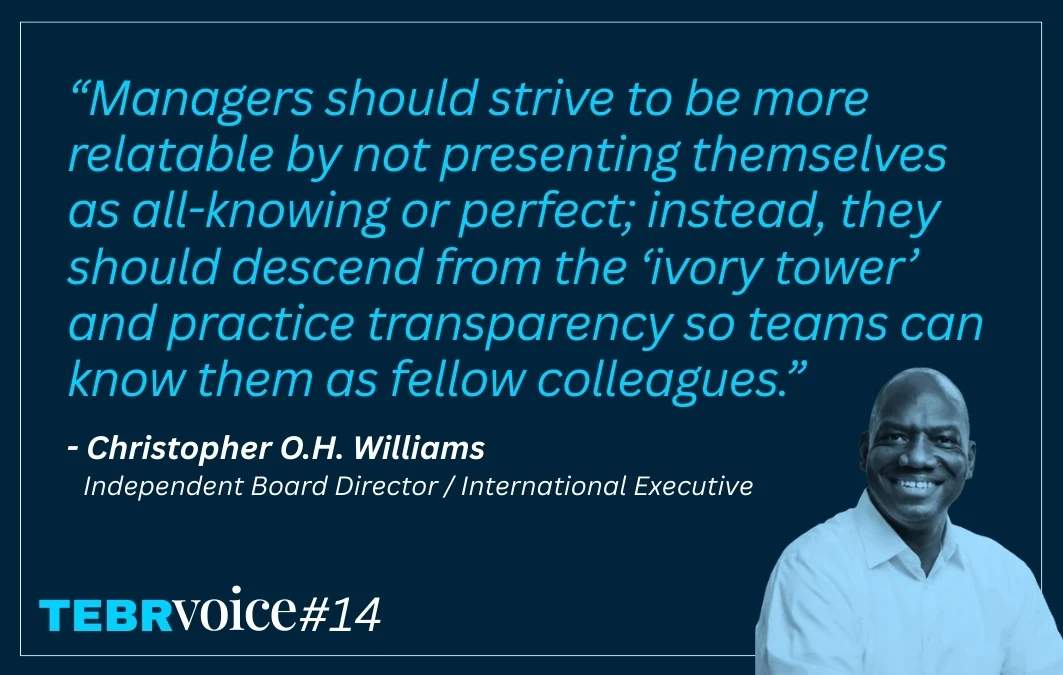
As we go into 2026, there are a few suggestions for managers to adopt to reverse these trends. Managers should strive to be more relatable by not presenting themselves as all-knowing or perfect; instead, they should descend from the “ivory tower” and practice transparency so teams can know them as fellow colleagues. While there is an instinct to avoid societal issues at work, creating room for employees to express their concerns builds inclusion and a sense of being fully recognized. Furthermore, addressing individual team concerns as distinct from larger organizational goals can earn managers credibility as caring leaders. Ultimately, top-down communication will be less effective in this landscape than regular, authentic peer-to-peer dialogue.
By bridging the gap between who we are and what we do, we unlock a level of resilience that strategy alone cannot provide. When we lead with converged purpose, we encourage, empower, and enable the pursuit of full potential. And this is true for all employees – both managers and their teams.
 Christopher O.H. Williams