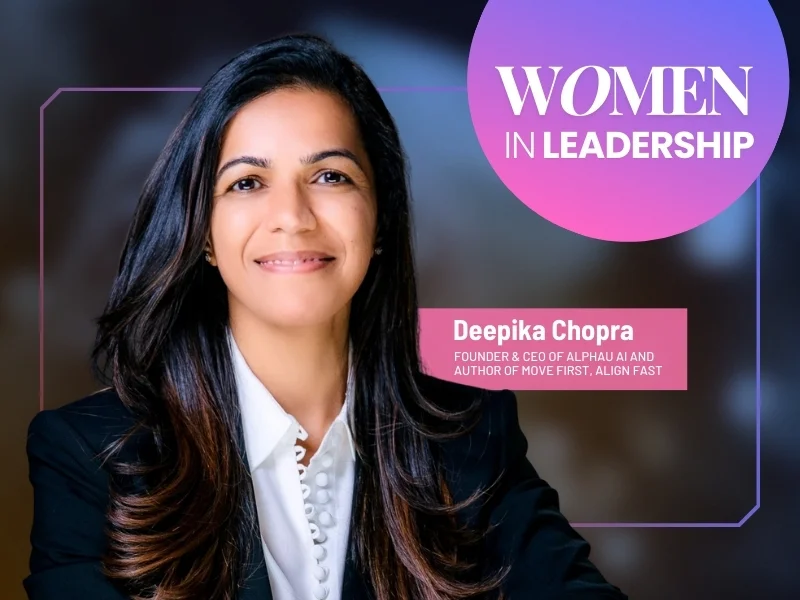
As AI reshapes how decisions are made, leadership misalignment has become a silent threat to value creation. Deepika Chopra shares why trust, readiness, and decision clarity now matter as much as technology itself, and how leaders can move faster by aligning human judgment with AI-driven insight at scale.
It’s lovely to have you with us, Ms. Chopra! In a recent article, you describe “misalignment” as the hidden leadership blind spot in AI transformation. Why do you believe this issue persists even among highly sophisticated organizations?
In many sophisticated organizations, readiness is often assumed rather than examined. Leaders invest heavily in strategy, governance, and technology, and understandably expect those elements to carry transformation forward.
What AI does, however, is change how decisions are actually made. It introduces probabilistic outputs, shared accountability, and new trust dynamics. If leadership teams haven’t aligned on how judgment, escalation, and ownership work in that environment, misalignment persists quietly—even when everything else appears mature.
Having worked with Fortune 100 boards and investors for years, what are the earliest signals leaders should look for that indicate AI initiatives are drifting into what you’ve called “execution theater”?
The earliest signals are usually behavioral. Decision cycles slow instead of accelerating. Teams seek additional validation even when insights are strong. Leaders override outputs informally, without shared reflection.
Execution theater tends to emerge when organizations focus on visible progress rather than confidence in their decisions. It’s not a failure of intent—it’s a signal that trust and clarity haven’t yet caught up with capability.
As a founder building an AI-native investment intelligence platform, how has your perspective on alignment shifted from theory to operational necessity?
My perspective shifted through repetition, not theory. After years in financial services and then building AlphaU as an end-to-end decision infrastructure across sourcing, evaluation, risk, and investment decisioning, I kept encountering the same pattern. We built systems that worked, yet at the highest-stakes moments, hesitation still surfaced. Teams paused, re-ran analysis, or quietly overrode insights—not because the data was wrong, but because trust and ownership were uneven.
That experience changed how I think about alignment. It stopped being a leadership concept and became a decision requirement. When leaders aren’t ready to trust and act on the intelligence in front of them, even strong systems slow down. That’s when readiness became measurable for me—not philosophically, but operationally.
From an investor’s perspective, how does misalignment within leadership teams translate into tangible value erosion?
It usually appears first in decision velocity. Opportunities are delayed, priorities shift frequently, and execution becomes cautious rather than decisive. Over time, this creates governance drag and weakens confidence both inside the organization and in the market.
What makes this difficult is that these signals don’t immediately show up in financials. They surface as momentum loss. By the time they’re obvious, recovery is much harder.
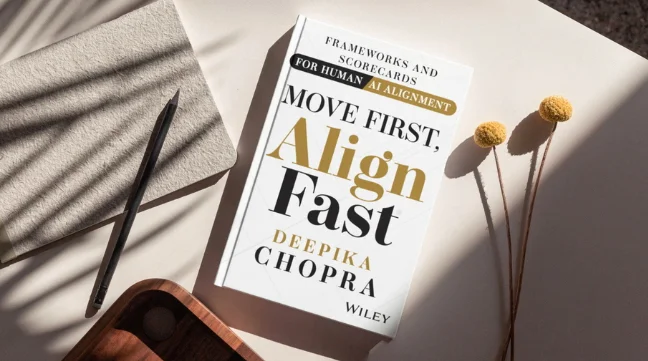
Your book, Move First, Align Fast, also introduces measurable frameworks for Human–AI Alignment. Why was it important to turn trust and readiness, often seen as “soft” factors, into hard metrics?
Because leadership can’t govern what it can’t see. Boards and senior leaders are rightly focused on safety, ethics, and compliance—but those controls don’t tell you whether an organization is actually ready to act on AI. Readiness gaps show up elsewhere: when trust fractures under pressure, when decision velocity slows even as insight improves, or when adoption is mandated rather than earned. Without visibility into those conditions, leaders end up reacting late to problems that were predictable early.
Measurement doesn’t reduce leadership to numbers; it creates a shared operating language. Used well, readiness metrics function as both a compass and an early warning system—helping leaders stay oriented as AI reshapes decision-making, while surfacing alignment, accountability, and execution risks early, so they can be addressed deliberately before they harden into systemic failure.
AI doesn’t replace judgment. It requires leaders to be more disciplined and consistent in how judgment is applied.
Many leaders assume better models or more data will solve adoption challenges. Based on your experience, what actually needs to change in leadership behavior when AI enters the decision-making loop?
Leaders must shift from “deploying AI” to “governing decisions.” That includes clarifying decision rights, setting norms around overrides, and being explicit about how uncertainty is handled without losing credibility.
AI doesn’t replace judgment. It requires leaders to be more disciplined and consistent in how judgment is applied.
In boardrooms today, what questions about AI risk and value creation are still not being asked but should be?
Most boards are focused on whether AI is compliant, secure, and ethically deployed. Those are necessary questions, but they address safety, not scale.
The questions that are often missing are about readiness:
- Are leadership systems prepared to absorb AI into real decision-making?
- Where do decision rights become unclear?
- Where does accountability diffuse?
- Where does speed slow despite better insight?
Boards should also be asking how AI changes operating rhythms and incentives. Are leaders aligned on when human judgment overrides AI, and who owns the outcome? Are we measuring whether AI is improving decision velocity, not just output quality? Without these questions, organizations risk doing the right things technically while failing to capture value operationally.
Women leaders are often expected to bridge gaps, build consensus, and manage complexity. How do you see women uniquely positioned to lead in this era of Human–AI collaboration?
Many women leaders have learned to operate with alignment, clarity, and shared accountability because they’ve had to. Those expectations were constraints for a long time.
In the AI era, they’ve become preparation. AI rewards leaders who can integrate perspectives, communicate uncertainty without losing credibility, and maintain momentum without relying on positional authority.
What’s changing is not women, but the leadership environment itself. AI is selecting for these capabilities, regardless of title or background
Looking ahead, what gives you the most optimism about the future of leadership as AI becomes a permanent presence at the decision table?
AI is forcing a reset. It makes misalignment visible and rewards coherence. That creates an opportunity to strengthen leadership systems rather than compensate for them.
I’m optimistic because it encourages a more deliberate, more human form of leadership—one grounded in trust, clarity, and responsibility.
Success, to me, is when humans remain confident decision-makers in an AI-rich world.
And lastly, what does success look like to you?
Success, to me, is when humans remain confident decision-makers in an AI-rich world. When leaders understand how to work with AI—trusting it where it’s strong, questioning it where it’s not, and staying accountable for outcomes—rather than feeling displaced or overridden by it.
At a broader level, success is building leadership systems where the next generation can move fast without fear, use AI without losing judgment, and make complex decisions without eroding trust. When Human–AI collaboration strengthens human agency instead of weakening it, AI stops being intimidating and becomes enabling. That’s when progress becomes sustainable.
Executive Profile
 Deepika Chopra is the Founder and CEO of AlphaU and the author of Move First, Align Fast (Wiley 2025) . She works with leaders, boards, and investors on leadership readiness and decision confidence in complex, high-stakes environments, focusing on how Human–AI collaboration can be governed to strengthen judgment, accountability, and execution at scale.