

By Alexander Skobtsev, Founder & CEO of Meet Future
This year, the live events industry has seen several striking examples of how much the role of visual technology has changed.
In April, Anyma premiered his new show, ÆDEN, at Coachella. The massive LED display was no longer just a backdrop for the artist. Digital characters, music and stage design became part of one experience, with visuals shaping the space around the performer.
That same month, Phish returned to Sphere in Las Vegas for a nine-show residency, where visuals evolved in real time, responding to the band’s live improvisation.
What makes these productions interesting isn’t the size of their screens. It’s how they use visuals to create depth, shape the environment and become part of the stage itself.
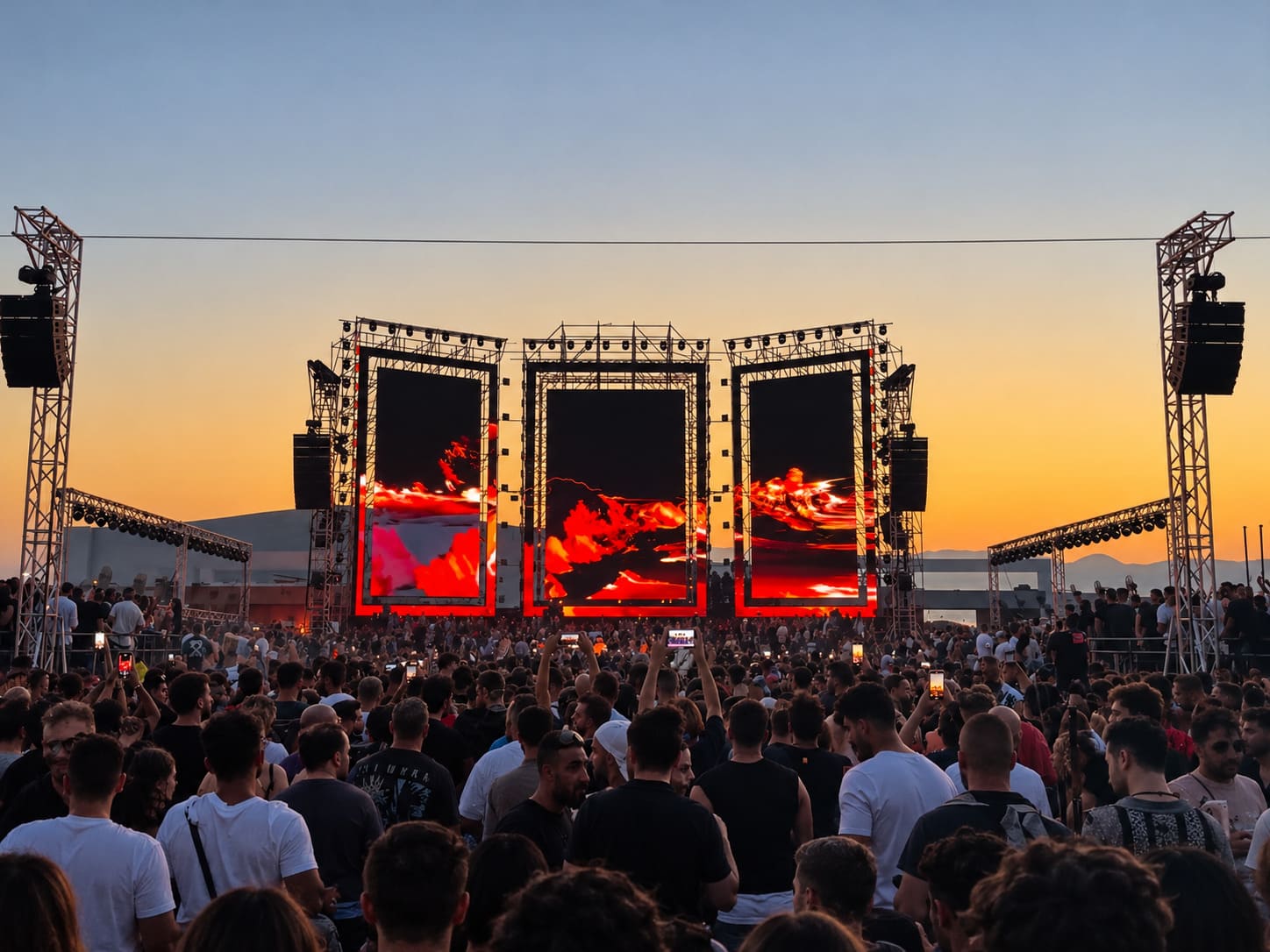
For me, these projects point to a major shift in live event production: LED is becoming an architectural element, not just a surface for displaying content.
From flat screens to three-dimensional spaces
Today, LED installations are no longer limited to rectangular screens. They can curve around a stage, form multi-sided structures, hang overhead, become part of the floor or blend into scenic elements. The physical shape of the display is now just as important as the content it shows.
This changes the way we approach event design. Instead of asking where to place a screen, we need to ask what role it should play in the space.
With a flat display, the visual experience is relatively predictable from different positions in the venue. Three-dimensional LED structures are more challenging. A design that looks spectacular from one angle may lose its impact when viewed from another.
That’s why LED needs to be planned alongside audience movement, lighting, camera positions, stage design and visual content. Something that looks impressive on a computer screen may work very differently in a real venue.
For production teams, this adds complexity, but it also creates far more opportunities.
We now have another powerful tool for directing the audience experience. LED can change how large a space feels, guide attention, create depth, reveal or conceal parts of the stage, and transform an entire environment throughout an event.
One event, two audiences
Another major change is how people experience live events.
Today, a large-scale production usually has two audiences: those attending in person and those watching through a livestream or a short video on their phones.
Anyma’s ÆDEN show offered a particularly interesting example.
During LISA’s appearance, viewers watching the YouTube livestream saw a giant augmented reality (AR) version of the artist towering above the stage. The festival audience couldn’t see this digital figure because it was created specifically for the broadcast.
The two audiences experienced the same performance in different ways.
And this presents a new challenge for event creators.
In a physical venue, we can build an experience through scale, movement, depth and the audience’s surroundings. On a phone, all of that is reduced to a small frame that needs to capture attention and communicate the idea within seconds.
This means both experiences need to be considered from the very beginning.
Rather than designing a spectacular stage and then figuring out how to film it, we need to understand how the same creative concept will work both in the venue and on camera.
Scale is no longer just about square metres
The approaches we’re seeing at Sphere, Coachella and major concert tours are gradually making their way into corporate events. Of course, not on the same physical scale. But size isn’t really the point.
A brand doesn’t need a stadium-sized LED wall to apply the same principles.
LED can reshape a conference stage, create several environments within a single venue, guide the audience through a programme or turn a product launch into a carefully directed visual experience.
For companies, this opens up new ways to communicate with their audiences. Instead of relying only on presentations and branded graphics, they can use the entire environment to tell a story, highlight a product and create a more memorable experience.
And this is where I see real value for brands. Technology should serve a clear purpose, whether that’s directing attention, improving how people experience a product or making a brand’s message more memorable.
For years, we’ve measured LED technology in square metres, pixel pitch and brightness. Those specifications still matter, especially when it comes to engineering and production.
But the most interesting development of recent years isn’t about technical specifications.
The screen is becoming a material we use to build the experience itself.
And that’s why the most important question today is no longer, “What kind of screen should we install?”
It’s what that screen can do for the space, the story we’re telling and the people experiencing it.
Disclaimer: This article contains sponsored marketing content. It is intended for promotional purposes and should not be considered as an endorsement or recommendation by our website. Readers are encouraged to conduct their own research and exercise their own judgment before making any decisions based on the information provided in this article.


