

By Professor Debbie Bayntun-Lees
New research across 350 global leaders and employees surfaces six practical shifts that redefine what “better” leadership truly means in today’s volatile world.
Leadership development is a multi-billion-dollar global industry. Yet across organisations, the same frustrations persist – micromanagement, poor communication, burnout, and leaders too buried in operational detail to think strategically. New research from Hult Ashridge Executive Education, drawing on more than 1,000 qualitative responses from 350 leaders and employees across industries, regions, and organisational levels, asks a deceptively simple question: what does “better” actually mean?
The Paradox at the Heart of Leadership
There is a fundamental problem with how we talk about leadership development. Most frameworks, competency models, and training programmes are built around the idea of becoming a “good” leader: a fixed destination, a standard to attain. Yet leadership is never finished. A leader who was effective yesterday may find themselves ill-equipped tomorrow if they stop adapting.
The Better Leaders Paradox research, conducted in partnership with Professors Vicki Culpin and Debbie Bayntun-Lees at Hult Ashridge Executive Education, set out to explore precisely this: what do leaders and employees actually mean when they say they want to be, or want their manager to be, “better”?
The distinction matters. “Good” implies a performance goal: reach the standard and the job is done. “Better” implies something more demanding and more honest. It calls for a learning mindset, a continuous journey, an embrace of imperfection alongside improvement.
Participants were asked not only what they themselves would do differently as better leaders, but also what they wanted to see change in the people who led them. Across more than 1,000 qualitative responses, a strikingly consistent narrative emerged. Whether individuals reflected on their own leadership or that of their managers, the same themes surfaced repeatedly. There is no significant disconnect between what leaders want to become and what their teams need from them. The gap lies not in awareness but in practice.
Six Shifts That Define Better Leadership
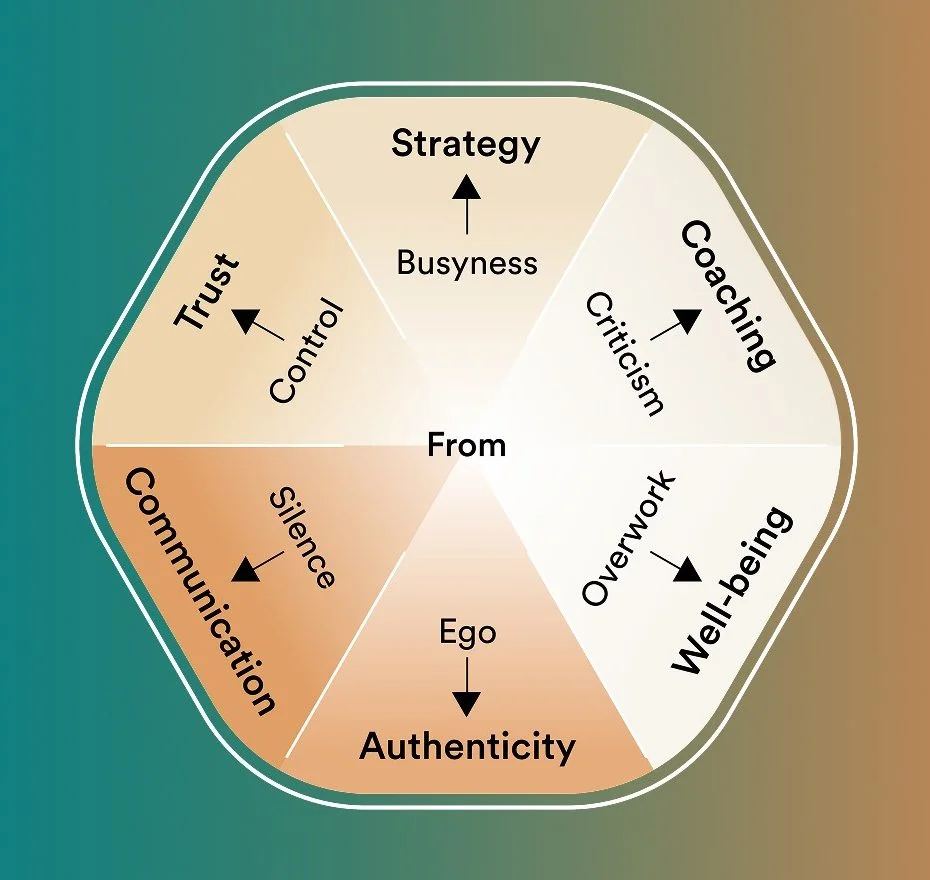
From thematic analysis of all responses, six major shifts emerged, not as a new competency checklist, but as a reorientation of how leadership is practised day to day.
From control to trust. Micromanagement was the single most cited frustration across every region and organisational level. Employees described leaders who second-guessed decisions, over-reviewed details, and intervened unnecessarily, undermining trust and stifling the very capability they hoped to build. Leaders themselves acknowledged the pattern: 35 cited wanting to do less micromanaging, and 42 expressed a desire to spend less time on day-to-day operational tasks. The call is unambiguous: give people the space to do the jobs they were hired to do. Trust, the research suggests, is no longer a soft aspiration. It is the new currency of effective leadership.
From criticism to coaching. The most hopeful theme in the data was leaders’ own desire to shift from “telling” to “developing.” With 85 responses citing the aspiration to empower and develop others, this was the single most frequently named area for personal growth. Coaching, once seen as a specialist or remedial tool, has become a defining leadership practice. Leaders who coach build confidence, resilience, and accountability. They scale trust rather than simply delivering outcomes. The future of leadership, the data suggests, is enabling, not directing.
From silence to communication. Employees across every level consistently asked for more clarity, more context, and more honesty. Communication gaps were cited 69 times as the top area for improvement in managers, making it the most requested behavioural change of all. When leaders fail to explain the reasoning behind decisions, people fill the void with assumptions, and those assumptions are rarely optimistic. The research is unequivocal on one point: people can handle difficult messages. What they cannot handle is silence.
From busyness to strategy. Strategic thinking ranked among the top three aspirations that leaders identified for themselves, and was equally prominent in what employees wanted from their managers. Yet many leaders described feeling structurally trapped: calendars colonised by meetings, inboxes demanding constant attention, and little protected space for reflection or horizon scanning. “We need less firefighting, more horizon scanning,” as one participant put it. When leaders are given permission and structure to step back from constant delivery, clarity returns and decisions become intentional rather than reactive.
From overwork to well-being. The strongest signal in the entire dataset was a plea for balance. Well-being and morale were cited 133 times, twice as often as the next most common theme, in response to the question of what managers should be paying attention to. Employees are exhausted, and they want leaders who notice not just outcomes, but the human energy required to produce them. When senior leaders model their own boundaries, they send a powerful signal to their teams: sustainable performance is wisdom, not weakness.
From ego to authenticity. What employees respond to most is not polish or projected confidence. It is genuine humanity. Humility, fairness, and integrity consistently surfaced as the foundations of trust. Leaders who “walk the talk,” who admit mistakes, and who treat others with consistent fairness create the psychological safety that makes real collaboration possible. Authenticity, in this context, is not a personality trait. It is a leadership discipline, and one that the data suggests organisations are still significantly undervaluing.
Figure: The Six Leadership Shifts (Visual attached)
When Leaders Know Better But Don’t Do Better
One of the most revealing findings concerns self-awareness. When asked whether their own manager would agree with their self-assessment, just over half of respondents (53%) said yes. A significant 34% answered “maybe,” a sizeable middle group reflecting uncertainty about whether their manager’s perception matches their own. This uncertainty likely stems from limited feedback, insufficient clarity around expectations, or simply the absence of honest developmental conversations.
This is the practical face of the paradox. Leaders often know what “better” looks like. They can articulate it clearly. Yet the organisational conditions they operate within, systems that reward control over trust, urgency over strategy, and busyness over reflection, make it extraordinarily difficult to put that knowledge into practice. Better leadership is not simply a matter of individual will. It is a matter of organisational design.
The research also points to notable differences by gender. Female participants were significantly more likely than male counterparts to identify emotional regulation as a personal development priority, reflecting an enduring cultural tension in which women are expected to demonstrate empathy while simultaneously being judged for “feeling too much.” Male participants, by contrast, more commonly focused on delegation, strategy, and control. These patterns suggest that leadership development programmes need to move beyond one-size-fits-all approaches and engage more directly with the structural and cultural contexts that shape leadership behaviour.
The Organisational Imperative
Across all six shifts, one pattern is unmistakable: leaders cannot make these changes alone. Building better leaders is a collective endeavour, and it depends on organisational design as much as on individual intent. Most organisations still ask leaders to embody trust and empathy while rewarding them for control and efficiency. Until those systems align, “better” leadership remains an aspiration rather than a reality.
What does this require in practice? It means redesigning performance frameworks to reward relational leadership, not just results. It means protecting strategic thinking time in leaders’ diaries and reducing the meeting overload that makes deep work impossible. It means embedding coaching skills development for all people leaders, replacing annual appraisals with frequent, meaningful conversations, and ensuring that well-being is treated as a leadership metric, not an afterthought.
Most importantly, it means treating leadership not as a destination but as a living, learning system. The organisations that will thrive in the coming decade are not those that define leadership success in static terms, but those that build cultures of continuous growth, where imperfection is acknowledged, feedback is welcomed, and development is never considered complete.
Conclusion: The Horizon That Keeps Moving
The paradox of better leadership is this: the pursuit never ends, and that may be precisely what effective leadership requires. In a world defined by volatility, uncertainty, and constant change, the leaders who will matter most are not those who have arrived, but those who have committed to the journey.
The research reveals that leaders and employees share a remarkably consistent vision of what “better” looks like. The challenge now is no longer one of definition. It is one of design, creating the conditions, cultures, and systems in which these six shifts can take root and, in doing so, building workplaces where both people and performance can genuinely thrive.
 Professor Debbie Bayntun-Lees