
By Fernando Díez, Elene Igoa, Elena Quevedo, and Josune Baniandrés
In increasingly noisy organizations, silent leaders may build deeper trust, stronger cultures, and more sustainable influence than highly visible leadership styles.
Charisma is, by definition, an attractive human trait that supposes an elevated capacity to influence others. Hence, a charismatic leadership style is typically considered beneficial for the organization. But there are also risks, including high organizational dependence on a single individual. Might there be a better way to lead?
Modern leadership is often associated with visibility, constant communication, and strong personal presence. Yet some of the most influential leaders operate very differently: they lead without constantly seeking attention. In increasingly noisy workplace environments, this silent form of influence may become not only relevant, but strategically essential for building trust, resilience, and long-term organizational sustainability.1
The Visibility Trap
For years, organizations have associated effective leadership with visibility. Executive presence, charismatic communication, confidence, and strong personal narratives have often been interpreted as signals of competence and authority. In many organizations, leadership has gradually become performative.1
The expansion of digital communication and social media has intensified this tendency. Leaders now operate in environments where constant exposure is frequently rewarded, and visibility itself is sometimes confused with influence.
However, excessive visibility can create important organizational risks.

The Costs of Permanent Exposure
First, highly personalized leadership may generate unhealthy dependence on the leader. Teams can become overly reliant on a central figure for direction, validation, and decision-making, weakening autonomy and long-term collective resilience.
Second, performative leadership may gradually prioritize perception over substance. Leaders exposed to constant public attention may invest more energy in maintaining visibility than in strengthening systems, culture, and sustainable organizational practices.
Third, continuous exposure often creates organizational fatigue. Employees may experience environments dominated by urgency, symbolic communication, and constant noise rather than reflection, stability, and meaningful coordination.
Visibility attracts attention. Consistency sustains influence.
Ironically, the louder leadership becomes, the harder genuine influence may be to sustain.
This growing tension is encouraging organizations to reconsider whether visibility should remain the dominant model of leadership effectiveness.
What Silent Leadership Really Means
Silent leadership should not be confused with passive leadership. It does not imply weak communication, low ambition, or absence of strategic direction. Rather, it represents a deliberate and disciplined way of exercising influence without excessive dependence on personal visibility.
At its core, silent leadership combines two essential elements: a low need for personal exposure and a high capacity for strategic influence. Silent leaders do not seek to dominate attention or occupy the center of every interaction. Instead, they influence through consistency, observation, trust generation, and the ability to shape environments where others can perform effectively.
Their impact is often less theatrical but more systemic.
Influence Through Restraint
Rather than concentrating influence around their own image, silent leaders redistribute attention toward teams, organizational culture, and shared purpose.
Leaders such as Amancio Ortega, founder of Inditex, illustrate how influence can emerge from strategic consistency, disciplined observation, and cultural shaping rather than constant public visibility.2
In noisy environments, restraint can become a strategic advantage.
Recent research in leadership and organizational behavior increasingly suggests that sustainable influence depends less on charisma alone and more on behavioral coherence, observable trustworthiness, humility, and consistent behavior over time.3 In this sense, silent leadership reflects a shift from leadership as visibility toward leadership focused on long-term responsibility for people, culture, and organizational sustainability.
Silent leadership reflects a shift from leadership as visibility toward leadership focused on long-term responsibility for people, culture, and organizational sustainability.
This perspective becomes especially relevant in complex and knowledge-based environments, where sustainable performance depends less on centralized authority and more on collective intelligence, autonomy, and collaboration.
In increasingly noisy organizations, silent leadership may therefore represent not the absence of influence, but one of its most mature forms.
The Five Dimensions of Silent Leadership
Although silent leadership can take different forms depending on the organizational context, it is often expressed through five interconnected dimensions that reinforce long-term influence and workplace trust.
1. Humility
Silent leaders tend to reduce unnecessary self-promotion. Their primary focus is not personal recognition, but organizational contribution. This humility should not be interpreted as insecurity or lack of ambition. On the contrary, it often reflects strong internal confidence combined with low ego dependency.
By placing collective goals above personal visibility, these leaders create environments where collaboration and shared ownership become more likely.
2. Behavioral Consistency
In silent leadership, credibility is built less through rhetoric and more through coherence over time. Employees observe whether leaders align their decisions, behaviors, and values consistently, especially under pressure.
This behavioral predictability strengthens trust because people perceive fairness, integrity, and reliability not as symbolic messages, but as everyday practices.
3. Attentive Observation
Rather than intervening constantly, these leaders often exercise influence through attentive listening and careful observation. They dedicate significant attention to understanding organizational dynamics, interpersonal tensions, emerging risks, and contextual signals before acting.
This observational capacity frequently allows them to make more balanced and sustainable decisions while avoiding reactive or excessively impulsive leadership behaviors.
4. Indirect Influence
Rather than controlling every interaction personally, silent leaders shape systems, norms, and organizational culture. Their influence is often embedded in the environment they create rather than in continual personal intervention.
As a result, teams may develop greater autonomy, accountability, and long-term maturity.
5. Disciplined Will
Because silent leadership does not depend on spectacle or constant visibility, it requires patience, persistence, and long-term orientation. Influence emerges gradually through sustained commitment, rigorous decision-making, and consistent long-term leadership discipline.
In many cases, the greatest strength of silent leaders lies precisely in their ability to remain effective without needing to remain constantly visible.
The Silent Leadership Matrix
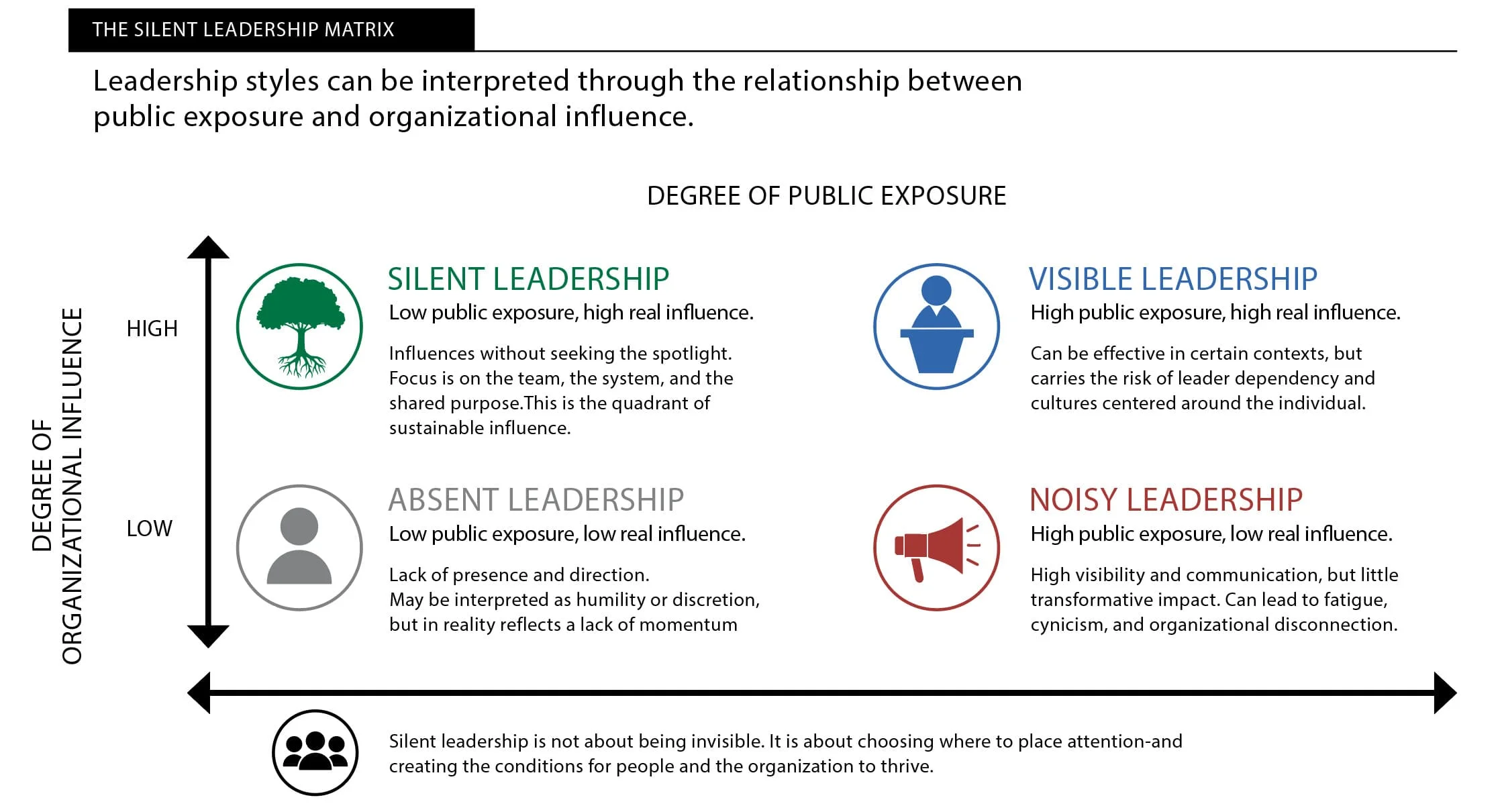
One useful way to understand silent leadership is through a simple two-axis framework based on visibility and organizational influence. While some leaders rely heavily on public exposure, others generate substantial impact with far less personal prominence. This creates four distinct leadership positions.
Four Organizational Leadership Positions
1. High Visibility – High Influence Visible Leadership
These leaders combine strong public presence with genuine organizational influence. They can be highly effective during periods of transformation, crisis, or large-scale mobilization because they inspire attention, emotional engagement, and collective momentum.
However, charismatic leadership also carries important risks. Organizations may become excessively dependent on the leader’s figure, making succession, distributed responsibility, and long-term sustainability more difficult.
2. Low Visibility – High Influence Silent Leadership
This is the quadrant of sustainable influence. Silent leaders shape organizations without constantly occupying the center of attention. Their impact emerges through culture, trust, systems, consistency, and long-term orientation rather than continuous exposure.
In these environments, attention shifts away from the individual leader and toward collective effectiveness, organizational maturity, and shared purpose.
3. High Visibility – Low Influence Noisy Leadership
Organizations increasingly encounter leaders who generate high levels of visibility but limited meaningful transformation. These environments often prioritize communication intensity over strategic depth, and symbolic activity over sustainable progress.
Over time, noisy leadership may contribute to organizational fatigue, cynicism, and reduced trust.
4. Low Visibility – Low Influence Absent Leadership
Not all silent leadership is effective leadership. Low exposure without direction, engagement, or strategic influence does not generate organizational value.
The distinction between silence and absence is therefore critical. Silent leadership is intentional and disciplined, whereas absent leadership reflects disconnection or lack of impact.
Ultimately, the matrix highlights an important organizational lesson: visibility and influence are not always aligned.
Why Silent Leaders Build Stronger Organizations
One of the greatest paradoxes of silent leadership is that reducing personal centrality often strengthens organizational capacity. When leaders stop positioning themselves as the permanent focal point, teams frequently gain greater autonomy, accountability, and confidence in their own decision-making.
This dynamic can have significant long-term effects on organizational health. Employees are more likely to develop ownership, collaboration, and initiative when leadership does not revolve around continual personal intervention. In these contexts, influence becomes more distributed and less dependent on a single individual.
Resilience Beyond the Leader
Silent leadership also tends to strengthen organizational resilience. Because authority is embedded in systems, culture, and shared responsibility rather than concentrated in one highly visible figure, organizations may adapt more effectively during transitions, uncertainty, or leadership succession.
Microsoft’s cultural transformation under Satya Nadella offers an example of leadership centered less on charismatic dominance and more on empathy, learning culture, and long-term organizational renewal.
This approach becomes especially valuable in knowledge-intensive and highly specialized environments, where innovation depends less on centralized authority and more on collective intelligence and professional trust. In such settings, leadership increasingly involves creating the conditions for others to contribute effectively rather than dominating every process personally.
Importantly, silent leadership does not eliminate accountability or strategic direction. Silent leaders still make difficult decisions, establish standards, and shape organizational priorities. The difference lies in how influence is exercised: less through symbolic dominance and more through trust, coherence, and long-term organizational responsibility.
Paradoxically, leaders who seek less attention may ultimately create stronger and more sustainable organizations.
Moral Authority in an Age of Exposure
As organizations become increasingly mediated by digital communication, visibility can easily be mistaken for legitimacy. Leaders are often evaluated not only by their decisions, but by how present, active, and publicly visible they appear to be. Yet visibility alone rarely creates lasting trust.
Trust Beyond Visibility
Silent leadership operates through a different source of authority: moral credibility. This form of influence emerges when employees consistently observe alignment between what leaders say, what they decide, and how they behave over time.
The leaders who leave the deepest organizational impact are therefore not always those who speak the most, but those whose actions remain coherent when visibility no longer guarantees legitimacy.
Unlike performative visibility, moral authority cannot be manufactured through communication strategy alone. It develops gradually through fairness, consistency, integrity, and relational trust. Employees tend to recognize these qualities not in isolated speeches or symbolic gestures, but in repeated everyday actions, especially during periods of pressure or uncertainty.
In highly exposed organizational environments, this type of credibility may become increasingly valuable precisely because it is increasingly rare. Workers are often capable of distinguishing between leaders who communicate effectively and leaders whose behavior genuinely inspires trust.
The leaders who leave the deepest organizational impact are therefore not always those who speak the most, but those whose actions remain coherent when visibility no longer guarantees legitimacy.
In this sense, silent leadership reflects a quieter, but potentially more durable, form of organiza-
tional authority.
The Limits of Silent Leadership
Silent leadership is not universally effective in every context. In periods of acute crisis, rapid transformation, or external uncertainty, organizations may sometimes require highly visible leadership capable of mobilizing attention quickly and symbolically. Excessive restraint can also generate ambiguity if teams perceive insufficient direction or emotional presence. The effectiveness of silent leadership therefore depends not only on the leader, but also on organizational context, culture, and timing.
Silent Leadership in the AI Era
The rise of artificial intelligence may further increase the relevance of silent leadership. AI is dramatically accelerating communication speed, information production, and digital visibility. Organizations are entering environments saturated with automated content, algorithmic amplification, and constant informational stimulation. In such contexts, attracting attention will become easier.
The future of leadership may depend less on being seen and more on being trusted.4
Human Leadership in Automated Environments
This transformation may fundamentally reshape the nature of leadership itself. As AI increasingly handles operational analysis, information processing, and communication support, leaders may derive less value from constant visibility and more value from uniquely human capabilities such as judgment, ethical consistency, emotional regulation, and long-term thinking.
In this emerging landscape, leadership may become less centered on performative presence and more focused on creating stable, trustworthy, and psychologically sustainable organizational environments.
Leaders such as Tim Cook have demonstrated that influence in highly technological environments does not always require hyper-visible leadership, but can also emerge through operational consistency, strategic discipline, and institutional trust.
Silent leadership aligns naturally with this transition because it places influence not in continuous exposure, but in the capacity to build credibility, cultural cohesion, and meaningful human relationships over time.
The AI era may therefore intensify an important organizational paradox: while technology amplifies visibility, effective leadership may increasingly depend on qualities that cannot be automated or artificially amplified.
As AI democratizes communication and amplifies visibility, trust may become the scarcest leadership resource of all.
Paradoxically, the future of leadership could become more human precisely because organizations will become more technological.

Leadership Beyond Visibility
For decades, leadership models have largely favored charisma, executive presence, and public visibility. Yet organizations today face a different challenge. They do not simply need leaders capable of attracting attention; they need leaders capable of building trust, stability, maturity, and sustainable influence in increasingly noisy environments.
Silent leadership offers an alternative logic of influence. It is not passive leadership, invisible leadership, or weak leadership. It is intentional leadership exercised through restraint, coherence, careful observation, and long-term responsibility.
The Future of Silent Influence
In the years ahead, the leaders who create the deepest organizational impact may not be those constantly occupying the spotlight, but those capable of strengthening organizations even when attention shifts away from themselves.
In an age saturated with visibility, the most transformative leaders may not be those who demand attention, but those whose silent influence allows others to thrive.
Silent influence may become one of the most valuable leadership capabilities of the next decade.5
Conclusion
In increasingly visible and digitally saturated environments, organizations may need to rethink what effective leadership truly means. Silent leadership does not reject influence, ambition, or strategic direction; rather, it proposes a more restrained and sustainable way of exercising them. As trust becomes a critical organizational resource, leaders capable of building credibility through consistency, humility, and long-term responsibility may become increasingly valuable. In the years ahead, the strongest leadership influence may not always come from those who speak loudly, but from those who create the conditions for others to thrive.