

By Tariro Mutizwa
Navigating the systemic friction of decentralised C-suites now necessitates that CEOs move beyond strategic aggregation to master the discipline of active strategic synthesis.
As executive teams grow increasingly specialized, aligning independent functions into a coherent enterprise agenda has become a defining structural challenge. This friction is not dysfunction; it is an inevitable byproduct of organizational maturity. Today, the competitive gap is defined less by functional expertise and more by the ability to integrate it, shifting the CEO’s role from strategic aggregator to an active synthesizer of competing functional priorities.
The decentralization of executive authority across the modern C-suite has significantly sharpened function-specific capabilities, but it has also created high-friction “Gridlock Zones” in the white spaces between functional strategies. When expertly designed plans optimize in parallel, their collision is not a sign of dysfunction, but an unintended consequence of organizational maturity. Maintaining a competitive advantage requires moving beyond strategic aggregation toward active strategic synthesis. By structurally balancing and sequencing these competing priorities, leaders can resolve this structural friction to drive sustained enterprise value creation.
The Paradox of Decentralization
The “Aggregator” model was the 20th century’s dominant paradigm, scaling linear businesses by consolidating discrete functional plans into a unified portfolio. While this served us well, it has reached its coordination limits in today’s digitally accelerated, highly complex business environment.
To maintain competitive speed, modern boards have wisely decentralized strategic authorship, elevating functional heads, such as the Chief Information Officer (CIO), Chief Data Officer (CDO), and Chief Growth Officer (CGO), into co-creators. This shift toward functional autonomy is a hallmark of organizational maturity; it empowers experts to make faster, more informed decisions at the edge of the business. Indeed, this evolution is evidenced by the 160% expansion of senior executive teams between 1990 and 2023 per SHRM and Burning Glass Institute study.
However, this successful shift toward a more democratic, distributed C-suite creates a paradox. While functional autonomy sharpens domain-specific decision quality, it exponentially increases the cost of enterprise-level coordination. We have successfully distributed the power to lead, but we have yet to evolve the mechanism to synthesize.
Defining the Democratisation Tax
The ‘Democratisation Tax’ is not levied on autonomy itself, but on the absence of cross-functional mediation. It manifests as the structural friction that emerges when autonomous strategies execute in parallel without a deliberate mechanism for integration. Crucially, this is not a sign of organizational dysfunction; it is simply the inevitable tax paid on modern complexity.
The Democratisation Tax functions as a structural trap. By optimizing within their respective domains, the CMO, CFO, and CIO are not creating separate strategies; they are inadvertently creating competing truths.
McKinsey’s research on organizational agility highlights that cross-functional misalignment is rarely the result of poor execution, but rather the predictable outcome of parallel optimization across specialized domains. Left unmanaged, this “Democratisation Tax” acts as a drag on the organization in three specific ways:
- Decision Latency: The widening gap between market signals and cross-functional responses.
- Coordination Debt: Unproductive hours spent reconciling misaligned departmental priorities.
- Capital Erosion: Lost enterprise value from fragmented, siloed resource allocation.
The result is clear: The organization stops moving at the speed of its fastest function and starts moving at the speed of its most complex internal reconciliation. Crucially, this is not a failure of leadership, nor a call to revert to the rigid hierarchies of the past. It is an indicator that your organization has outgrown its current operating system: as functions become more capable and autonomous, the necessity for explicit, structural synthesis at the enterprise level becomes absolute.
The Diagnostic Shift: Utilizing the Strategic Architecture Matrix
Faced with this decentralized complexity, many well-intentioned executives rely on “Strategic Aggregation”, a model that functioned as a pillar of past success but now faces the limits of modern volatility. To understand how organizations manage this tension, it is helpful to distinguish between two operating modes:
- The Aggregator functions as an elite facilitator, assembling high-calibre functional strategies into a broad portfolio. They implicitly ask: “How do we fit all these excellent functional initiatives into the enterprise strategy and budget?”
- The Synthesizer optimizes for interaction. They evaluate how strategies affect one another over time, sequence competing initiatives, and explicitly resolve trade-offs. They ask: “Which of these initiatives must we sequence or defer so the broader enterprise can thrive?”
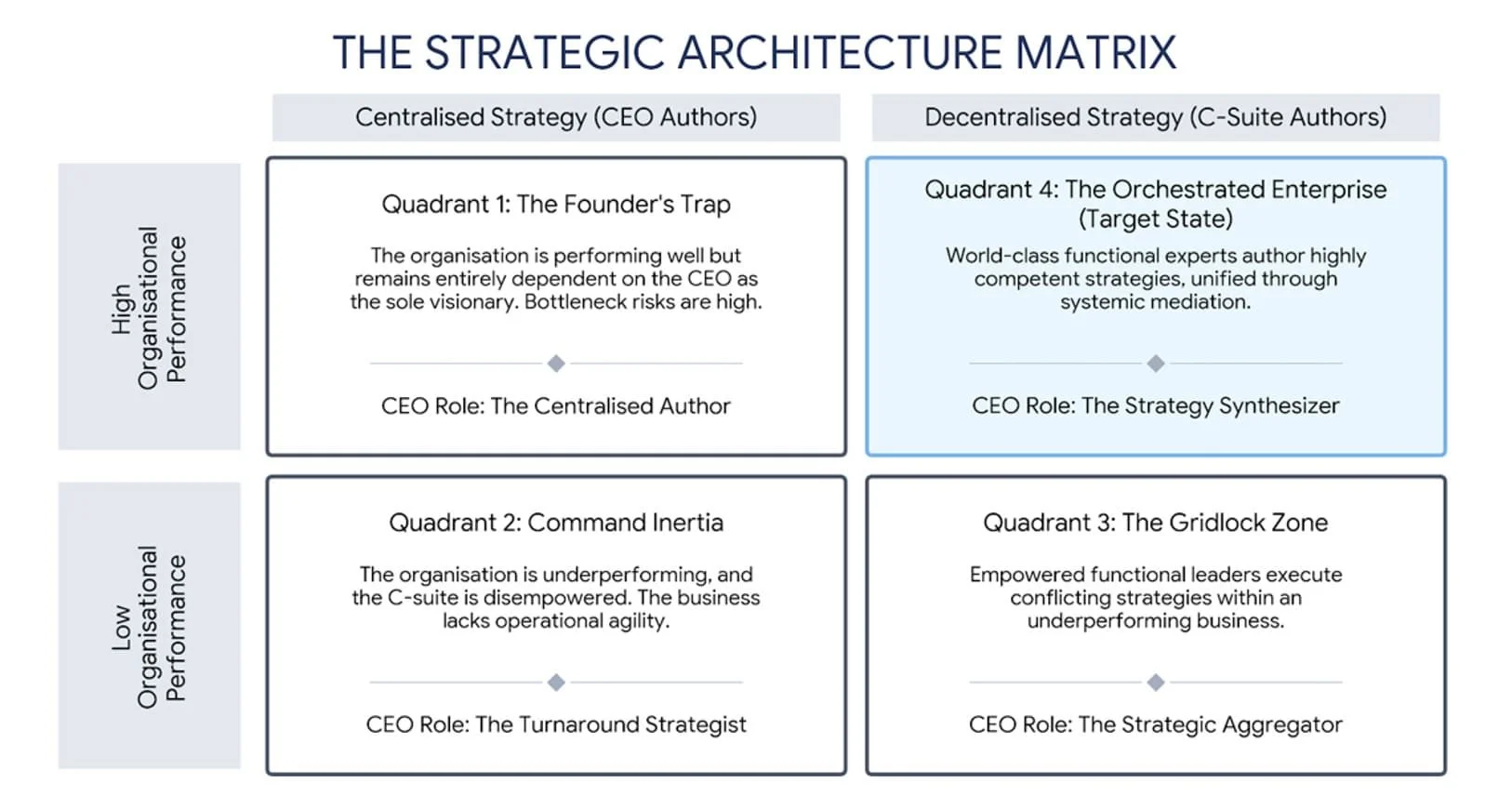
The critical differentiator is not the degree of functional autonomy, but whether that autonomy is structurally integrated through an explicit synthesis mechanism. To diagnose this, I use the Strategic Architecture Matrix. By mapping Strategy Autonomy (the extent to which functional leaders define their own agendas) against Enterprise Performance (the organization’s collective execution velocity and financial health), this framework exposes the “architectural gaps” that keep many organizations stagnant.
The matrix reveals a fundamental truth: functional autonomy is a competitive necessity, not a risk to be curtailed. The goal is to move beyond the structural extremes, the “Founder’s Trap” (where high performance creates a dangerous dependency on the CEO) and the “Gridlock Zone” (where decentralized autonomy breeds conflicting execution), toward the “Orchestrated Enterprise.” In this final state, functional independence is not stifled, but harnessed through a deliberate, structural mechanism of synthesis.
The Architecture of Strategic Integration
Moving from diagnosis to coordinated execution is where many teams falter. Dismantling the “Democratisation Tax” requires shifting consolidation to a structural framework for continuous trade-off resolution. This operating system rests on two distinct pillars:
- Defensive Architecture (The Systemic Blind-spotter): In hyper-specialized C-suites, risk typically compounds in the “white space” between functional strategies. A robust Defensive Architecture maps these intersections, formalizing the identification of execution gaps before they manifest as enterprise-level performance failures.
- Offensive Architecture (The Force Multiplier): Beyond risk mitigation, this framework catalyses growth by converting executive forums from reporting sessions into “trade-off arenas.” By using data to force debate on competing priorities, such as rapid acquisition versus infrastructure stabilization, the organization orchestrates the friction necessary to clarify resource allocation.
Putting the Pillars to Work: The XTY Case Study
To see these pillars in practice, consider XTY, an anonymised mid-sized supply-chain platform company. Like many firms, XTY was trapped in the “Gridlock Zone,” where functions performed well, but enterprise execution stalled due to competing imperatives:
- Commercial: A drive for rapid market expansion.
- Technology: An urgent mandate for AI modernization.
- Finance: Strict capital controls to mitigate risk.
These strategies were sound in isolation but created structural friction. To break the deadlock, the team transitioned to Strategic Integration using two architectures discussed earlier:
- Implementing Defensive Architecture: Instead of forcing plans into an aggregated portfolio, the team implemented a “Defensive” layer focused on dependency mapping. They evaluated initiatives based on systemic interaction effects rather than standalone value. This surfaced “white space” risks, revealing that technology modernization throttled commercial expansion, allowing them to move from reaction to orchestration.
- Implementing Offensive Architecture: With dependencies mapped, the team triggered the “Offensive” pillar to resolve trade-offs via a dynamic model:
- Constraint-Based Evaluation: Initiatives were measured against shared enterprise constraints (e.g., total organizational capacity) rather than functional KPIs.
- Explicit Sequencing: Where conflicts existed, they moved from “do it all” to staged execution, intentionally delaying parts of the AI rollout to ensure the Commercial team had bandwidth.
- Dynamic Capital Allocation: Resources were pivoted in real-time based on enterprise priorities, not departmental legacy.
Within two planning cycles, XTY reduced cross-functional execution delays and stabilized leadership turnover. The turnaround succeeded by replacing functional optimization with a structural mechanism for synthesis.
The Board’s Evolving Oversight Role
Boards have long recognized that financial results are merely lagging indicators of organizational health. In complex, decentralized enterprises, the perennial challenge is not simply what decisions are made, but how effectively those decisions are integrated across the enterprise. Consequently, the focus of governance has evolved toward the architecture of execution.
Alignment is now treated as a measurable performance variable rather than a subjective governance concern. Boards increasingly scrutinize the mechanisms of synthesis, evaluating whether the executive team possesses the structural capacity to resolve trade-offs in real time. When these mechanisms are absent, the resulting slower execution cycles, high coordination costs, and reduced adaptability is no longer viewed as an unfortunate side effect, but as a systemic failure of strategic design.
Conclusion
In an era of hyper-specialization, competitive advantage is no longer determined by the depth of singular functional strategies, but by an organization’s capacity to integrate those strategies into a coherent, sequenced engine of execution. The shift from aggregation to synthesis is not a theoretical evolution, it is a fundamental requirement for the modern CEO.
The most resilient organizations have moved beyond aggregation of functional plans, choosing instead to architect the trade-offs between them. The pressing question for modern leadership is no longer whether your functional executives. are experts in their domains, but whether you have institutionalized the structural architecture necessary to make them experts in the enterprise. Ultimately, the future of competitive advantage lies not in functional brilliance, but in the structural mastery of execution.
Disclaimer: The views expressed in this article are my own and do not reflect the position of my employer. This piece is intended as a personal contribution to the ongoing discourse on organizational strategy.
 Tariro Mutizwa