

By John Almandoz and Carlos Rey
It’s one thing to talk about corporate purpose, quite another to make it happen in a way that has real-world meaning for those at all levels of the organisation. In this article, the authors offer a framework designed to assist leaders in doing just that.
Corporate purpose has become a hotly debated topic in recent years, yet its practical implementation often lags behind the rhetoric. Defining purpose is only the starting point; the real challenge lies in living it—creating an emotional connection to a set of ideals and translating them into tangible actions and practices. Purpose is not a slogan; it is a strategic and cultural force that shapes how organisations operate and how they impact society.
This article explores purpose-driven leadership as a multidimensional concept, combining internal motivations—the intrinsic and transcendent motivations of employees—with external impact—in response to societal or environmental challenges. Drawing on insights from companies such as Unilever, Best Buy, ISS, La Fageda, Anglo American, and DaVita, we examine how leaders can embed purpose into the very fabric of their organisations—turning aspirations into reality.
- Best Buy Co., Inc., founded in 1966 in Richfield, Minnesota, is an American consumer electronics retailer. Facing competition from Amazon, its sector declined. CEO Hubert Joly led a dramatic, purpose-driven turnaround of the company in 2012.
- Unilever, formed in 1929, is a major consumer goods company with a longstanding focus on social and environmental responsibility. Under CEO Paul Polman (2009-19), Unilever became a champion of sustainability and advocated for climate action and human rights.
- ISS, established in Copenhagen in 1901, is a global company that delivers facility management services like security, cleaning, technical support, food, and workplace solutions. Its purpose has been defined as “connecting people and places to make the world work better.”
- La Fageda, a Spanish yogurt maker founded in 1982 by psychologist Cristóbal Colón, provides jobs for people with mental disabilities, operating as a social enterprise.
- DaVita offers kidney dialysis in the U.S. and abroad. CEO Ken Thiry led a successful transformation starting in 1999 by establishing a purpose-driven culture and renaming the company DaVita, meaning “giving life” in Italian.
- Anglo American, a global mining company founded in 1917, underwent a significant cultural and safety transformation under CEO Cynthia Carroll (2007–13), who prioritised worker welfare and bold operational reforms in an industry long resistant to change.
Corporate Purpose Dimensions
Recent research identifies two complementary perspectives of purpose—inside-out and outside-in1—along with three key dimensions—head, heart, and hands2. Together (figure1), these lenses offer a robust framework for leading with purpose, enabling leaders to transform it from an abstract ideal into a living force that inspires people and shapes society.
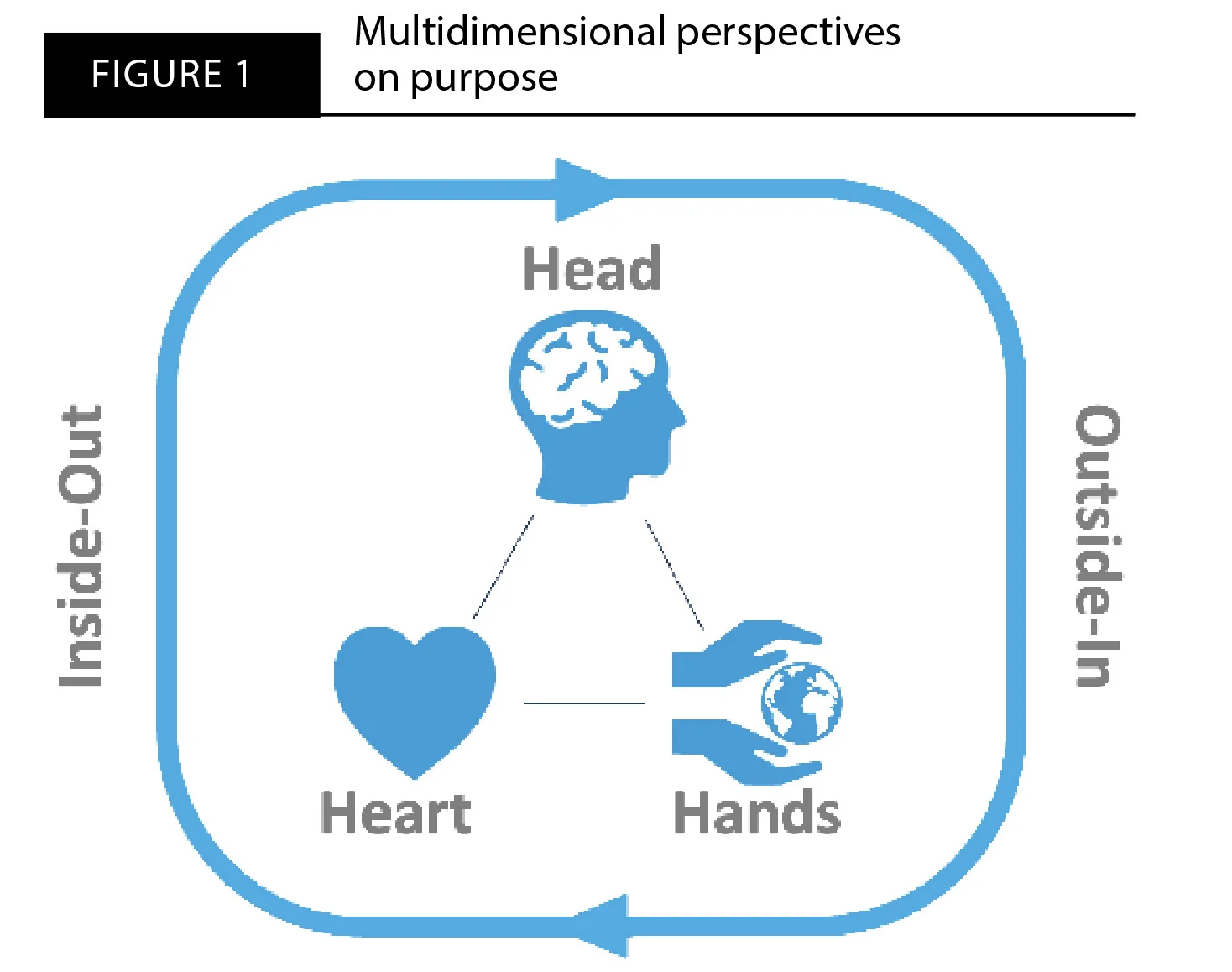
Inside-Out and Outside-In Perspectives
Understanding corporate purpose begins with two complementary lenses: inside-out and outside-in. Together, these perspectives illuminate how organisations balance and integrate internal motivational alignment with the external impact that society increasingly demands.
- Inside-Out: this perspective focuses on aligning an organisation’s purpose with the values, beliefs, and aspirations of its members. When employees find personal significance in their work, they become more passionate and committed, contributing energy and creativity to organisational goals. Leaders play a critical role as “meaning-makers,” articulating a purpose rooted in core values and inspiring employees by making their impact visible—connecting daily tasks to service or a greater cause.
- Outside-In: this perspective emphasises a company’s responsibility to address broader societal and environmental challenges, such as social injustice and climate change. Leaders adopting this perspective act as “statesmen,” prioritising systemic impact, building legitimacy, and collaborating with external organisations to advance social causes.
The Three ‘H’ Dimensions of Purpose
Purpose is not one-dimensional. It comes to life through three interconnected dimensions—head, heart, and hands—that transform lofty ideals into strategy, emotion, and action.
The Head
Purpose must be clear. This dimension focuses on the rational articulation of purpose. It involves defining and clearly communicating the organisation’s reason for being, answering questions such as: What is our business for? What should our business become? The head dimension establishes a coherent vision that connects strategic objectives with societal contributions.
The Heart
Purpose must resonate emotionally, not just intellectually.
Purpose must resonate emotionally, not just intellectually. The heart dimension ensures that purpose aligns with the values and aspirations of stakeholders, creating a shared sense of meaning. Emotional engagement is cultivated through stories and narratives that bring purpose to life, inspiring genuine commitment and passion.
The Hands
Purpose must be operationalised. The hands dimension ensures that purpose is embedded in actions, decisions, and day-to-day operations. This includes aligning performance metrics, integrating purpose into incentives, and demonstrating commitment through leadership and participation in initiatives—even social movements. The hands dimension transforms purpose from an aspirational ideal into a lived reality.
The Six Key Drivers of Purpose Implementation
Purpose-driven leadership is not a one-time declaration; it is a continuous process that requires alignment across strategy, culture, and operations. Within the inside-out and outside-in perspectives—and across the dimensions of head, heart, and hands—we identify six fundamental drivers that enable organisations to lead with purpose effectively (see table 1).
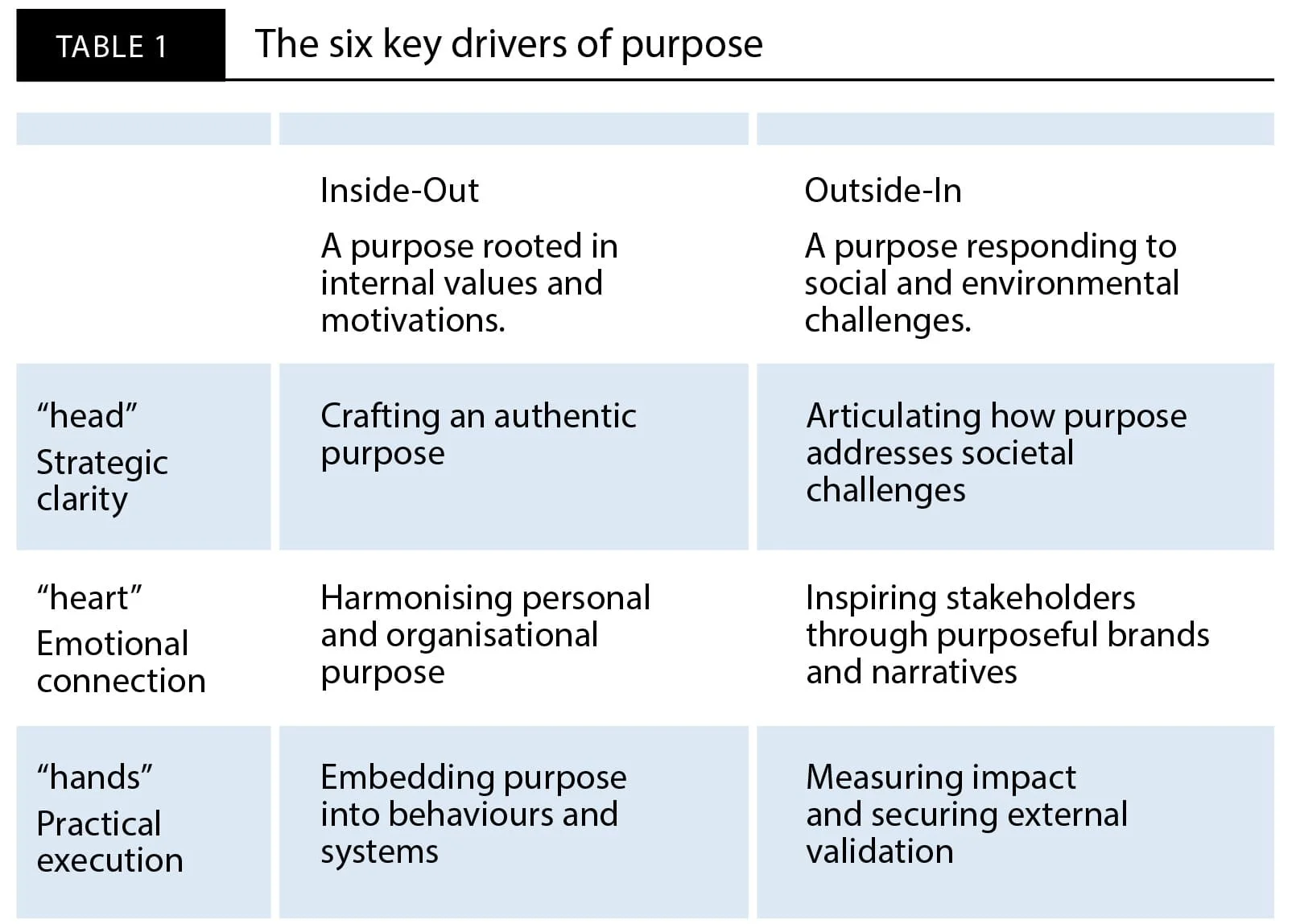
1. Crafting an authentic purpose (Head–Inside-Out)
Defining and communicating a company’s purpose is the cornerstone of the inside-out approach. This involves articulating why the organisation exists and what makes it unique—not as a vague aspiration, but as a rational foundation for strategy and decision-making. A well-crafted purpose brings clarity, aligns teams, and strengthens identity.
Authenticity is critical. Purpose must resonate with the company’s values and culture, making it more than words on paper. Many organisations draw on founder motivations or internal stakeholder needs. For example, La Fageda was born from Cristóbal Colón’s vision to provide meaningful work for people with mental disabilities. Yogurt production became the means to fulfil a deeper social mission—the actual work could have been something very different— creating a strong sense of identity and shared meaning.
Similarly, Unilever, under Paul Polman, revisited its historical roots to shape a narrative that connected sustainability with its core business. DaVita engaged employees at every level to co-create and articulate its values, fostering ownership and alignment. Best Buy used executive retreats and workshops with frontline staff to define its values, which ensured broad buy-in, turning purpose into a shared commitment. Other companies may use tools such as the Ikigai framework—exploring the intersection of contribution, passion, capabilities, and financial sustainability—to help them define a purpose that inspires and endures.
2. Articulating how purpose addresses societal challenges (Head–Outside-In)
A purpose confined to internal motivations risks appearing self-centered or narrow. Increasingly, companies are redefining their purpose to address societal challenges—social, environmental, and ethical. This outside-in perspective involves engaging with systemic issues and aligning the company’s mission with broader stakeholder needs.
Unilever exemplifies this evolution. Beyond its roots in hygiene and nutrition, it championed sustainability and social equity through initiatives such as the Unilever Sustainable Living Plan, the €1 billion Climate and Nature Fund, and campaigns like #Unstereotype. Its brands integrate activism into messaging, advancing causes like climate justice and body positivity. The company’s commitment extends to ensuring living wages across its supply chain and combating modern slavery—actions that reinforce trust and legitimacy.
Other organisations, such as La Fageda and ISS, expanded their impact by supporting communities and improving working conditions. Patagonia shifted from producing outdoor gear to leading environmental activism. These efforts demonstrate that success can be measured not only by profit but by contributions to societal well-being.
3. Harmonising personal and organisational purpose (Heart–Inside-Out)
Purpose must be internalised—not just understood intellectually but felt emotionally. This inside-out “heart” dimension transforms corporate values into a shared source of motivation. When employees see how their work improves lives, engagement deepens. Motivation becomes more intrinsic and transcendent.
Best Buy’s CEO Hubert Joly reframed the company’s mission around “happiness,” inspiring employees by connecting their efforts to customer well-being. Research by Adam Grant shows that gratitude from beneficiaries significantly boosts employee commitment. Companies like ISS and DaVita reinforce this connection through storytelling, recognition rituals, and symbolic language—calling employees “teammates” or “citizens” and referring to the company as a “village.” These practices foster belonging and shared purpose.
True internalisation also requires leaders to show genuine care for employees, recognising their values and aspirations. Initiatives such as ISS’s community programs strengthen emotional bonds. Large-scale training, like Unilever’s personal purpose workshops, illustrates how embedding purpose throughout the organisation can inspire thousands and foster a vibrant, purpose-driven culture.
4. Inspiring stakeholders through purposeful brands and narratives (Heart–Outside-In)
Internal alignment is essential, but credibility depends on external legitimacy. Companies with a strong outside-in “heart” perspective inspire stakeholders by addressing societal challenges and championing meaningful causes. Leaders act as statesmen and responsible role models, setting industry standards and rallying others to create positive change.
Purpose-driven marketing connects brands with values. When companies weave their mission into slogans and campaigns, they differentiate themselves and build loyalty. Examples include Warby Parker’s “Buy a Pair, Give a Pair” initiative and Dove’s body positivity campaign, which embed social impact into brand identity. Rebranding around purpose can transform culture. DaVita, meaning “giving life,” rebranded itself and took that name to foster a community-first mindset focused on service. These narratives galvanise not only employees but also patients and their families and creates goodwill in the communities proving that purpose can be both inspiring and commercially powerful.
5. Embedding purpose into behaviours and systems (Hands–Inside-Out)
Purpose must move beyond words and emotional connection to become actionable. The “hands” dimension ensures that purpose is integrated into core processes—recruitment, performance evaluation, promotion, and incentives. When behaviours and systems reflect values, purpose becomes a lived reality.
When behaviours and systems reflect values, purpose becomes a lived reality.
Companies operationalise purpose by equipping employees with tools and knowledge to embody values in their work. ISS conducts workshops for frontline staff, while DaVita uses recognition systems to reward values-driven behaviour. In both organisations, team-building activities connect leaders to the mission through service, reinforcing cultural alignment.
Measurable goals are essential. Leading companies like Unilever and Best Buy set ambitious targets—from sustainability milestones to employee engagement metrics. Tracking progress demonstrates commitment and builds trust among stakeholders.
6. Measuring impact and securing external validation (Hands–Outside-In)
Internal systems are vital, but self-assessment alone can lead to bias or complacency. To ensure objectivity, organisations increasingly adopt external frameworks such as ESG (environmental, social, and governance) criteria, SROI (social return on investment), and certifications like B Corp. These tools provide rigorous methods for quantifying impact and benchmarking against global standards.
External validation enhances credibility and drives continuous improvement. By integrating these frameworks into operations, companies demonstrate that their commitment to purpose is genuine, measurable, and aligned with societal expectations.
Starting from Within: Leadership at the Crossroads
Leadership stands at the crossroads of the inside-out and outside-in perspectives of organisational purpose, serving as the pivotal force that unites them. Great leaders don’t just connect with their organisation’s history and core values; they cultivate authenticity and pride among employees, building a strong, cohesive culture. This deep internal orientation, as shown in the example of La Fageda, can create lasting bonds, but risks an excessive company-centered outlook unless balanced with openness to the outside world.
Equally important is a leader’s ability to interpret and respond to the shifting expectations of society and external stakeholders. By integrating their organisations into broader social systems and engaging with groups such as unions, as demonstrated by ISS, and regulators, leaders ensure that their companies remain both legitimate and impactful beyond internal boundaries. The best leaders understand that external collaboration amplifies their organisation’s collective influence and credibility.

However, our research—based on these six cases presented in this article and over 100 companies studied across 15 years—shows an important sequence: authentic purpose-driven leadership starts from the inside-out and is reinforced by the outside-in engagement, not the other way around. True purpose isn’t imposed by outside pressures or regulatory demands. It’s first forged in a leader’s personal convictions, often rooted in the values and company history, then refined by responding to the world around them. When this sequence is followed, inside-out and outside-in perspectives reinforce each other, creating a meaningful and sustainable sense of purpose.
The six-drivers framework illustrates how purpose may spring from within, then may grow to shape the world outside, uniting personal conviction and societal impact. When leaders inspire their organisations with genuine purpose, they not only foster social change but also infuse daily work with meaning. Lasting purpose is not an external mandate; it is a journey that begins in the head, heart, and hands of leaders and radiates outward, transforming both business and society.
Cynthia Carroll’s early leadership at Anglo American shows how inside-out and outside-in purpose can be mutually reinforcing. She began with a deeply held personal conviction that every miner deserves to return home safely, which directly confronted one of the mining sector’s most entrenched societal challenges. Rejecting the industry’s fatalism about deaths, she reframed safety as a moral non-negotiable, then worked to translate this conviction into organisational purpose by building a guiding coalition of internal influencers who shared her intolerance for preventable harm and by inspiring broader stakeholders with a bold narrative of “zero harm.”
Yet she quickly discovered how difficult it was to embed this purpose into behaviours, systems, and mindsets across a vast, hierarchical, and historically divided organisation. With little external pressure for reform, Carroll deliberately activated outside-in forces by engaging the South African government, the National Union of Mineworkers, and local communities to form the Tripartite Alliance, an unprecedented partnership aimed at raising safety standards across the entire industry. She opened the company to public scrutiny, co-hosted a national safety summit, and initiated global benchmarking of best practices. The results were substantial: fatalities fell from 44 in 2006 to 17 in 2011, a 62 per cent reduction. Over time, she built mechanisms for measuring impact and securing external validation, revealing a central truth: authentic purpose can spark transformation, but operationalising it demands sustained coalition-building, systemic redesign, and the intentional mobilisation of societal actors.