
Interview with Asha Palmer of Skillsoft
Compliance is no longer a checkbox. It is a catalyst for ethical innovation andstrategic growth. Asha Palmer, SVP of Compliance Solutions at Skillsoft, shares howtoday’s leaders can stay ahead of regulation, shape company culture, and build AI-ready organizations rooted in trust, transparency, and real-world accountability
What originally drew you to the field of compliance, and how has your personal mission evolved alongside the changing landscape of regulation and ethics?
I’m a lawyer & litigator by background, so my role was to help people and companies after they were in trouble. But I always felt there was an opportunity to help people before they got into trouble and deter and prevent problems from arising. That is the core of ethics and compliance – the opportunity to empower individuals and companies to protect themselves and their organisation against risk and harm before things go wrong.
As for my personal mission, that has never changed. The profession of ethics and compliance has an extreme opportunity to impact the lives of individuals and the cultures of companies by positively influencing behaviour and empowering people to take the right actions that keep themselves and their companies safe. Regardless of how regulations shift, my mission remains the same: to empower individuals to understand and comply with these changes and to meaningfully act in accordance with them.
As a leader in compliance, how do you personally stay inspired and resilient when navigating complex, high-stakes regulatory environments?
I stay inspired and resilient by embracing the fact that truly effective and efficient compliance is hard. There is a powerful concept called “relentless incrementalism” that keeps me motivated to make small changes and small improvements every day in my job, profession and the people and cultures I impact through my work.
When we empower people to apply the insight they learn and put it into practice in safe environments, they’re better equipped to navigate the complex, high-stakes regulatory environment around them.
Getting a little bit better, a little bit more empowered and a little bit more confident to make the right decisions in the right way is all we can do. When we empower people to apply the insight they learn and put it into practice in safe environments, they’re better equipped to navigate the complex, high-stakes regulatory environment around them. They understand the risks, what’s at stake and how to mitigate and manage those risks.
In your role at Skillsoft, how have you seen the compliance function shift from a back-office obligation to a strategic driver of organisational culture?
This shift occurs once a company sees compliance as a necessity to drive business strategy and culture. It involves understanding the nature of the business, its operations, markets and stakeholders, alongside the potential risks it may encounter or generate. Managing these risks effectively becomes essential to conducting business responsibly. The integration of compliance into areas like AI development demonstrates how it can play a strategic role in guiding organisational decisions while also protecting against potential risks.
Can you share a career-defining moment where you realised the true power of aligning compliance with business purpose?
During my time as an Assistant U.S. Attorney (AUSA), albeit brief, I quickly and truly saw the impact of failing to align compliance with business purpose, and the impact it can have on people, culture, and organisations. When ethics and compliance are disconnected from business purpose, objectives and performance or outcomes, it will lead to failure. It will fail to manifest itself in the actions of the individuals who act on behalf of the organisation, in its leadership and in its organisational culture. Compliance can only succeed when it is aligned with business purpose, objectives, and outcomes.
With the EU moving toward regulatory simplification, why is internal engagement and upskilling more critical than ever—even when the rules are ‘simplified’?
As the EU AI Act seeks to simplify regulatory requirements, internal engagement and upskilling are more important than ever. While simplification may streamline external reporting, it doesn’t reduce the complexity of applying these rules in real-world contexts. In fact, in many cases, it shifts the burden inward, placing greater responsibility on employees to understand and apply evolving standards.
That’s why compliance must be woven into the fabric of the organisation through tailored, risk-based training that reflects the realities of different roles, regions and generations. AI literacy should be treated as a foundational skill, with training that goes beyond theory – using simulations, scenario-based learning and knowledge checks to help employees build confidence and real-world capabilities.
Equally important is organisations investing in their employees and building a culture where compliance is a shared responsibility, understood and embraced across the business. Ultimately, simplified laws don’t eliminate complexity – they just shift the focus inward.
How can compliance leaders help ensure ethical innovation, especially in emerging technologies like AI, without slowing down progress?
Compliance leaders can drive ethical innovation by integrating governance directly into the innovation process rather than treating it as a barrier. This begins with asking the right questions early, particularly around data privacy, algorithmic bias and transparency.
Rather than slowing progress, this integrated approach builds trust, reduces risk and accelerates the safe and responsible deployment of emerging technologies.
It also means developing agile, adaptable policies that evolve alongside technology. When legal, IT, product and compliance teams work together from the outset, they build a shared understanding of both the risks and the opportunities AI presents. Open dialogue, establishing ethics boards and creating a culture of continuous learning help ensure innovation stays aligned with organisational values.
Rather than slowing progress, this integrated approach builds trust, reduces risk and accelerates the safe and responsible deployment of emerging technologies.
What should the next generation of compliance leaders focus on to build transparent, AI-ready frameworks that work both locally and globally?
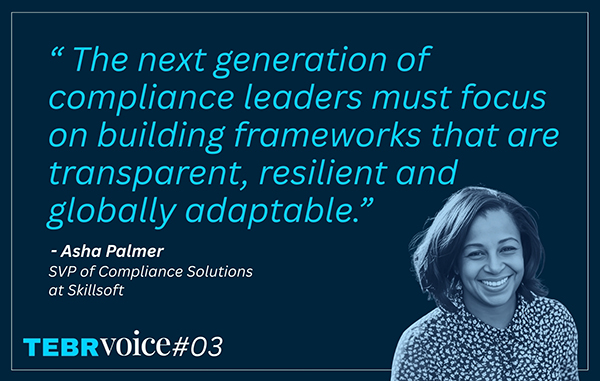
The next generation of compliance leaders must focus on building frameworks that are transparent, resilient and globally adaptable. This means aligning compliance with innovation, ensuring AI systems are explainable, fair and ethically designed throughout every stage of development.
It also calls for targeted investment in role-specific training and fostering a culture of continuous learning, so teams are equipped with the skills to navigate emerging risks and shifting regulations with confidence.
Transparency should be reinforced through regular audits and open communication with stakeholders. At the same time, collaboration with internal and external experts ensures governance models remain responsive to diverse regulatory demands and scalable across global operations.