
By David Booth and Eva Tomas Casado
The business environment is changing, and strategy needs to follow. Traditional strategic planning methods no longer serve their purpose in today’s complex, unpredictable world. This article explores how organizations can build dynamic strategy capabilities that embrace uncertainty, foster adaptability, and integrate futures thinking, ensuring ongoing thriving in an ever-changing landscape.
All is in flow – so is strategy
The ability to adapt and transform is and has been a survival necessity in the complex environment our world creates. While we accept this as a given, the pace of the changes around us in the past few decades has come as a surprise for many. For example, while businesses in the past operated for long periods on the same business models in relatively stable industry sectors, this is no longer the situation today: according to PwC’s Annual Global CEO Survey this year, 40% of CEOs believe their companies won’t be viable in 10 years if they continue on their current trajectory.
Yet our management tools and methods have not kept pace with these challenges: the traditional approaches to strategic planning, which served organizations well in the past, are no longer sufficient. They are designed for a more stable environment: their approaches are too linear and static, based on predictions and extrapolations, and fail to account for the complexity and non-linearity that is the reality of our world today.
So how can organizations start their journey into a different way of strategizing, one that addresses the reality of today’s environment in a more holistic and coherent way, considers the uncertainties of futures with confidence, and enables the organization to adapt and respond dynamically to challenges and opportunities as these futures evolve?
Changing the approach to strategy
Developing such a dynamic and ongoing approach to strategy requires a shift in focus within an organization – away from the dogmatic application of tools and frameworks to developing its strategy capabilities.
Capabilities, in this context, refer to the broader organizational potential that combines both knowledge and skills, allowing a company not only to perform tasks effectively but also to adapt, innovate, and deploy those competencies flexibly in the face of changing conditions and uncertainty. Importantly, they also involve developing the organizational mindset and shared understanding about how the organization is approaching strategy and thinking about the future.
This focus on capabilities is arguably a major and fundamental development in organizational strategy: as Professor Kurt Verweire states, “Strategy is no longer about finding a favourable position in a well-defined industry and exploiting a long-term competitive advantage: it’s about building dynamic capabilities to cope with changing conditions and turbulent times.” (‘Strategy in Turbulent Times‘, Lannoo, 2023)
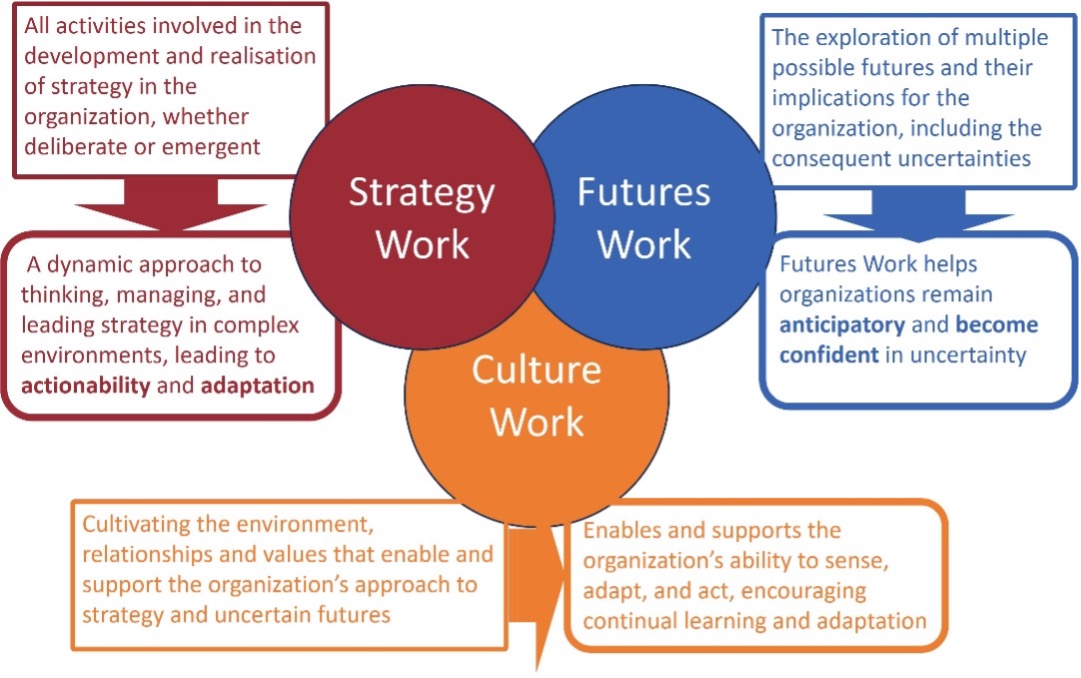
There are three key aspects that organizations need to consider in developing a more dynamic approach to strategy:
- How strategy ‘flows’ in their organization: the conversations, processes and engagement that occurs in their ‘Strategy Work’, including considering multiple possibilities and anticipating and responding to any changes in the organization’s ‘ecosystem’, continuously adapting decisions and actions as situations evolve.
- How the organization considers multiple possible futures and their implications and integrates this ‘Futures Work’ into their strategic thinking. This is more than strategic foresight and scenarios planning: the goal is to become more confident in uncertainty and to develop an anticipatory mindset. By embracing futures as a resource organizations become more resilient and adaptive.
- How it cultivates the organizational culture (the environment, relationships and values) that enables and supports the organization’s approach to strategy and futures – how people are engaged in strategy and supported in decisions and risk-taking, and fostering continuous learning to create an environment where adaptability is sustainable rather than draining.
What strategy capabilities should organizations consider?
These three key aspects do not operate in isolation, they are shaped through each other. Strategy is shaped by and shapes the future, and its effectiveness depends on the organizational culture that supports it. Strategic thinking directly influences futures thinking, and vice versa, while culture underpins both by enabling them.
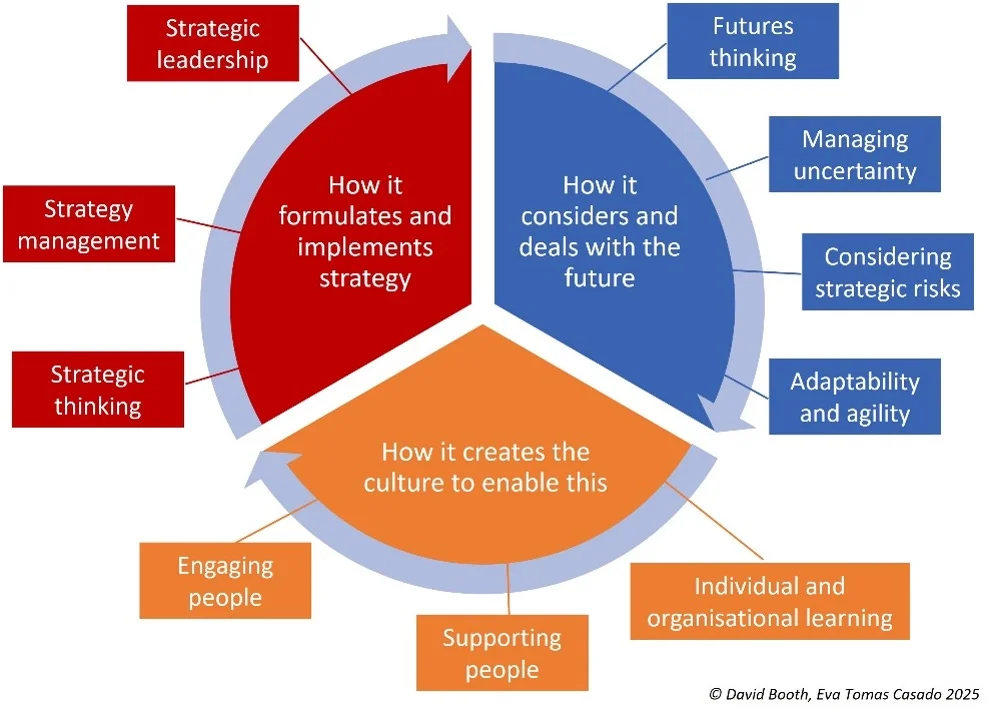
Considering these three key aspects together offers a conceptual structure to help frame this, but to provide more actionable clarity we need to look at the key capabilities embedded in each aspect.
- Strengthening the organization’s ‘Strategy Work’ capabilities includes the strategic thinking abilities of people across the organization, both individually and collectively; how strategy develops and is managed, the processes by which strategy conversations occur and decisions are made; and how strategic leadership guides and enables this
- ‘Futures Work’ capabilities include not just the skills, thinking and processes by which the organization considers various futures and their implications and integrates this into its strategy work, but also developing the organizational mindset to accept the lack of certainty and to begin to view this as an opportunity. There are implications too for how the organization assesses and manages strategic risks, and – critically – how it can respond and adapt to opportunities or challenges (actual and anticipated) with agility and confidence
- How the organization engages people in this, and how it supports them, are key capabilities within the ‘Culture Work’ domain, fostering adaptability, risk taking, and continual learning (both individually and for the organization as a whole)
Since the three aspects are interconnected, the capabilities within them can’t be developed in isolation—they grow together, not apart.
How do organizations strengthen these strategy capabilities?
The first step in building strategy capabilities is to acknowledge that there is no single “magic bullet” or ‘best practice’ method that will transform the organization’s approach to strategy. Rather, this is a journey of continual development, working collectively through aspects of these capabilities across all three of the ‘domains’, making adjustments (which will depend on the organization’s context, maturity, and readiness for change), and learning from the experience of putting these into practice. These are iterative steps that together help cultivate a more adaptive and responsive approach to strategy over time.
These gradual improvements – whether it is incorporating creative futures practices, regular horizon scanning to sense future changes, moving towards participatory practices that engage the wider organization in setting the strategic direction, or piloting small, safe-to-fail experiments in organizational units – serve to strengthen the organization’s overall strategic capabilities and enable it to navigate uncertainty with greater agility. It is for each organization to embark on their own journey to build the strategy capabilities they need to thrive in an unpredictable world.
At the same time, it is important not to discard traditional strategy practices altogether. Traditional strategic methods still hold value. They provide valuable insights into the current landscape and offer clarity in well-defined contexts. However, their applicability is limited in an environment where the degree of complexity means that linear predictability is no longer possible: strategy needs to be treated as a dynamic, evolving process that adapts to the needs of the organization, the market, and the changing global landscape. The key lies in understanding the strengths and weaknesses of traditional strategy tools and methods and recognizing when it is appropriate to use them—while also embracing new approaches that allow organizations to anticipate, sense, and adapt to the complexities of the future.
Strategy is an ongoing journey
Strategy is not a fixed point on the horizon, nor is it a one-time event – it is an ongoing journey. Organizations need to be prepared to adapt continuously, refining how they think about and act on strategy. The journey is not linear; it is iterative, where every step forward informs the next.
By shifting from method-driven strategy to a capability-centered approach, organizations can enable adaptive strategy. This ongoing journey begins by focusing on three interrelated areas – Futures Work, Strategy Work, and Culture Work – each carrying essential capabilities that need to be developed together, not in isolation.
This is not a one-time effort but an ongoing process of action, learning, and improvement. It is the interplay of these ‘building block’ capabilities that strengthens the organization’s ability to navigate uncertainty with agility and foresight, positioning it for sustained success in a volatile world.
 Eva Tomas Casado
 David Booth