
Interview with Nikolas Badminton
Organisations that combine AI with futures thinking and human insight are better equipped to innovate, adapt, and create lasting value.
As AI reshapes how organizations operate, leaders face a critical question: Are they using technology to create lasting value, or simply automating existing ways of working? Futurist and Hope Engineer™ Nikolas Badminton explores why true transformation requires more than AI adoption, offering insights on strategic foresight, human capabilities, organizational resilience, and building better futures.
Having advised organizations such as NASA, Google, Microsoft, and the United Nations on AI and strategic foresight, what common patterns have you observed that distinguish organizations creating lasting business value from AI from those that remain stuck in pilots and experimentation?
Many of these organizations – and those similar in size and scale – feel that the pressing tasks at hand are more important than slowing down and considering what will unfold in the futures ahead of them, and us all. This means that they are in constant reactionary mode with little thinking of what comes next. That means reduced resiliency with respect to unforeseen risks, missed opportunities for innovation and investment, and stifled growth. What comes eventually is stasis and a slow decline headed towards obsolescence.
When our moral senses, sensibilities, and beliefs meet with the hope for a better world and the hope to make an impact today.
Real leaders that embrace the ideas of hopeful futures implement a layer of futures thinking to complement the strategic and delivery work. That’s where The Hope Engineer’s Playbook comes in by encouraging increased adaption and at the intersection of futures work and hope with imagination, anticipation and empathy:
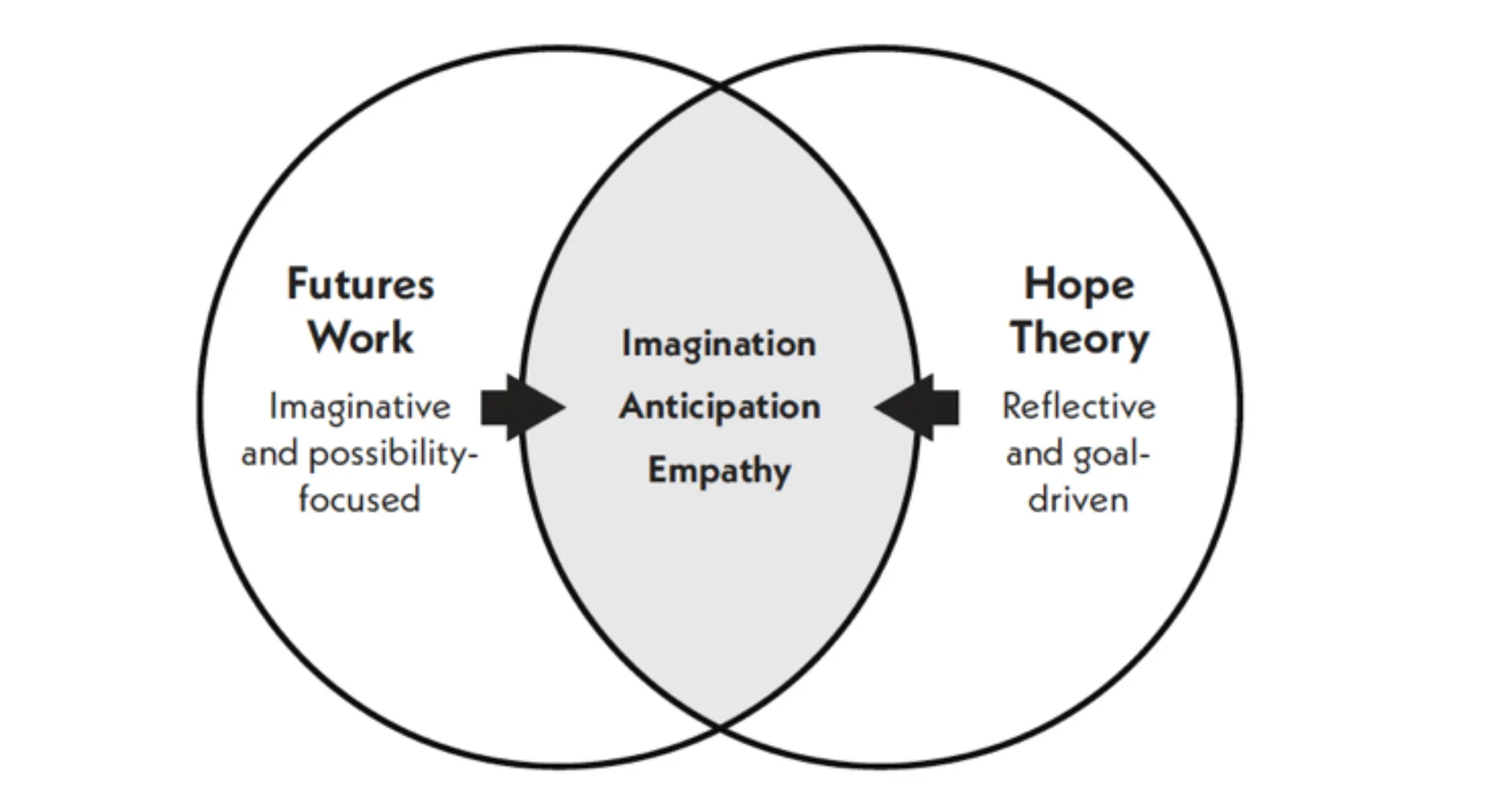
- By igniting imagination—and asking “what if …” to stimulate scenarios exploration—we push ourselves outside our boundaries of what is expected and expected into a creative territory of unlimited possibilities.
- Through building anticipation, we start to see what might come next and that builds a preparatory sense in the organization. Considering the signals of change, the emerging trends, and the scenarios that might play out uncovers opportunities and challenges ahead of competition and gives us resiliency and an ability to wonder “what if …” when considering what might happen.
- Then by deepening empathy – our deeply human ability to communicate, listen, and understand the feelings of others – we can start to truly feel the futures ahead of us. When our moral senses, sensibilities, and beliefs meet with the hope for a better world and the hope to make an impact today.
Business leaders are under pressure to deliver quick results from AI investments. How can they balance short-term productivity gains with the longer-term innovation and transformation that AI promises?
Here’s the thing – it’s not about productivity. It’s about rethinking how we can best undertake the work we do and applying AI tools just enough to boost our inherent human capabilities driven by futures thinking, hope and guided by wisdom. In fact, it’s been found (by ActivTrack) that employees who spend 7–10% of their total work hours in AI tools have the highest productivity rates.
AI, in fact, reminds leaders that their organizations are wildly inefficient and there’s work to be done to rethink people + process + information + technology + governance at all levels of the organization. AI ROI really is a misnomer when we consider this. But, without implementing AI organizations will be left under the foundational ceiling of capabilities that every other competitor is building. It’s almost worth noting it as ‘survival technology’ and through that urgency gains are likely to be seen in some smaller ways.
Organizations often treat AI as a technology initiative rather than a business strategy. How should leaders rethink AI’s role in driving long-term transformation?
AI is not the strategy.
It’s a tool in the stack of methods, frameworks, tech tools and processes. AI, in fact, must be less of an emotional play and one framed as tech – albeit great and transformational tech – that people can use to augment their capabilities.
There is a business hangover though. With new tech there comes new ways of thinking and working and new work in the mix i.e. checking information, editing, applying our knowledge and wisdom.
As AI takes on more analytical and routine work, what uniquely human capabilities will become more valuable, and how should organizations cultivate them across their workforce?
Next level creativity – unique thinking and ideas – will be key and the moat between us and AI as will the futures work, we undertake with hope for better futures and the imagination, anticipation and empathy we nurture.
Honesty up and down the organization – We should not continue to find application for AI everywhere. Yes, test. Then quickly qualify value and move along to find deeper work. In my hopeful futures work I use methods like ChatGPT optimizing prompts for Gemini Deep Research to go to town on new futures exploration and strategies. Then it’s human work where we discuss thoughts, discount, embellish and take to the next level to create useful artifacts to be used in the organization.
Many companies are adopting AI, but few are transforming how they operate. What separates true business transformation from technology adoption?
Technology adoption is more closely related to a transaction. You buy the licenses, deploy the models, automate a workflow, and report a change (better, worse, different and hopefully better). The trap is that some sense of efficiency (or investment in the face of pressure in the organization and/or industry) can feel like progress. There is much to look out for as we can easily automate our way deeper into a faltering strategy and that is a real risk.
Impactful transformation starts from the opposite end. It begins with a vision of better futures and the conviction that we can build it together. That’s hope engineering, and we must have three things: an audacious goal, considered pathways to reach that, and an individual and collective agency that created a renewable energy for change. AI can be great at widening those possible pathways forward by surfacing new options and reducing the distance between idea and action and it lets more people contribute and be recognized as part of the progress being made. We have a reminder here – AI cannot supply the goal or create the agency. Those are deeply human, and leadership has to be ready to nurture them.
As technological change accelerates, how can leaders build organizations that embrace uncertainty without losing strategic focus?
Leaders need to stop trying to predict the future and start preparing for several by exploring scenarios and creating stories of the futures ahead of us to see the possible unknown dynamics – wins, losses, changes, risks, and likely behaviours. This allows for us to stress-test our strategy by asking ‘what would we do if…’ before we’re forced to. Then futures-ready leaders stop seeing uncertainty as a threat to manage and it’s reframed as a source of intelligence: we see change coming while your competitors are still reacting to it. That can mean more opportunity, resiliency, revenue and even market capitalization.
A fixed point on the future horizon, many pathways to reach it, and people with the energy and agency to keep moving forward in the face of hard times.
None of this work holds without the agency applied to projects and programs. If every change must travel up and back down the hierarchy or an organization, you’ll be coherent yet too slow. Organizations that achieve change towards better and more hopeful futures give their people a clear sense of the destination and real authority over the route. They can move more fluidly and quickly at the edges without losing the intention at the heart of the change needed.
This is the discipline of hope engineering: a fixed point on the future horizon, many pathways to reach it, and people with the energy and agency to keep moving forward in the face of hard times.
Looking ahead, what AI-driven shifts do you believe business leaders are underestimating, and how should they prepare for them?
The cost of transformation is being wildly underestimated. This comes from two sides: the infrastructure and the wisdom side of things.
Infrastructure may become more affordable over time however it will lead to complexity being introduced to the business architecture – even with the same or potentially fewer people.
With wisdom we need to remind ourselves that we build and maintain this day-by-day. There’s intellectual effort in this and those leaders that consider the need to build a ‘wisdom economy’ as imperative will see huge change in attitude and ability across their organizations.
If you could change one assumption executives have about AI, what would it be, and why does it matter?
That AI is ‘magical technology’ that delivers on exponential capabilities and change without a deeper and more considered transformation across the organization. The hard work is truly starting now – the tests and pilots have been run, then tech has been tried, and now someone must be responsible to usher in organizational transformation across people + process + information + technology + governance.