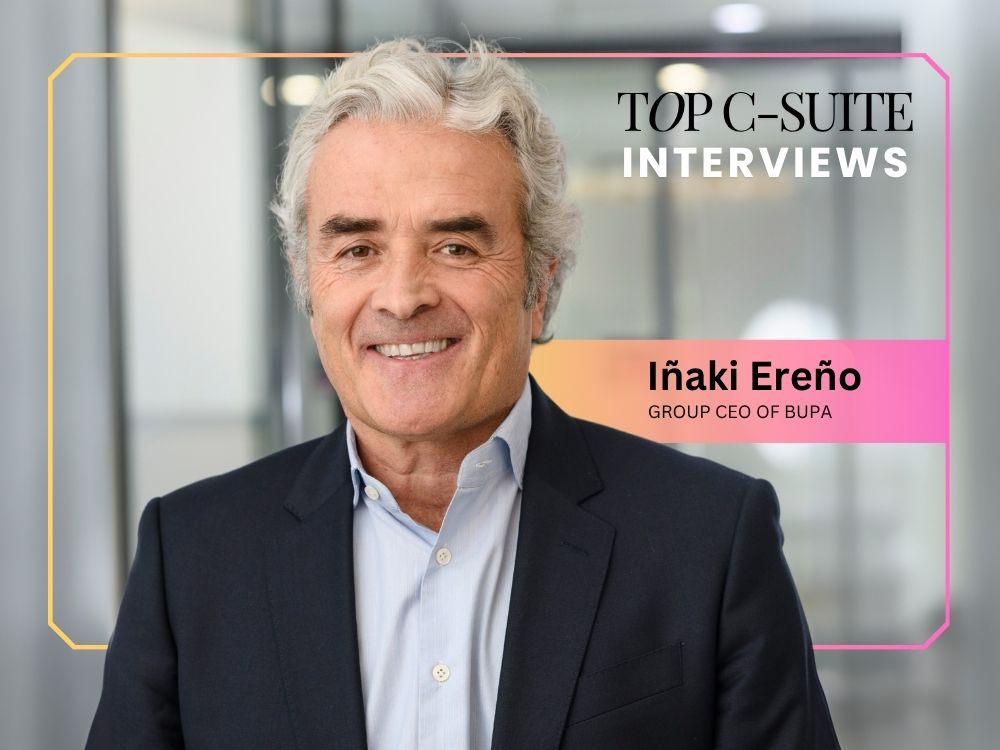

The health sector has gone through some testing times since Iñaki Ereño became part of it in 2005, including COVID-19. Now Group CEO of Bupa, he puts into focus the group’s priorities and achievements, as well as its ambition to become the world’s most customer-centric healthcare company.
Hello, Iñaki. Thank you for taking the time to speak with us today. To begin, you’ve had a remarkable journey from leading Sanitas (part of Bupa) in Spain to becoming Group CEO of Bupa. What key experiences have shaped your leadership style?
I first joined Sanitas in 2005 and it’s hard to believe that it is now 20 years ago! I became CEO in 2008 and that timing coincided with the Spanish financial crisis. That was a very hard situation to navigate, and it had a huge impact on my leadership style, because to survive we needed to choose a growth mindset no matter what the obstacles were. We had to find new, creative ways to work and to be resilient through it all.
Another experience that shaped my leadership style was the knowledge that healthcare as an industry needed to transform. As a sector, healthcare has been slow to digitise. We wanted to offer something different and provide care in a way that customers experience other consumer products and services so that it is on their terms.
My leadership style evolved again during the COVID-19 pandemic. It was a very intense period. We were caring for people in very tough situations and some of our patients and residents did not survive this terrible virus. We wanted to honour them and make sure that we always spoke their names and that those impacted were all remembered for the people they were, and not as a statistic. The organisation demonstrated its immense capacity to be caring at this time and that has shaped my leadership style, too.
How have these experiences influenced the way you steer a global healthcare business today?
We can never be complacent. That’s especially true for a global healthcare company, where our customers are relying on us to deliver for them in one of the most important areas of their lives. Bupa is over 75 years old, which is a wonderful achievement, but we need to keep adapting. We are a unique company who do not have shareholders. Our structure means we are able to reinvest our profits back into the business and into our purpose, ensuring we are constantly improving the services we provide for our customers.
These improvement ideas can be small, for example training our dental reception teams to be able to detect a nervous patient and put them at ease when they arrive for an appointment. Or, the innovation can be in the form of much more significant business initiatives; for example we are making a significant investment in expanding mental healthcare support by opening 200 mental health facilities called “mindplaces” worldwide.

Since taking the helm in 2021, what shifts or transformations are you most proud of initiating?
We’ve grown hugely as a business over the past few years; we now have more than 60 million customers worldwide and 100,000 colleagues. We’re growing faster than the market average, too, and that is testament to the hard work of the teams around the world and their growth mindset, and I’m truly inspired by them.
We’ve also made a lot of progress towards our ambition of becoming the world’s most customer-centric healthcare company. We’ve built a customer system so we can listen to our customers’ feedback right across the organisation via a customer listening app, and we’ve asked all our colleagues to listen and generate ideas to improve the experience that we provide wherever possible.
Since 2022, we have listened to nearly 200,000 customer calls and made over 24,000 customer improvements. As a result of this, our customers’ likelihood to recommend us is now much higher than ever before, which makes us all incredibly proud, while recognising that there is always more we can do.
This focus on our customers and their experience has also had a significant impact on our colleagues and their sense of pride. We measure colleague engagement twice a year and our latest results from May 2025 saw 87 per cent of colleagues participate and give an engagement score of 83 per cent. I am especially positive because there were so many comments provided, which shows that our people believe we take their feedback very seriously, too, which we definitely do.
Having worked across diverse markets in Europe and Latin America, what leadership lessons have you learned from managing teams across different cultures? How have these insights shaped your approach to leading Bupa?
It has been extremely valuable to build a broad perspective from working across our different markets. A big reflection for me is how to communicate well and keep it simple. We want our strategy to be understood around the world by every colleague, which means we need to be simple, clear, and consistent.
In 2021, one of the first projects we introduced was the launch of an internal communications platform so that all our 100,000 colleagues could connect with each other. Through this platform, there are hundreds of groups which have been spontaneously created on different topics, where our people can ask each other questions, share problems, and find solutions together, no matter which country they are working in.
While we’re a global company that benefits from global collaboration, it’s clear that each market faces a range of different needs and challenges, whether that’s different regulatory environments, healthcare landscapes, or cultural trends. It is so important to empower the local management teams, who know their market and are best placed to take care of the customers who live there.
Fostering innovation at scale is a major challenge for any multinational. How are you cultivating a culture at Bupa that empowers employees to take smart risks and learn from both success and failure?
One of the biggest shifts has been reshaping Bupa’s culture. In early 2021, we consulted with the leadership team about streamlining the company’s values and together we refined them from seven down to three: Brave, Caring, and Responsible.
We consulted with the leadership team about streamlining the company’s values and together we refined them from seven down to three: Brave, Caring, and Responsible.
Caring and Responsible were more established and expected values, but Brave was deliberately new. Bravery is central to the culture we’re building here at Bupa. That means pushing boundaries, taking calculated risks, and innovating – and that applies to everyone.
We want all our colleagues to be involved and to think of innovation as both the big, exciting, strategic ideas and the small suggestions that each make such a difference for our customers. With our customer listening app and the ability to listen and make improvement suggestions, we’ve tried to create a tool that enables every single colleague to be able to innovate.
How is the business’s leadership focusing on fostering talent and supporting people’s careers at Bupa?
We’ve had a strong learning and development programme in place for our colleagues for years, but we’ve recently made additional investments to ensure that our people have the skills and confidence to thrive in their careers and change the future of healthcare.
In June 2025, we launched a global initiative, known as Bupa Campus, that is bringing together the best in physical and digital learning experiences, creating a modern way of growing the skills of our people, to deliver better care for our customers. While it is a global programme, it will be tailored to the specific needs of each market.
We also take advantage of our global footprint to learn from each other, offering short-term placements, long-term relocations, or temporary secondments to the various Bupa offices across the globe. We want to do even more to offer mobility in a flexible way and to encourage more colleagues to try something new, boosting their skills and capabilities.
Bupa’s ambition is to become the world’s most customer-centric healthcare company. How is your digital health solution Blua transforming the healthcare experience for customers globally?
Blua, our digital health solution, is core to our customer-centric philosophy. Blua gives our customers access to virtual consultations, digital health programmes, and remote healthcare, which is revolutionising the way we deliver care. And our customers agree – we’re seeing widespread adoption across our markets, with 7.5 million customers already using the service globally.
Blua is always evolving. A good example of this is the “Monitor your Health” feature used by our Spanish customers with chronic illnesses like arrhythmias or high blood pressure. Instead of waiting for issues to arise, the “Monitor your Health” feature detects early warning signs, enabling patients to set goals and make lifestyle adjustments proactively, helping to prevent potential health problems.
Blua also integrates with customers’ wearable devices to sync their real-time health data directly with a team of healthcare professionals, including doctors, psychologists, nutritionists, personal trainers, and physiotherapists.
In 10 years, I think we’ll look back and wonder how we managed our health without this kind of digitisation. The potential is massive.
You’ve spoken passionately about the link between planetary health and human health. How is Bupa embedding a sustainable approach into its global operations?
It’s undeniable that human health and the health of the planet are linked. To help people stay healthy, we are working to help create healthy environments where everyone can thrive. We call this our “better world” strategy and there are three core elements.
Firstly, we want to help even more people access affordable and preventative healthcare. We have set ourselves the target of helping 25 million people in this way by 2027.
Secondly, we want to help improve the environments where people live: cities. As part of our ongoing “Healthy Cities” initiative, we’re working to get our people, customers, and communities active. We want to support at least 50 cities to become healthier places to live in over the next few years by investing in projects that champion healthier, more inclusive communities and that ultimately will contribute towards creating a healthier society.
Lastly, we want to invest in nature restoration, too, reducing our impact on the planet and restoring key nature ecosystems. Our intention is to ensure that 75,000 hectares of nature can be restored in order to support people’s health. It’s a big, ambitious plan but one that we are tremendously excited about delivering.
As you look to the future, what is your vision for Bupa’s role in shaping global healthcare?
It’s an incredibly exciting time; we want to become the world’s most customer-centric healthcare provider and redefine what people expect from a healthcare provider.
Through this process, we know that we will find solutions and create tools that we can share beyond Bupa, finding new methods to help the whole healthcare sector improve how we serve customers and patients. We want to encourage even more sharing between private healthcare providers and public health systems for the benefit of all.
This will be a game-changer for global healthcare, revolutionising our ability to prevent and treat disease so we can live longer, healthier, happier lives.
And finally, as a CEO, how do you define success?
We have a method for measuring success that we call a “performance triangle”. As you would expect, there are three elements, given that it’s a triangle! Financial performance is obviously key. Making sure we have a strong, sustainable business that is generating profit and enabling us to reinvest in our purpose is one of the core elements.
In addition, we must prioritise customer experience. Having customers that recommend our services to others and that choose to stay with us and trust us to look after their health needs is a critical factor in our success.
And finally, it’s about doing the right thing for our colleagues, investing in their development, supporting their careers, and listening to their feedback. High rates of colleague engagement are the third element to our triangle.
Success, to me, means delivering each of these factors in balance, so that each side of the triangle is equal, ensuring that one aspect does not overpower the others. Strong financial performance, and customers who highly recommend our services, and a team of colleagues who are highly engaged and want to do their best work is when we know we have been successful.
 Mr. Iñaki Ereño