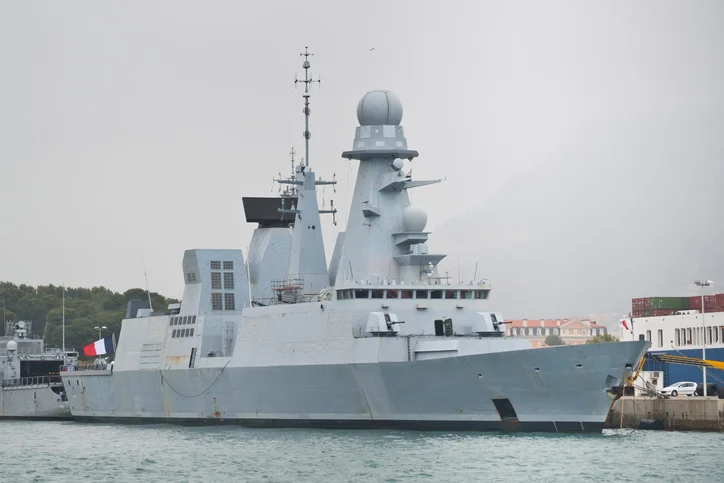
Continuing the successful FDI HN programme, on November 18th, Greece announced it signed a contract with France’s Naval Group to co-construct, with “25% of the value of FDI HN4 in local content,” its fourth defence and intervention frigate (FDI). A relief for the French DTIB, which, despite ranking second among global exporters, has had a few recent setbacks.
Norway recently chose British BAE System’s Type 26 frigate over Naval Group’s FDI and it also appears India plans to scrap an almost signed deal for new Scorpène submarines for an offer from Germany’s Thyssenkrupp Marine Systems. KNDS France (formerly state-owned Nexter) had a similar experience after losing an order, likely to European contenders, from Qatar for 490 VBCI armoured vehicles used by the French army, synonymous with high standards and real operational experience, after nine years of negotiations.
Last March, the Stockholm International Peace Research Institute (SIPRI) revealed that France had replaced Russia as the world’s second largest arms exporter with 9.6% of global exports, behind the United States’ 43%. The French DTIB is comprised of 4,000+ companies and 225,000 jobs, led by global powerhouses including Thales, the French division of European conglomerate MBDA, Safran, Naval Group, KNDS-France and Dassault. Recently questioned during military budget hearings about such companies, Catherine Vautrin, France’s current Minister of the Armed Forces, responded, “We are the clients but also shareholders of a number of these companies and these relations must remain balanced.“
Indeed, this symbiotic relationship is crucial, but delicate, as Le Monde describes France’s “ambition for independence, it produces almost all of its military equipment, enabling its land, naval and air forces to avoid reliance on “off the shelf” purchases from the Americans and other European suppliers.” The French DTIB relies on orders from the French army, but given France’s limited procurement ambitions, it also relies on exports to survive and needs the government’s help with diplomatic backchanneling to seal deals.
France Hasn’t Conquered Europe, Yet
Indeed, Éric Pommellet, President of the French Maritime Industry Association (Gican) and of Naval Group, says his industry needs to move from 40% exports to 50% and that, “We are leaders in Europe, the continent where competition is the sharpest since it is home to the majority of naval defence players, such as Germany, Spain, Italy, Great Britain or the Netherlands,” but other new rivals threaten this position including China, South Korea, Israel and Turkey.
Defence budgets across Europe are up and with EU nations, except Spain, pledging 5% spending on defence by 2035, the European market represents an enormous opportunity for the French DTIB, but according to SIPRI, 64% of Europe’s arms imports since 2020 have come from the U.S. From 2019-2023, France’s exports grew 47%, supplying 64 countries with India receiving 29%. Only 9.1% of French exports went to Europe, with 53% of that directed to Greece.
To seize the opportunity of Europe’s widespread rearmament, French manufacturers and politicians must figure out how to overcome certain challenges. One problem is European countries’ tendency to prefer “off the shelf,” mainly American, products. The Center for European Reform observes that while France and EU officials push for less reliance on Washington, Nordic/Baltic states and Poland prefer to buy “off the shelf” arms to meet missing capabilities with the U.S. seen as the historically reliant supplier.
There is also the problem of internal competition. Germany has drastically increased military funding, projected to rise to €83 billion in 2026, but nearly half of its military expenditures from 2020-2024 went to German companies and another third to ventures involving German companies. Like Rheinmetall, with recent record sales, who has pursued partnerships with American companies including Lockheed Martin and Anduril, in an attempt to become the major European defence contractor in all domains. Then France’s Defence Minister Lecornu has argued against such licensing agreements saying they give “the illusion of European sovereignty.”
Indeed, recent concerns about dependence on the United States and its technology could represent an opportunity for French companies as France is working to position its DTIB as providing combat-proven, politically-autonomous products. Bruegel reports that officials from Portugal, Switzerland and Denmark have expressed concerns about ‘kill switches’ and Spain and Portugal are reconsidering F-35 purchases because of sovereignty concerns. Dassault is upgrading its Rafale fighter to the F5 standards with advanced electronic warfare capabilities to be delivered in 2027 as a non-American alternative.
Prioritising Partnerships, especially in Europe
French manufacturers have also demonstrated their capacity for shared design and production, particularly in electronics, with Thales working with British, French and Italian navies to produce the CAPTAS system for variable depth sonar technology, used by 17 navies worldwide. The company also joined forces with MBDA to develop the SAMP/T air defence system that is gaining notoriety after proving its efficacy in Ukraine and being selected by Denmark over the American Patriot system. The next generation of SAMP/T is being developed for 2026-2027 with new Aster 30 B1 NT missiles.
French companies have also demonstrated their willingness and aptitude for partnering with clients for construction within countries to transfer high-end know-how and technology. Naval Group has done this over the past two decades in India, co-building six Scorpène submarines. In 2024, Macron announced the co-production of a third Scorpène in Brazil and that France would help build Brazil’s first nuclear-powered submarine. Naval Group was also chosen by the Netherlands to build four Barracuda submarines with Dutch Royal IHC.
Bilateral and multinational partnerships let French industry shine in what it does best, while sharing the cost and workload as with France and Britain’s creation of the MBDA consortium in 1997 to develop SCALP/Storm Shadow missiles. The missiles have proven their worth in Ukraine, but also serving the French army. This legacy continues as the two countries signed the Lancaster House 2.0 agreement this summer with a new “entente industrielle.” They pledged to increase SCALP production and to begin the development phase of its successor under the STRATUS programme (with Italy), with MBDA developing two complementary missiles: STRATUS RS with speed and manoeuvrability and STRATUS LO for stealth.
France also recently signed a letter of intent with Poland to cooperate on developing ground-launched cruise missiles with 1,000+ km ranges. The two countries are part of the European Long-Range Strike Approach (ELSA) and French MBDA’s Land Cruise Missile (LCM), based on its battle-proven Naval Cruise Missile (MdCN) is being positioned as a lead contender for ELSA’s first project.
These are all opportunities that only signed government contracts can translate into reality, with European orders potentially having an imitation effect on other markets. This is crucial for France at a time when its economy is otherwise declining. As Jean-Michel Jacques, president of the French Assembly’s Committee on National Defense and Armed Forces, argues, “We must have a real return on investment on our defence spending and make our territories benefit from the impact of European defence budgets. Let’s not forget that a euro invested in our defence creates two euros of wealth in the medium term.”