Digitalized systems are generally supposed to represent improvements on non-digital predecessors, but what if we could distill and blend the most appropriate essences of each?
In this article, Silvia Gadola, Daniel Trabucchi, and Tommaso Buganza of the School of Management, Politecnico di Milano describe how unconventional platforms, by adopting a new and agnostic perspective on the mechanisms digitized into digital platforms, can lever physical spaces, human interaction, and digital tools to create hitherto overlooked forms of value.
Introduction
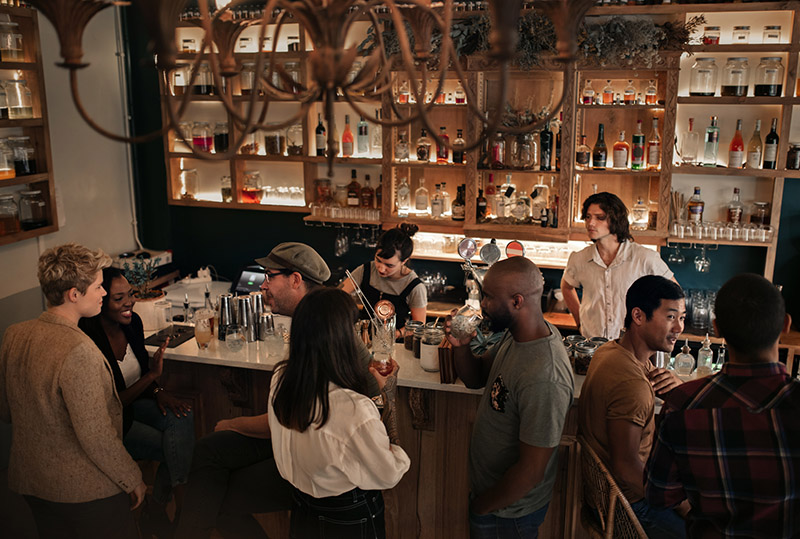
Imagine walking into a room full of strangers looking for the same thing you are: a meaningful connection. No profile to check, no screen to scroll through, and no algorithm deciding who you should meet. Instead, the setting itself helps you take the first step. A few prompts and structured interactions make approaching someone easier, while what happens next is left to you. The match, if there is one, emerges from interaction and exchanged glances.
This is the idea behind Break the Swipe, an Italian event format created as an alternative to Tinder and other digital dating apps, giving people the confidence to meet strangers, again, in a physical setting. While Tinder turned dating into one of the most recognizable examples of digital matchmaking, Break the Swipe brings that same fundamental challenge: connecting people with potentially complementary needs back into a physical environment. Similar initiatives, such as Pitch-a-Friend, point in the same direction: matching people beyond algorithms and swipes.
Despite the enormous opportunities that digitalization brings in our lives, unconventional platforms do not challenge this progress.
These cases suggest an intriguing possibility. What if some of the mechanisms that made digital platforms so powerful do not have to remain digital? Platforms such as Airbnb, Uber, Shopify, Amazon, Spotify, and Tinder have shown how effectively technology can connect different actors and facilitate exchanges at scale. Yet digitalization is only one way of orchestrating these interactions. Despite the enormous opportunities that digitalization brings in our lives, unconventional platforms do not challenge this progress. Instead, they remind us to keep exploring how value can also emerge from the physical and relational dimensions of businesses that are here to stay.
As platform business models continue to transform how organizations create value, one question becomes increasingly relevant: what role can physical proximity and human interaction play in platform value creation?
What Changes When Matchmaking Moves Beyond the Algorithm?
When managers think about platforms, Airbnb, Uber, Amazon, or Tinder usually come to mind. Despite their differences, these businesses share three basic features: they connect at least two interdependent customer groups; the value for each group is influenced by the presence of the other and by network effects, encouraging platforms to build sufficiently large networks; and a central platform facilitates their interaction. Digital technologies have made these mechanisms exceptionally powerful by expanding reach, accelerating exchanges, collecting data, and improving matchmaking precision.
But none of these underlying mechanisms necessarily requires an algorithm. When digital mediation is reduced, the mechanisms do not disappear, they change.
Break the Swipe makes this shift visible. Rather than matching people through a screen, it brings participants into the same physical setting and uses prompts, groups, and nudges to help them initiate conversations. Participants are guided enough to overcome the uncertainty of approaching strangers, while remaining free to decide how the interaction develops. In this setting, value depends less on the sheer number of potential matches and more on the quality of encounters and participants’ willingness to engage.
This is consistent with platform thinking, which focuses on the mechanisms through which platforms create value rather than on digital infrastructure alone.
Where Can Unconventional Platforms Hide?
Unconventional platforms do not describe a single organizational form. They identify different settings in which platform mechanisms can emerge through physical spaces, organizational processes, and human action. These three layers move progressively from a tangible spatial dimension toward increasingly human-driven forms of orchestration.
Is the space simply hosting people or actively helping them connect? Break the Swipe and innovation spaces show that co-location alone is not enough. Venue layout, prompts, and small-group interactions can reduce uncertainty and create the conditions for participant-led conversations. In the CDL format, a program designed to support start-up innovation, physical interaction is used to bring start-ups together with mentors, turning the space into part of the matchmaking mechanism rather than a neutral backdrop.
Physical space can also blur its boundaries and extend into organizational settings, where unconventional platforms can nurture knowledge sharing and collaboration. In Confcooperative Lombardia, an Italian association supporting local cooperatives, platform thinking was used to address knowledge scattered across organizational units. Employees seeking support were reframed as the demand side, while employees holding relevant knowledge or best practices became the supply side, with collaboration itself becoming a matchmaking process. The result was a human-driven organizational process that empowered employees to find the right support and make better use of best practices already available across the organization.
Finally, who becomes the algorithm when there is no algorithm? People do. Employees, organizers, managers, champions, and community members can identify needs, surface resources, connect individuals, validate information, and sustain interactions. In unconventional platforms, individuals do not merely operate inside the platform. Through active listening, engagement, and awareness of complementarities, they can enact the platform mechanisms themselves.
What If Scale Is Not the Goal?
The conventional platform playbook often assumes that more users create more value, as illustrated by worldwide platforms such as Airbnb, Uber, or Spotify. Unconventional platforms suggest a different question: what kind of network creates the value we actually want?
The first shift is from quantity to quality. When the asset exchanged is knowledge, trust, or collaboration, a smaller network can still create substantial value if it enables meaningful connections. The Digital Innovation Observatories at Politecnico di Milano, a research platform centered on in-person interaction around digital phenomena, illustrate the tension between keeping a network large enough to sustain reputation, interest, and diverse insights, but small enough to preserve engagement and meaningful interactions.
The second shift is from global scale to local embeddedness. Physical and relational platforms operate within bounded networks, but proximity can support trust, repeated interaction, and access to resources rooted in a specific community. The Digital Innovation Observatories offer another scaling path: rather than turning one community into an unlimited network, they identified a repeatable format and replicated it across adjacent thematic fields while preserving focused communities. Unconventional platforms can therefore scale through a compound network structure composed of smaller, relatively independent networks.
This locally bounded evolution also reveals another opportunity: using platform mechanisms to support social and sustainable goals by activating local communities and resources. Platform cooperatives, for example, combine platform mechanisms with democratic governance, local embeddedness, and fairer value distribution. Nonprofit organizations can do something similar through different forms of resource orchestration. Make-A-Wish, for instance, matches trained volunteers with children to help fulfill their wishes, while relying on donors to sustain the service. In this setting, human matchmaking becomes a mechanism for creating social rather than purely economic value.
Why Do Unconventional Platforms Matter?
Recognizing unconventional platforms changes what managers are able to see. First, it makes hidden assets and roles more visible. Knowledge, relationships, physical spaces, local networks, or employees’ expertise may already exist, yet remain underused because no mechanism connects them with those who need them.
Second, the platform lens highlights interdependencies. Once managers distinguish who is seeking something, who can provide it, and what prevents them from interacting, they can identify new directions for innovation. The response may be a new interaction mechanism, a stronger orchestrating role, or a different way of involving people who already belong to the organization or ecosystem.
Third, unconventional platforms broaden the meaning of scalability. Growth does not have to come only from adding users. The Digital Innovation Observatories show that organizations can codify a successful format, replicate it in adjacent fields, and reuse the knowledge generated across initiatives. Local connection can therefore remain central while the overall platform expands.
Finally, unconventional does not mean anti-digital. Digital tools can complement these mechanisms when they enhance a value-creation logic that already works. In the Observatories, for example, accumulated knowledge from non-digital communities later supported a digital extension, allowing that knowledge to reach customers who could not participate in the physical setting. The managerial opportunity is therefore to treat technology as one possible layer of the platform rather than as its starting definition.
How Can Managers Obtain Value from Unconventional Platforms?
The first step is to recognize the platform opportunity. Managers should identify who is seeking a resource, who may already possess it, and which frictions prevent the two from connecting. This reframes stakeholders as potentially interdependent sides rather than as isolated actors.
The second step is to map the value exchange. What does each side gain from participating? Which idle asset is being mobilized (knowledge, expertise, relationships, time, physical resources, or access)? Why is that asset not already reaching the people who could use it? Clarifying these questions helps managers identify where a platform mechanism could create value.
The third step is to activate the interaction by designing formats and lightweight mechanisms that empower participants to connect. A recurring matchmaking moment, workshop, shared ritual, broker or champion, structured request for support, or deliberately designed physical encounter may be enough. In Confcooperative Lombardia, the collaborative process and recurring matchmaking moments were defined before a digital repository became part of the discussion.
The fourth step is to learn and replicate. If the mechanism repeatedly creates value, managers can codify it, make it reproducible, and reuse the knowledge it generates. The Digital Innovation Observatories followed this logic by consolidating a repeatable format and using accumulated knowledge to support further expansion.
The sequence matters: recognize, map, activate, then learn and replicate. Technology can enter at any stage, complementing mechanisms when the digital dimension can generate additional value, for example, by making accumulated knowledge accessible to a new customer group that cannot be physically present.
What Should Managers Take Away?
Break the Swipe does not suggest that the Tinder era is over, or that people searching for a partner will simply return to bars and dating events. Rather, it offers a compelling alternative to a matchmaking system that has gradually become predominantly digital. Similarly, recognizing the power of unconventional platforms shows that there is more than one way to design a valuable match.
Science parks, coworking spaces, and other innovation spaces show that platforms can support innovation beyond launching digital solutions by recognizing and designing suitable interaction mechanisms. Cooperatives and nonprofits show that platform mechanisms can also serve communities and social goals through alternative governance roles, matchmaking practices, and network structures.
Recognizing these elements helps managers decide more deliberately how and where platform mechanisms can create new value, whether by reframing existing organizational interactions or designing entirely new roles and connections.
Silvia Gadolaobtained her PhD at the School of Management, Politecnico di Milano, where she researched on Platform Thinking as a mechanism for fostering collaboration and knowledge sharing through non-digital platforms. She currently works in the field of Innovation Management at PwC Italy.
Daniel Trabucchi is Associate Professor at the School of Management, Politecnico di Milano. He was featured in the Thinkers50 Radar list in 2024. He co-founded Symplatform and is co-founder and scientific director of Platform Thinking HUB. He co-authored ‘Platform Thinking’ and ‘The Digital Phoenix Effect’.
Tommaso Buganzais Full Professor at the School of Management, Politecnico di Milano. He was featured in the Thinkers50 Radar list in 2024. He co-founded Symplatform and is co-founder and scientific director of Platform Thinking HUB. He co-authored ‘Platform Thinking’ and ‘The Digital Phoenix Effect’.
The European Business Review uses cookies to improve site functionality, provide you with a better browsing experience, and to enable our partners to advertise to you. Detailed information on the use of cookies on this Site, and how you can decline them, is provided in our Privacy Policy and Terms and Conditions. By clicking on the accept button and using this Site, you consent to our Privacy Policy and Terms and Conditions. ACCEPT Reject
Privacy & Cookies Policy
Privacy Overview
This website uses cookies to improve your experience while you navigate through the website. Out of these cookies, the cookies that are categorized as necessary are stored on your browser as they are essential for the working of basic functionalities of the website. We also use third-party cookies that help us analyze and understand how you use this website. These cookies will be stored in your browser only with your consent. You also have the option to opt-out of these cookies. But opting out of some of these cookies may have an effect on your browsing experience.
Necessary cookies are absolutely essential for the website to function properly. This category only includes cookies that ensures basic functionalities and security features of the website. These cookies do not store any personal information.
Any cookies that may not be particularly necessary for the website to function and is used specifically to collect user personal data via analytics, ads, other embedded contents are termed as non-necessary cookies. It is mandatory to procure user consent prior to running these cookies on your website.