

By Dr Iain Brown
AI can make decisions faster, but the organisations that succeed will be those where human judgement remains firmly in control.
Artificial intelligence is rapidly transforming how organisations analyse information, automate processes, and make decisions. But as AI becomes more capable, the role of leaders is changing too. Rather than making every decision themselves, today’s executives face a different challenge: knowing which decisions require human judgement and which can safely be delegated or automated. Dr. Iain Brown, Global Head of AI & Data Science at SAS and Fellow of The Operational Research Society, explores how leaders can navigate this shift while ensuring AI strengthens, rather than replaces, sound decision-making.
The growing complexity of decision-making
Boston Consulting Groupi reports that almost 60% of CEOs say short-term issues are consuming a disproportionate amount of their time, while more than 70% report “clinically high” stress levels. The findings reflect a growing challenge for business leaders, many of whom are struggling to balance immediate operational demands with longer-term strategic priorities.
At the same time, artificial intelligence (AI) is increasingly being promoted as a way to improve productivity and support better decision-making. AI can already summarise information, identify patterns, recommend actions and automate routine tasks, and its role in business decision-making will expand significantly over the coming years. However, there is a risk in assuming that more information automatically leads to better decisions.
Many leaders already face a relentless flow of meetings, reports, emails, dashboards and requests for approval. The challenge is often not a lack of information but deciding what deserves attention and where leadership time can add the greatest value.
As the volume of decisions continues to grow, many organisations are also grappling with the effects of decision fatigue among leaders and managers. This raises an important question about which decisions genuinely require executive involvement, and which can be automated, delegated or handled elsewhere?
The most effective organisations deliberately classify decisions according to risk, impact and reversibility. High-impact strategic decisions, particularly those that are difficult to reverse, deserve senior leadership attention. Routine, repeatable decisions often do not.
Leaders often become bottlenecks because too many decisions are escalated to them. In many cases, teams closer to the work have the expertise and context to make those decisions, allowing leaders to focus on the choices that matter most.
The roots of decision fatigue
Decision fatigue is often discussed as a personal productivity issue, but a significant proportion of decision fatigue is organisational rather than individual.
When accountability is unclear, decisions are revisited repeatedly, discussed across multiple meetings or escalated unnecessarily. As a result, leaders can find themselves reviewing the same issues multiple times because ownership has never been clearly established in the first place.
Well-designed organisations reduce this burden by creating clarity around decision rights and accountability. When people understand who owns a decision and who is responsible for acting on it, leaders can focus on the strategic choices that genuinely require their judgement.
The arrival of AI does not automatically solve these challenges. In fact, if implemented poorly, it can make them worse, adding new layers of information and complexity to organisations already struggling to make effective decisions.
AI should support judgement, not replace it
There is understandable excitement around AI-powered decision-support tools. These systems can filter information, summarise large volumes of data and identify risks or opportunities that might otherwise be missed. Used effectively, they can reduce workload and improve the quality of decision-making.
However, there is also the potential for information overload. Research from the Upwork Research Instituteii found 88% of heavy AI users reported increased feelings of burnout, suggesting digital tools can sometimes increase workload rather than reduce it.
If every dashboard, alert, recommendation and AI-generated summary demands attention, leaders may simply end up processing more information than before, and technology intended to reduce cognitive burden can end up increasing it.
There is also danger if organisations place too much confidence in AI-generated outputs. While AI can provide valuable insights, it cannot replace human judgement. The most effective use of AI is to support decision-makers rather than act as a substitute for them. Leaders should think of AI as an advisor, not an authority. They should also establish clear governance around when AI recommendations can be acted upon automatically and when human review remains essential.
This distinction becomes particularly important in high-velocity business environments where leaders are under pressure to make decisions quickly. Speed matters, but speed without judgement creates risk.
Not every decision requires the same level of analysis or deliberation. Effective leaders recognise the difference between decisions that require immediate action and those that benefit from additional data, consultation or reflection. A useful principle is to move quickly on decisions that are reversible and more carefully on those that are not. The objective should not be maximum speed, but appropriate speed.
Why human judgement remains the competitive advantage
The leaders who sustain high-quality decision-making over many years tend to share several common habits. They are disciplined about where they spend their attention, establish clear decision rights within their organisations and build trusted teams capable of handling issues independently. They also create space for strategic thinking rather than becoming involved in every operational detail.
Importantly, they recognise that decision quality is closely linked to energy management. Recovery time, reflection and the ability to step away from constant operational demands all play a role in maintaining sound judgement over the long term.
As hybrid working, constant connectivity and information overload become permanent features of modern business, these skills are likely to become increasingly important.
Over the next five years, leaders will almost certainly rely more heavily on AI-powered decision-support systems to filter information, identify risks and surface priorities, and many routine decisions will become automated, allowing organisations to operate more efficiently.
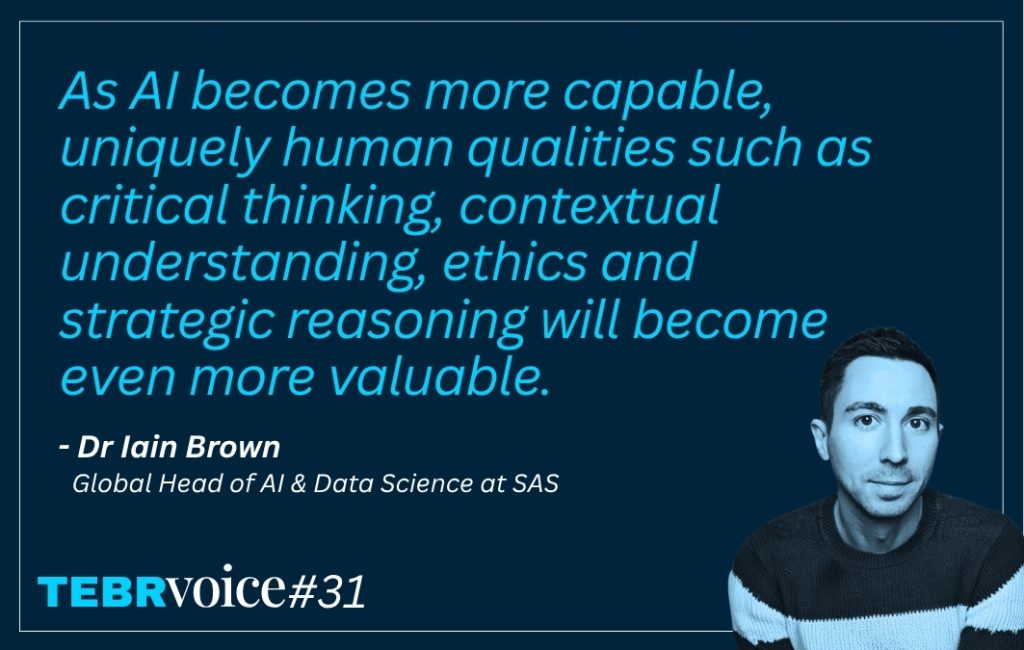
But the key differentiator will not be access to more information. As AI becomes more capable, uniquely human qualities such as critical thinking, contextual understanding, ethics and strategic reasoning will become even more valuable.
Conclusion
The future of leadership will not be defined by who has the most data or the most advanced technology. It will be defined by who combines technology, data and human judgement most effectively. Organisations that succeed will be those that use AI to enhance decision-making while ensuring people remain accountable for the choices that shape strategy, culture and long-term success. In an era of intelligent machines, human judgement remains one of the most important competitive advantages an organisation can possess.