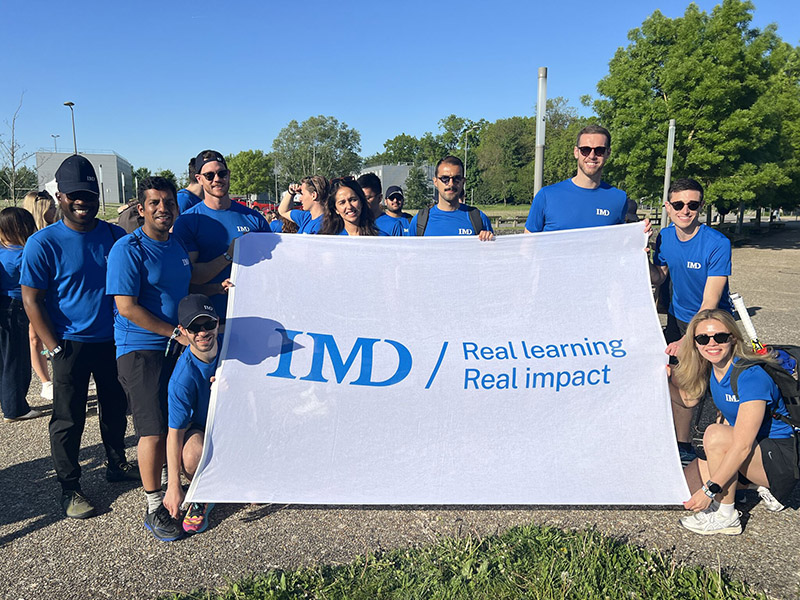
How an athletic mindset is shaping tomorrow’s business leaders in the IMD MBA class of 2025.
At 6 a.m., while most of his IMD MBA classmates were still asleep, Connor Lewis clipped into his bike and rode out around Lake Geneva. “It’s silent, you’re alone, and the whole country’s beautiful,” he says. A former competitive cyclist, Connor still trains most mornings before class. Not for medals anymore, but because the discipline clears his head and sets the tone for the day.
He’s not the only one in the IMD MBA program with an athletic background. This year’s class includes several Olympians and world-class competitors. But this isn’t a story about sports. It’s a story about what sport reveals – and how the same mindsets that help athletes perform under pressure now shape how these students learn, lead, and grow.
Because whether you’re lining up at a starting line or leading business under pressure, the same principles apply.
Training a winning mindset: what athletes learn about discipline, consistency, and resilience.
1. Discipline drives performance
When Olympic skier Fabian Wilkens Solheim talks about his racing career, he doesn’t focus on the thrill of competition. He talks about discipline, training day after day, often with no immediate results.

You might have two really good races in a season,” he says. “Everything else is either average or a failure. You learn to focus on the inputs, not the outcomes.
This mindset – consistency over perfection – is one of the most transferable traits to business and leadership. Whether you’re managing people, building a company, or making tough calls, showing up and doing the work, especially when it’s uncomfortable, matters more than momentary success.
2. Teamwork: leading together
Winning is not just about personal performance. It’s about how you bring others along with you and set them up to thrive long after you’re off the field. Aundria “Auni” Mirabrishami, a cricket player, captain, and coach, reflects on a recent match:

Losing is tough, but it taught me more about leadership than any win ever could. I realized it’s not about me – it’s about the team. As captain, I had to let go of personal disappointment and focus on how I could show up for others.
Leadership is a primary focus of the IMD MBA program, and this includes emotional intelligence, shared ownership, and the ability to create space for others. “True leadership is about legacy,” says Aundria, “not spotlight.”
3. Resilience: playing the long game
Oliver Zeidler, an Olympic gold medallist in rowing, puts it clearly:
Success didn’t define me. The reset after failure did. 
That ability to bounce back – to learn, recalibrate, and return stronger – is what sets high performers apart.
In the IMD MBA, resilience shows up in multiple ways: navigating difficult feedback, adapting to new cultures, or confronting the limits of your own expertise. Everyone in the program knows what it feels like to be challenged – and to keep going.
4. Strategy in motion
In sport, strategy is essential – but so is adaptability. You start with a plan, but when the environment changes, you need to read the moment and pivot fast. In business, that same agility is critical. Georg Lauritsen, a competitive sailor turned consultant, says it well: “Most skills are trained, not gifted.” Whether he’s racing or solving complex problems in class, his approach is the same: prepare deeply, respect the team, and stay focused when things get tough.

You have to build a practice that helps you stay grounded in the middle of uncertainty.
5. Performance under pressure
Whether it’s a race against the clock or a crucial client pitch, business and sport both demand clarity and focus when the stakes are high. That’s why IMD’s approach to learning isn’t just academic; experiential, hands-on projects create the kind of stretch moments where performance under pressure becomes real.
The habit of staying composed, staying grounded, and executing under stress is one that athletes know well. As Konstantin Dreyer, former captain of the Austrian Rugby 7s team says:

I’ve learned to handle pressure, setbacks and long-term goals.
That skill isn’t just useful in the game, it’s essential in leadership.
6. Goal setting and continuous improvement
In sport, every action is measured: progress tracked, weaknesses identified, plans refined. Fabian remarks, “I think goal setting and the ability to work toward that goal is a skill that I’ve learned through sports.” IMD takes the same approach in the MBA program. Whether it’s evaluating functional knowledge, assessing transversal skills or reviewing leadership competencies, students bring a performance mindset and faculty serve as the coach.
Underpinning this is the principle of Kaizen, continuous improvement through incremental progress. Just as in sport, success at IMD is defined by the commitment to regularly refine, adapt, and grow. Connor sums it up:

It’s consistently showing up. It’s maintaining an open mind. Then it’s stepping back and listening.
This mindset fuels both personal and professional growth throughout the journey.

Why these mindsets matter – athlete or not
The truth is, not everyone in the IMD MBA has stood on a podium. But almost everyone has experienced pressure, self-doubt, and the challenge of stepping outside their comfort zone. That’s why the lessons from sport resonate so widely – not because of competition, but because of what it teaches.
At IMD, the setting may be different, but the inner work remains the same. Whether you’re on the field, in the classroom, or in the boardroom, success is a combination of habits, mindsets, and values that take shape under pressure.
So while this may not be a story about sport, it is a story about performance, resilience, and growth – which are central to the IMD MBA experience, and one of the many reasons why Bloomberg Business week ranked the IMD MBA #1 in Europe.
To find out more about the program, visit imd.org/degree/mba/.
About the International Institute for Management Development (IMD)
The International Institute for Management Development (IMD) has been a pioneering force in developing leaders and organizations that contribute to a more prosperous, sustainable, and inclusive world for more than 75 years. Led by an expert and diverse faculty, with campuses in Lausanne and Singapore, a Management Development Hub in Shenzhen, and an Innovation Hub in Cape Town, IMD strives to be the trusted learning partner of choice for ambitious individuals and organizations worldwide. Our executive education and degree programs are consistently ranked among the world’s best. Through our research, programs, and advisory work, we enable business leaders to find new and better solutions, challenging what is, and inspiring what could be. To learn more, visit www.imd.org.