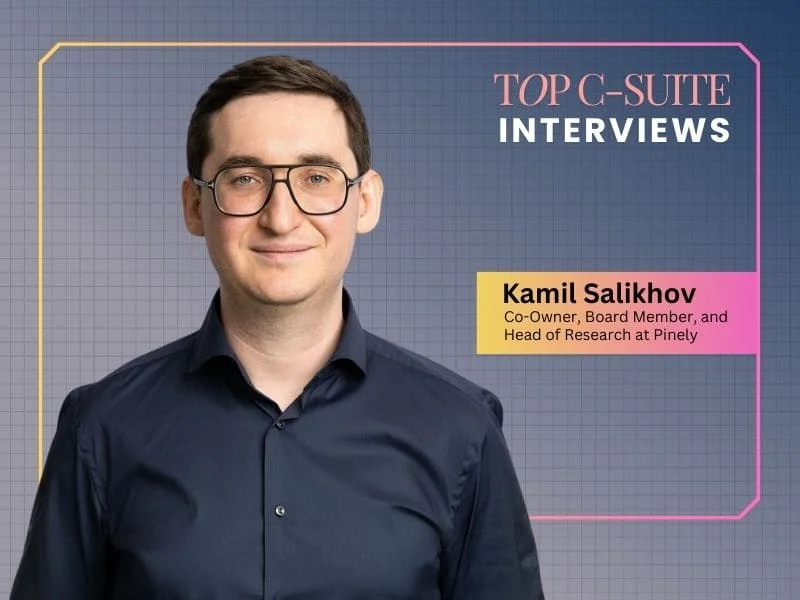
Interview with Kamil Salikhov of Pinely
After an early career that, in addition to math and science, included bioinformatics, Kamil Salikhov entered the world of high-speed, high-frequency trading, a field that is, as he puts it, at the intersection of finance, technology, and science. We managed to catch up with him to hear more about it.
It’s great to have you with us, Mr. Salikhov! Your academic and career journey is impressive. With multiple publications in bioinformatics and algorithms, you have nevertheless found yourself on the business side. Can you walk us through your path and key milestones which led you to the high-frequency trading field?
My journey to HFT was not linear, and it is rooted in my strong background as a mathematician. I studied mathematics and computer science in the late 2000s and early 2010s. It was a time of rapid growth of tech companies, and it was very natural for people with my background to pursue a career there (which I almost started as well, but that’s a completely different story). I didn’t know anything about HFT and even algorithmic trading in general. It was a coincidence that I joined a small startup doing high-frequency trading. As it turned out, my love for math was a perfect fit; HFT is one of the most mathematically intensive fields in finance, built on complex models and sophisticated algorithms.
HFT is one of the most mathematically intensive fields in finance, built on complex models and sophisticated algorithms.
Around the same time, I was offered an opportunity to go to Paris for a short internship at Paris-Est Marne-la-Vallée to work on problems in bioinformatics. It was another field that represented an appealing combination of mathematics, science, and technology. I joined the program and spent several years as a researcher, pursuing a PhD in a joint program between Moscow State University and Paris-Est Marne-la-Vallée, working at the intersection of technology and computational biology. It was a productive period for me as an academic. I authored and co-authored several papers and even developed a paper that (to some extent) improved the state-of-the-art solution to the problem of genome assembly.
Both HFT and bioinformatics were very interesting to me at the time, so for four years I worked on my PhD while also growing within an HFT startup. It was a challenging but rewarding period. In parallel with my doctoral studies, I was exploring the new and rapidly emerging field of HFT. Eventually, I decided to focus more and more on my career in the algorithmic trading industry. Now, after more than 10 years in this field, I am the co-owner and Head of Research at Pinely. However, a part of me will always belong to academia.
How has your academic background shaped your approach to algorithmic trading today?
I see algorithmic trading as a very special field, one that lies at the intersection of finance, technology, and science. HFT began to truly take off in the early 2000s, and data and technology have since become absolutely central to it. On the practical side, working in HFT means constantly exploring new ideas, especially with the boom in machine learning and data-driven methods, which form the core of our algorithms.
HFT research, in many ways, mirrors academic research. Behind every system and model lies deep exploration, experimentation, and innovation. At Pinely I also hold the position of Head of Research, a role that is not typical in most tech or finance firms. However, for companies like Pinely, it represents the very essence of our philosophy, combining scientific rigor with entrepreneurial agility.
In the end, the work of a researcher shares common ground across disciplines. You tackle complex problems from multiple angles, experiment with different approaches, and (hopefully) achieve great results—sometimes even ones that no one has reached before.
My strong academic background has shaped my mindset, to view challenges not only as business problems but also as opportunities for discovery and innovation. From this perspective, my work in algorithmic trading, my PhD studies, and my master’s degree are all deeply and organically connected.
To thrive, you must constantly develop new ideas, test them, and refine them faster than anyone else.
Pinely is known for its “technology-first” mindset. How does this philosophy influence your approach to research, experimentation, and product development?
HFT is not a trading strategy, it is a technology and an approach. Understanding this nature of the field, we at Pinely have incorporated a technology-first mindset into every part of our work. Technology became the cornerstone of every process we deal with, whether it is analyzing large volumes of data or developing and optimizing our trading infrastructure for this purpose. We are much closer to tech companies than to traditional trading firms.
This technology‑first philosophy ensures that our research doesn’t just ask, “What strategy can we deploy?” but also “What infrastructure, what algorithms, and what design will enable a strategy to execute reliably and at unrivaled speed?”
Our aim is always to stay ahead of the market, developing not just innovative trading models but modular, adaptive systems that can respond intelligently to dynamic and complex market conditions.
The HFT field is pretty mystifying compared to other tech subsectors. Could you tell us more about it? For example, what qualities, in your opinion, differentiate HFT professionals from developers in big tech?
Many of my colleagues have a background in big tech, so the fields are not that far apart. One noticeable difference is that our researchers and developers usually see the results of their work much faster than in big tech—sometimes in hours or days. It’s also important to note that HFT involves different parts of technology. One part is more data-driven, where the key skills are understanding advanced mathematical models. Another part is the infrastructure, where ultra-low-latency technology is critical. This means building systems that can process huge amounts of market data and react instantly.
From my experience, two qualities truly distinguish HFT professionals: a research-oriented mindset and a relentless drive for innovation. The industry is intensely competitive, and competition breeds creativity. To thrive, you must constantly develop new ideas, test them, and refine them faster than anyone else.
The company is also highly engaged in the tech community, supporting programming competitions like ICPC and educational conferences. Why is community involvement such an important part of Pinely’s culture?
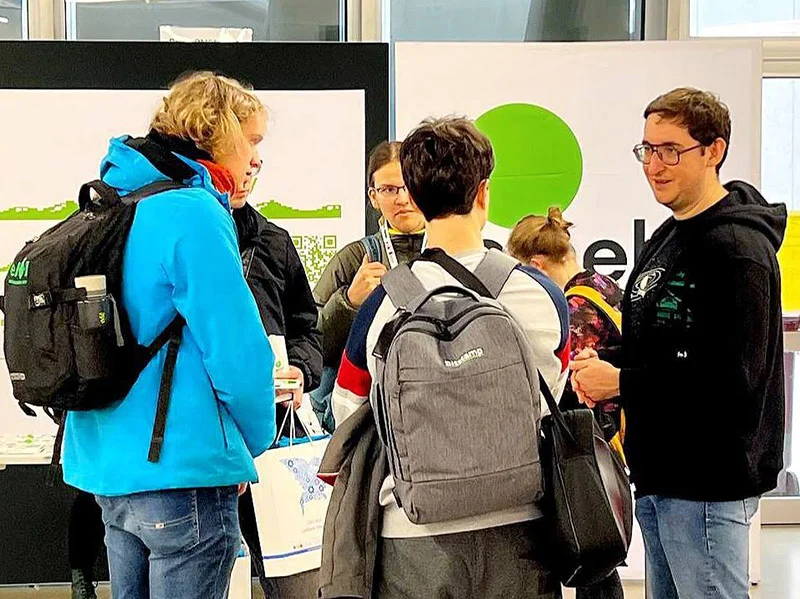
I and many of my colleagues come from backgrounds in competitive mathematics and programming, so supporting younger generations of talented and motivated people feels very natural to us. From my own experience, I know how much of a difference it can make when someone’s talent is recognized at the right time. I’ve seen people whose lives and careers were completely shaped by being noticed and encouraged early on, and that’s something I want to help create for others.
I also deeply believe that innovation doesn’t start at the corporate level; it starts early, with curiosity, inspiration, and the drive to explore new ideas. By engaging with students through competitions like ICPC and educational conferences, we can spark that curiosity, encourage experimentation, and perhaps even help someone discover a passion that shapes their future.
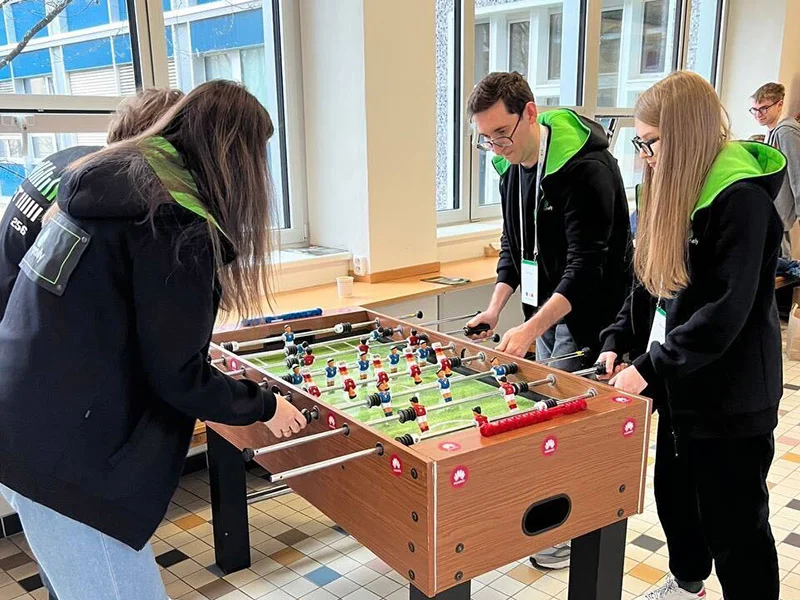
Another factor is the Pinely team. We have a tremendous amount of expertise across research, technology, and problem-solving, and it feels only natural to share this expertise with the next generation—to mentor, inspire, and challenge their minds. This is not just giving back, it’s investing in the future of technology and innovation. Supporting the community has become a part of our culture.
As the co-owner of Pinely, how do you personally define success, both for yourself and for the company?
Throughout my career, I have grown with the company, and now it’s almost impossible to separate the company’s success from my own. I don’t see success as a single final point but rather as a journey, working on challenging problems with some of the smartest people in the world and building something that has never been done before is the best way I can describe it.
Finally, as an experienced tech leader with a solid scholarly background, what are the most important trends in technology that leaders should be aware of and understand? What should they understand about them?
Everyone is talking about AI nowadays, and I really think it’s changing the world, including our industry. At the same time, I think we should value the people we are working with and human interaction.