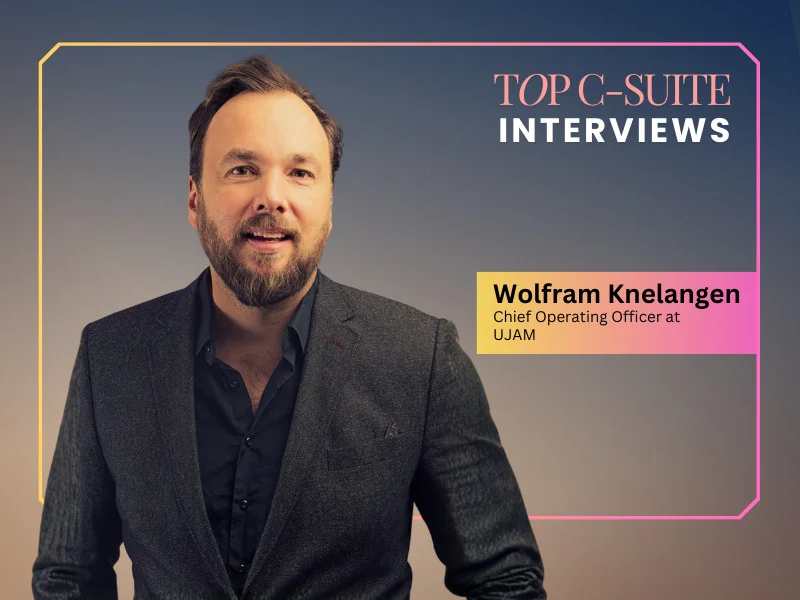
Interview with Wolfram Knelangen of UJAM
As AI tools make it possible to generate polished music in seconds, UJAM COO Wolfram Knelangen argues that the act of learning and making music still holds irreplaceable value. In this Q&A, he reflects on creativity, technology, and why human skill and practice remain essential in an increasingly automated musical landscape.
What early influences or moments in your life sparked your interest in helping people make music more creatively and intuitively?
I’ve lived through a fascinating period of change in music creation: in the 1980s and 90s, it still took quite deep pockets or connections to make a halfway-decent record. Tape machines and big mixing consoles were still the norm. Access to studios was guarded by inhibitive fees, which meant A&Rs and label executives ultimately decided what was worthy of being produced. Nowadays – and for a while now – entire albums are made “in the box” on computers using software. Even more so, we see the first entirely AI-created songs charting. For me personally, in the late nineties, I found myself confronted and frustrated with this reality as an amateur guitar player. A friend handed me one of those unprinted CD-ROMs of unknown provenance and told me that it contained music-making software. I was sceptical but desperate enough to try it. What a revelation! I could now make music on my Pentium computer. It was all still very rudimentary and quirky, but a proof of concept. Back then, there were no YouTube videos or Reddit or Chat GPT – the learning curve was long and steep. It took me probably two years of desperate trial and error to figure it out. So, I fell down a rabbit hole of wondering how to make music software easier and more accessible, and never really climbed back out.
Throughout your career, what experiences have most shaped your leadership approach in a space where artistry and technology often intersect?
One key experience shaping my view was seeing how poor leadership and management by spreadsheet drives competent people away and leads to deteriorating products. When our small German startup was acquired by Digidesign in 2005, I joined their San Francisco-based Pro Tools team. Pro Tools is the industry standard used in professional audio production, and I was immediately fascinated by how people there were so deeply driven by a true passion for music and audio technology. Even the GM had been playing live keyboards for David Bowie and other rock stars. I was stunned! People truly cared, and it created an atmosphere of happy productivity.
We believe that people with autonomy, mastery, and purpose build strong businesses and are more invested and more fun to work with.
After a management change at the parent company, there was more focus on optimizing for profits than generating value for customers. The attempted assimilation into the structures and culture of the mothership and the reduction of creative freedom led to an exodus of market knowledge, competency, and passion. The right people count everywhere, but especially in our field, as it’s a very niche market with a complex product. At UJAM, we make people a priority, emphasizing trust and constructive conflict. For example, we offer training for giving and receiving critical feedback. We have facilitators who run meetings, making sure there’s a psychologically safe space to speak up for everyone. We assign decision-making authority by competency rather than hierarchical seniority and with high levels of autonomy, as long as decisions and actions serve the company’s purpose. We believe that people with autonomy, mastery, and purpose build strong businesses and are more invested and more fun to work with.
How has your work with musicians and creators informed your understanding of what people truly need when engaging with modern music-making tools?
Our customers are people who make music, and they belong to a distinct psychological cohort. Nature magazine recently published research that predisposition for musical sensitivity is predicted by three personality traits: openness, agreeableness, and neuroticism. Openness reflecting curiosity and creativity; agreeableness showing compassion and cooperation; and neuroticism indicating a tendency towards self-doubt and emotional sensitivity. Caring for our customers means that we need to take this into account. Making music is a joyful exploration of new ideas, sounds, and patterns. It is also a deeply collaborative process, and people play off one another’s ideas like in improvisation. Finally, it can be a powerful way to process and express difficult emotions, as we know from works like Mozart’s Requiem to Céline Dion’s My Heart Will Go On. Recognizing this helps us understand how our customers experience the world.
AI can now generate music instantly, yet many still values learning an instrument or developing musical skills. Why do you believe that human learning and practice remain essential in this new landscape?
It’s the big question in our industry these days: whether human learning and practice will remain essential. Our answer is a clear yes. Why? Because it’s the same question as “Why still learn French when my AirPods can now simultaneously translate?” Or even “Why bother to dice vegetables if you can buy stock cubes?” As a small preliminary MIT Media Lab study earlier this year reported, reliance on AI may contribute to cognitive atrophy and shrinking of critical thinking abilities – the same is likely true for our creative faculties.
Learning a language or an instrument develops new neural pathways and may even influence long-term health. Research published in the International Journal of Geriatric Psychology suggests that learning music may delay cognitive decline and improve executive function. Learning music has been linked to better memory, enhanced pattern recognition, and increased empathy.
The value is in the process of learning and joyful experimentation. It’s like with a physical muscle: use it or lose it. And like a gym session that can be enjoyable, I think that many people are enjoying the creative struggle. “Musicing” as some younger students call it now, according to Derek von Krogh, head of the German Pop Academy.
As AI-assisted and AI-generated music expands, what misunderstandings or assumptions do you often encounter about its role in creativity and musicianship?
AI music generators ingest vast libraries of recorded music, convert it to training data, then recombine elements based on user prompts akin to an LLM like Chat GPT which is basically predicting the most likely next word. This isn’t as much a creative process, as it is an elaborately stitched-together quilt from the fabric collection of a century of recorded music. No original musical idea emerges from this process.
It suggests that as AI-generated music floods the market, genuinely original ideas—born from human creativity—will become increasingly valuable.
The results sound impressive and realistic and these tools are potentially a new gateway for people entering music creation or are handicapped in some form. However, if we’re brutally honest, it’s clear that generative AI tools are built on the appropriation of artists’ intellectual property. Not paying them equals theft. Pending lawsuits from the record industry may confirm this from a legal perspective, but the technical reality is that without the preexisting fruits of creative struggle by human artists, the generative AI systems would have nothing to recombine. This isn’t moral judgment but mechanical fact. And it suggests that as AI-generated music floods the market, genuinely original ideas—born from human creativity—will become increasingly valuable. As Rick Rubin, the producer of artists like Run DMC or Johnny Cash, observes: “What makes an artist a great artist is that their point of view does something to me. I’m not sure that AI has a point of view.”
With real-time AI music tools emerging, what do you see as the biggest challenges for the industry in keeping human expression at the centre of music Creation?
I don’t think that the industry will keep human expression at the center, I think that humans will. We need to build the tools that augment and support their creative process, taking them seriously and celebrating their results. At UJAM, for example, we are employing machine learning-based tools to help our users find the right sound. This is AI working quietly in the background, it leaves creative control in the hands of the artist, making sure they can find and express their vision with joy.