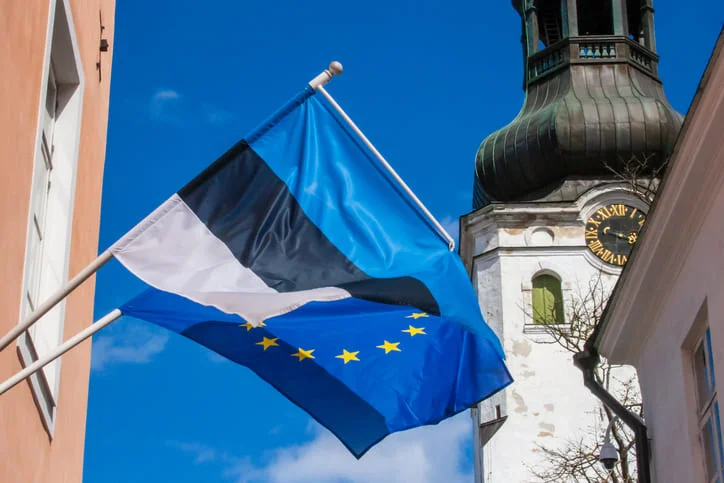
SMEs are the backbone of the EU economy. The European Commission’s SME Performance Review (Annual Report on European SMEs 2024/2025) states that SMEs account for 99.8% of all EU enterprises and tracks their performance across enterprise counts, employment, and value added. In 2024, EU SMEs saw a minor decline in real value added (-0.2%), while employment increased (+1.1%) – a pattern consistent with a “soft landing” economy where labour markets remain relatively resilient.
In this environment, Member States compete less through deregulation and more through regulatory design: predictable company law, low administrative friction, digital compliance, and credible (substance-based) residence routes for third-country founders. Estonia is a particularly instructive case because it combines (i) EU-aligned corporate regulation and AML compliance with (ii) exceptionally strong digital public services and (iii) a business-residence framework that is not automatic and is assessed on economic substance.
1. EU Legal Baseline. Establishment vs. Residence Rights
The EU’s legal architecture draws a sharp line between:
- Freedom of establishment for EU nationals and EU-incorporated entities (primary law: Articles 49–55 TFEU), and
- Immigration/residence rights for third-country nationals, which remain largely within Member State competence, complemented by EU-level instruments for specific categories (e.g., single-permit or highly skilled routes).
As a result, incorporation is not a residence right. It can be a commercial-law act that supports an immigration application only where national law creates a specific business-based permit and the applicant meets statutory criteria (substance, investment, business plan, etc.). This distinction is central to compliance and to editorial credibility in any expert publication.
2. Estonia’s Corporate Layer. Predictability + EU Compliance
Estonia’s corporate environment is often discussed in marketing terms, but the more important point for EU-credible analysis is the institutional design: transparent registries, standardised reporting, beneficial ownership disclosure, and AML/KYC alignment with EU frameworks (e.g., the EU AML directive family). These mechanisms reduce information asymmetry for regulators and counterparties.
From a practical standpoint, founders typically begin with the corporate layer – formation, governance, reporting, and local statutory requirements. For readers seeking a structured overview of Estonia company formation, see this reference guide.
3. Estonia’s Digital Governance as an Economic Variable (Not a PR Slogan)
Estonia’s digital public administration is not just a “nice-to-have”; it functions as a measurable competitiveness factor by lowering compliance transaction costs.
The European Commission’s Digital Decade reporting shows Estonia as a front runner in digital public services, citing 95.8 for digital public services for citizens and 98.9 for digital public services for businesses.
The DESI/Digital Decade visualisation also places Estonia among the highest-performing EU countries on digital public services indicators.
For SMEs and early-stage firms, this matters: lower friction in filings, reporting, and administrative interactions can improve survival odds and speed of iteration – key drivers when EU-wide SME value added is under pressure (as reflected in the 2024 value-added contraction).
4. Business Residence – Substance-Based Logic
Estonia’s “entrepreneurial migration” concept is best analysed as a substance test: authorities assess whether the company and activity are real, viable, and compliant. While thresholds and criteria are national-law specific, the policy logic aligns with EU-wide enforcement priorities around beneficial ownership transparency, AML integrity, and anti-shell standards.
Crucially, a registered office (legal address) is a statutory requirement for companies, yet it must not be confused with “substance” by itself. A registered address is necessary for formal correspondence and registry compliance, but substance is demonstrated through operations: contracts, revenues, staffing/contractors, governance decisions, and reporting discipline.
A practical note for compliance planning: registered address in Estonia should be positioned as a corporate-law requirement (and operational support), not as a “visa mechanism.”
5. France vs. Germany vs. Estonia. A Benchmark for Founders
France (corporate taxation context)
France’s standard corporate income tax has been structured around a mainstream CIT regime; authoritative tax summaries describe the CIT basis and rules for resident and non-resident entities.
At the same time, France has applied exceptional surcharges for very large companies in certain fiscal years. A BDO summary of the France 2026 budget describes surcharge mechanics for large taxpayers and the resulting increase in effective tax burdens for that narrow segment.
For an entrepreneur comparing jurisdictions, the key takeaway is that France can combine a stable baseline with policy-driven overlays for specific taxpayer categories, which increases forecasting complexity at the top end.
Germany (corporate taxation context)
Germany’s corporate profits are typically subject to a layered structure: corporate income tax plus solidarity surcharge, and (critically) trade tax at the municipal level. PwC’s Germany tax summary highlights the 15% corporate tax and the 5.5% solidarity surcharge on the corporate tax, resulting in 15.825% before trade tax, with trade tax varying locally.
Separately, EY analysis notes policy discussion around gradually reducing the CIT rate over time and the effect this could have on combined corporate taxation (with meaningful variance depending on trade tax rates).
For founders, Germany’s headline issue is not simply the rate but the local variance + compliance intensity typical of a federal system.
Estonia (comparative note)
Estonia’s competitive proposition is less about “low tax” and more about timing design + administrative efficiency, especially relevant to SMEs reinvesting cashflow. Coupled with top-tier digital public services scores, Estonia can reduce operational friction in ongoing compliance compared to more complex multi-layer systems.
However, Estonia should not be framed as a shortcut: EU-consistent AML scrutiny and substance expectations mean that governance, reporting, and beneficial ownership transparency remain central.
6. Evidence-Based Interpretation: Why This Matters for EU SME Policy
The SME Performance Review’s 2024/2025 findings, flat-to-negative value added with rising employment – suggest an EU SME sector operating under margin pressure while still hiring.
In such conditions, regulatory environments that reduce administrative costs can have outsized impact at the margin. Estonia’s model illustrates a “high-compliance, low-friction” approach: tight alignment with EU governance expectations, delivered through digital processes rather than bureaucratic expansion.
7. Expert Commentary. Legal Substance and Market Entry
As Jana Kamoza, corporate law expert in Estonia and Director of eBusiness OÜ, explains: “From a corporate law perspective, the registered office is a statutory requirement under the Commercial Code. However, it does not replace operational substance. EU-level transparency standards – particularly AML and beneficial ownership disclosure, have significantly strengthened oversight in recent years. Estonia’s advantage lies in digital execution of compliance, not in regulatory relaxation.”
Conclusion
Estonia’s entrepreneur-oriented framework is best understood as a legally conservative model delivered through digitally advanced administration: incorporation is corporate law, residence is immigration law, and the bridge between them is substance, not formalities.
For founders comparing EU entry points, the France–Germany benchmark highlights differing tax architecture and compliance dynamics, while Estonia demonstrates how administrative digitalisation can function as a competitiveness instrument, especially when EU SME value added is under pressure.