
By Nitish Jain
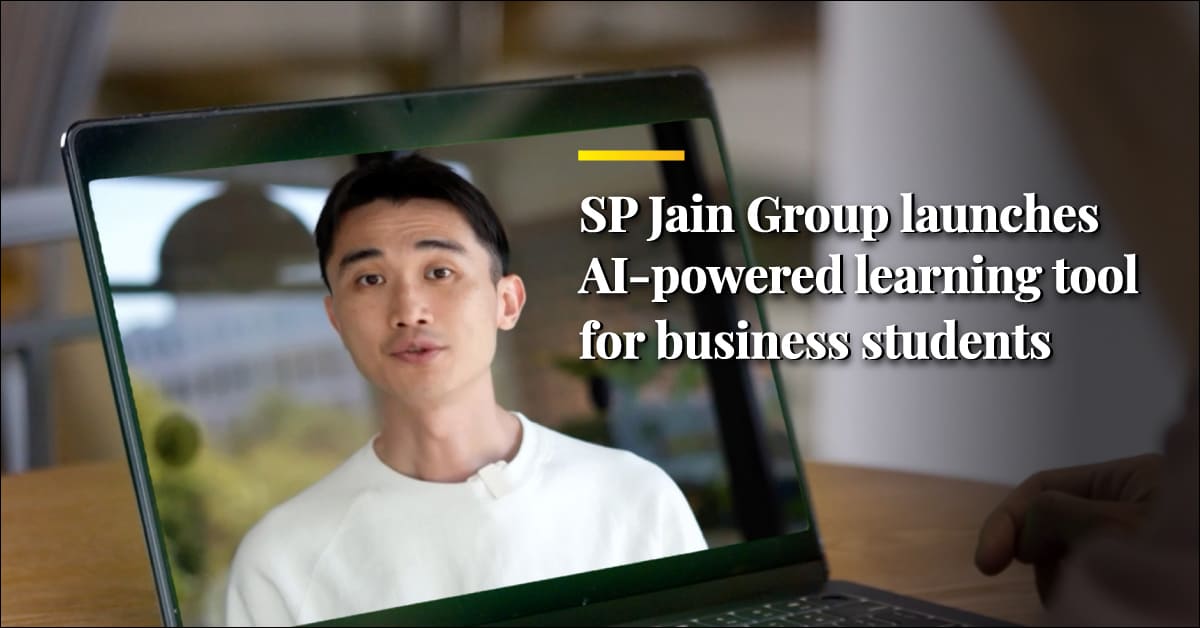
SP Jain School of Global Management transformed its approach to business education by integrating AI into the learning process. Nitish Jain outlines how this shift has empowered students to prepare more effectively, engage more deeply, and succeed faster in competitive job markets by turning traditional lectures into personalised, high-impact learning experiences.
You’re 24. You walk into a job interview with a global tech firm. It’s your dream role. A panel of three stares back at you, resumes in hand.
The questions come fast. Go-to-market strategy for Southeast Asia. Pricing model for a new subscription-based product. A curveball on AI ethics. You’re nervous, but not frozen. You’ve been here before. Not once or twice, but repeatedly over the past week.
What the panel doesn’t know is that you’ve faced these exact questions. At 10 PM, 2 AM, whenever you needed to. Not with YouTube videos or coaching classes, but with an AI tutor that’s been part of your MBA journey from day one, fully integrated into your curriculum.
This tutor didn’t spoon-feed answers or give generic hacks. It interrogated your thinking. Pulled up real questions asked by real companies and challenged your logic until your answers held up under pressure. It even pushed back: “What is the risk you’re not seeing here?” or “That answer sounds safe. Do you actually believe it?”
This wasn’t revision, it was targeted career prep shaped around you. And by the time you sat in that interview, you were ready.
Sounds like a future ambition? It’s not. It’s happening right now at SP Jain School of Global Management. Students are showing up sharper—cracking interviews in half the attempts it used to take. Not because they studied harder, but because we stopped teaching like it’s 1985.
Learning that listens, not lectures
Walk into most university classrooms today, and it feels like stepping into a time capsule. A professor stands at the front, delivering a lecture. Students take notes. Then come the exam, the grade, the degree—a model that hasn’t changed in over a century.
Meanwhile, the world outside is moving at warp speed. Job roles are being reinvented. Skills become obsolete in months. AI and automation are rewriting the rules. And yet, education remains slow, standardised, and one-size-fits-all. The disconnect keeps growing—and students are the ones paying for it.
At SP Jain Global, we didn’t just tweak the old model. We asked: What would learning look like if we built it for tomorrow’s learners?
The answer was AI. Not as a chatbot or a shiny tool on the side, but as the foundation. That’s how we built AI-ELT, our AI-enabled learning assistant, to become a core part of how our students learn.
More than technology. It’s intent.
AI-ELT wasn’t built to just deliver content or run base-level quizzes. It was built to question you, challenge you, push you. It prepares you before class. Supports you after class. And sharpens your thinking when no one else is around. It takes you from two to four to six to ten. Step by step, until your thinking holds up anywhere.
Imagine the confidence with which you enter class. You’re energised because you’re no longer scrambling to understand the basics. You’ve covered that with the AI already. You’re ready to speak up. To debate. To make decisions. And so is everyone else.
The lecture disappears. Instead of defining what a market strategy is, the professor throws a live case on the table: “This company’s failing in India. What would you do?”
Class time shifts from what to why. From definitions to decisions. It becomes a live, intellectual workout. Faster-paced. More demanding. Infinitely more valuable. Even quiet students speak up because they’ve already done the hard thinking in private, with the AI-ELT forcing them to clarify and commit to their ideas.
Faculty don’t have to fill the hour. They get to stretch it. Push it. Lead real conversations with students who’ve shown up switched on.
And we’re seeing the results. Students are coming to class better prepared. Faculty say the quality of discussion has gone up. Questions are deeper. Thinking is stronger. And the impact goes beyond the classroom. Students using AI-ELT are cracking tough job interviews faster. On average, in just two attempts. That’s half of what it used to take!
That’s the real power of AI in education. Not automation. Not convenience. Not replacing teachers. But transformation. Removing the parts of education that never really worked. The lectures no one remembers. The surface-level prep. The guesswork.
It’s about creating thinkers, not note-takers. It’s about turning classrooms into conversations.
And most of all, it’s about giving every student, not just the lucky few, access to the kind of deep, personal mentorship and learning that actually sticks.
This is what education should have been all along. And now, it finally is.
The photo in the article is provided by the company(s) mentioned in the article and used with permission.